1995Experiment
LSND reports an unexpected oscillation signal
The Liquid Scintillator Neutrino Detector at Los Alamos reported an excess of electron antineutrinos in a beam of muon antineutrinos from muon decay at rest, over a baseline of about 30 m. Interpreted as oscillation, it would require a mass-squared difference near 1 eV², incompatible with three neutrinos and suggesting a sterile neutrino. KARMEN did not confirm it, and MiniBooNE was built to test it. The anomaly remains unresolved.
- Date
- 1995
- Kind of event
- Experiment
- People involved
- Hywel White, William C. Louis
The situation before
In the early 1990s neutrino oscillation was suspected but not established. The solar deficit pointed to a mass-squared difference far below 10⁻⁴ eV², and the atmospheric anomaly to around 10⁻³–10⁻² eV². Accelerator experiments at short distances could test much larger differences. At Los Alamos, the LAMPF linear accelerator delivered an intense 800 MeV proton beam. Pions stopping in the beam dump decay, and the resulting positive muons decay at rest into a positron, an electron neutrino and a muon antineutrino – a well-understood source with essentially no electron antineutrinos. Appearance of electron antineutrinos would therefore be a clean sign of oscillation, the principle of a decay-at-rest source.
What happened
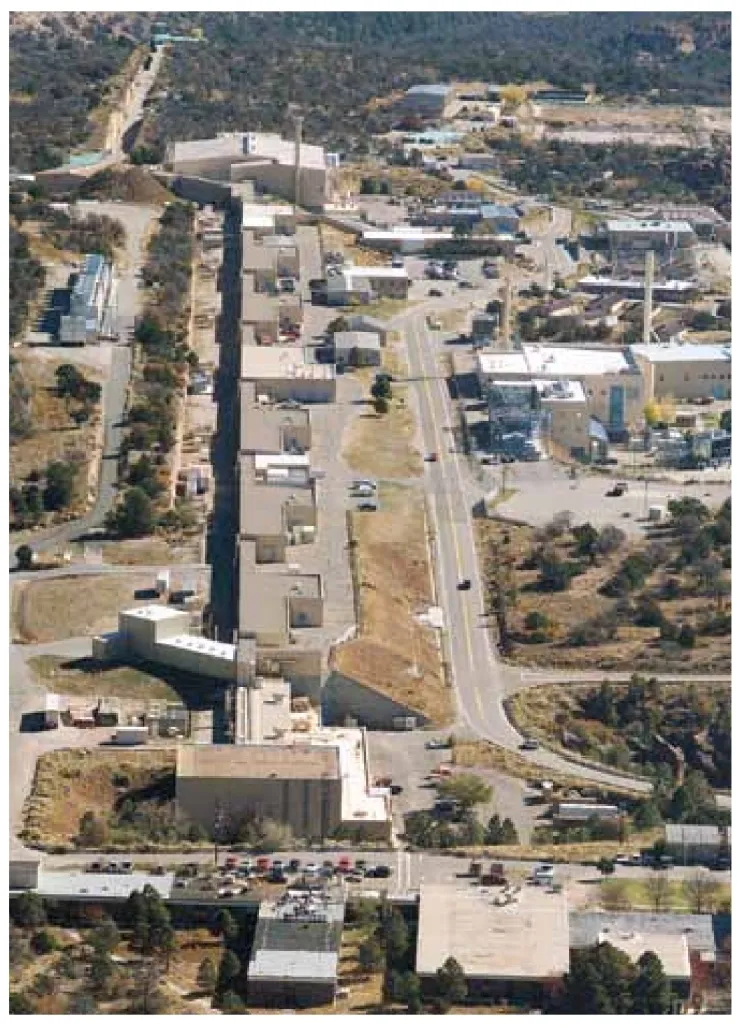
The Liquid Scintillator Neutrino Detector, LSND, was a tank of 167 tonnes of mineral oil with a small admixture of scintillator, viewed by about 1,200 photomultipliers, about 30 m from the beam stop. With Hywel White and William Louis among its leaders, it began running in 1993. An electron antineutrino would be captured by a proton, giving a positron followed by a 2.2 MeV gamma ray from neutron capture.
In 1995 the collaboration published 'Candidate events in a search for ν̄μ → ν̄e oscillations' in Physical Review Letters. It reported 9 events with an expected background of 2.1 ± 0.3, corresponding to an oscillation probability of about 0.3 percent. In the same issue, collaboration member James Hill published an alternative analysis that did not find evidence for oscillation. Later papers with more data, culminating in the final result of 2001, reported an excess of about 88 events, a significance of 3.8σ and an oscillation probability of 0.26 percent.
Reaction
The signal could not fit into a three-neutrino picture together with the solar and atmospheric results. Three neutrinos allow only two independent mass-squared differences, and LSND required a third, around 0.2–10 eV². Explaining all three would need a fourth, sterile neutrino. Many physicists remained sceptical. KARMEN, a similar experiment at the ISIS facility of the Rutherford Appleton Laboratory in England, found no excess and excluded part of the allowed region, though not all of it.
Consequences
- MiniBooNE at Fermilab was built specifically to test LSND at a different distance and energy. From 2007 it reported results that did not confirm LSND in its main analysis but found an unexplained excess of low-energy electron-like events, which grew with more data.
- MicroBooNE, a liquid-argon detector in the same beam, reported from 2021 that the MiniBooNE excess was not explained by electron neutrinos at the expected level.
- Reactor and gallium deficits added to a set of short-baseline anomalies, but disappearance searches have not found the matching signals.
- The Short-Baseline Neutrino programme at Fermilab is designed to settle the question.
Three decades after the first publication, the LSND result has neither been confirmed nor explained.
Frequently asked questions
What did LSND find?
An excess of electron antineutrinos in a beam of muon antineutrinos over about 30 m, which, read as oscillation, suggests a mass-squared difference near 1 eV².
Why is the LSND result controversial?
It does not fit the three-neutrino picture and would require a sterile neutrino. KARMEN did not confirm it, and later tests have given mixed results.
Has the LSND anomaly been resolved?
No. MiniBooNE saw a related excess, MicroBooNE did not find electron neutrinos as its explanation, and the question remains open.
Original papers
- DiscoveryC. Athanassopoulos et al. (LSND), Candidate events in a search for anti-νμ → anti-νe oscillations, Phys. Rev. Lett. 75, 2650 (1995)DOI 10.1103/PhysRevLett.75.2650arXiv:nucl-ex/9504002
- Final resultA. Aguilar et al. (LSND), Evidence for neutrino oscillations from the observation of anti-νe appearance in a anti-νμ beam, Phys. Rev. D 64, 112007 (2001)DOI 10.1103/PhysRevD.64.112007
Concepts
Mentioned in 2 pages
Last updated: · Editorial standard
Cite this page
Text
Neutrino Atlas (2026). “1995: LSND reports an unexpected oscillation signal”. Retrieved 22 November 2026, from https://neutrino-atlas.com/timeline/1995-lsnd-excess/BibTeX
@misc{neutrinoatlas2026timeline1995lsndexcess,
  title        = {1995: LSND reports an unexpected oscillation signal},
  author       = {{Neutrino Atlas}},
  year         = {2026},
  url          = {https://neutrino-atlas.com/timeline/1995-lsnd-excess/},
  note         = {Accessed 2026-11-22},
  language     = {english}
}