MiniBooNE
A Fermilab mineral-oil Cherenkov detector designed to test LSND, which found its own low-energy excess.
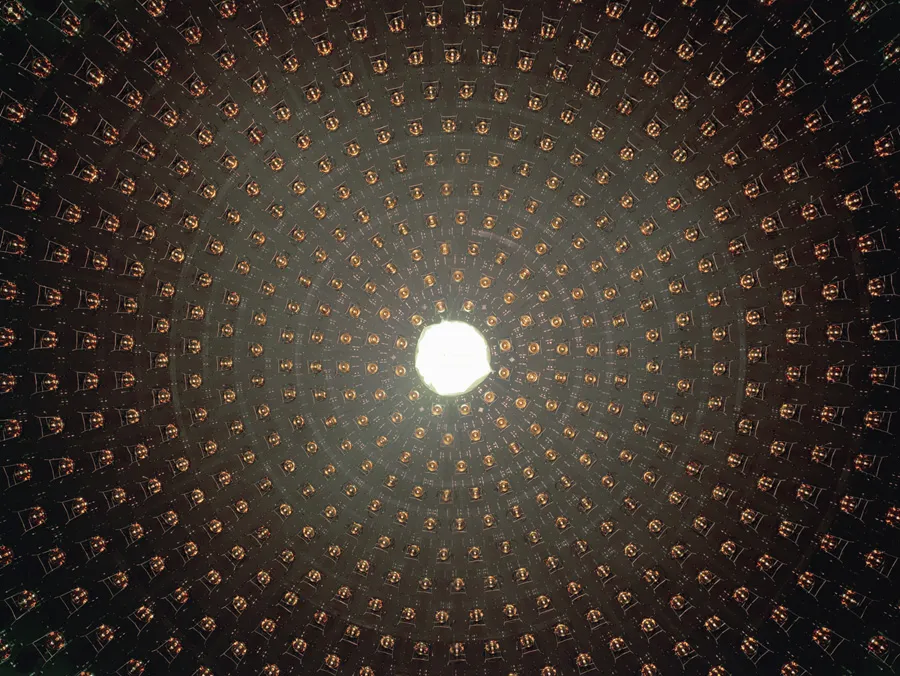
An 800-tonne mineral oil detector 541 m from the BNB target looked for νe appearance in both ν and ν̄ modes. It observed an excess of electron-like events at low energy (combined 4.8σ by 2018), but its Cherenkov detector could not distinguish electrons from photons.
Compare all experiments → · World map →
In plain words
MiniBooNE was designed as a clean test of LSND: the same ratio of distance to energy, but ten times more distance and ten times more energy, a different beam, different backgrounds and a different detector. If LSND had seen oscillation, MiniBooNE should see it too. It did not see it where expected, but it found an excess of its own at lower energies that has never been fully explained.
How the detector works
Protons of 8 GeV from Fermilab's Booster hit a beryllium target, and a magnetic horn focused the pions into the Booster Neutrino Beam, with a mean neutrino energy of about 800 MeV. Reversing the horn produced antineutrinos. The detector, 541 m downstream, was a 12.2 m diameter sphere filled with 818 tonnes of mineral oil and lined with 1280 photomultipliers, surrounded by a veto region with 240 more. Electrons and muons were identified by the shape of their Cherenkov rings. A fuzzy ring signals an electron, but a single photon produces exactly the same pattern, and so does a π⁰ whose two photons merge.
Key results
- 2007: no excess in the energy range where an LSND-like oscillation was expected, between 475 and 1250 MeV, but an unexpected excess of electron-like events below 475 MeV.
- 2010: antineutrino-mode data showing an excess compatible with LSND.
- 2018: combined neutrino and antineutrino excess at 4.8σ; together with LSND, 6.0σ.
- 2021 final analysis of 2002–2019 data: 638 ± 133 excess events, still at 4.8σ.
- Precise measurements of neutrino–carbon cross sections, notably charged-current quasi-elastic scattering, which revealed the importance of multi-nucleon effects.
Why it matters for neutrino physics
Because MiniBooNE cannot tell electrons from photons, its excess could be electron neutrinos from oscillation, photons from a poorly modelled process, or something new. Resolving that ambiguity was the reason for building MicroBooNE, a liquid-argon TPC in the same beam with electron–photon separation. Janet Conrad and William Louis were among the founding spokespersons.
Frequently asked questions
Is the MiniBooNE excess explained?
Not completely. MicroBooNE ruled out an electron-neutrino origin in the simplest form and also tested the leading photon explanation, without finding the source.
Why is it called MiniBooNE?
It was the first phase of a proposed Booster Neutrino Experiment (BooNE); the planned full two-detector version was never built.
Original papers
- First resultA. A. Aguilar-Arevalo et al. (MiniBooNE Collaboration), A Search for Electron Neutrino Appearance at the Δm² ~ 1 eV² Scale, Phys. Rev. Lett. 98, 231801 (2007)DOI 10.1103/PhysRevLett.98.231801arXiv:0704.1500
- MeasurementA. A. Aguilar-Arevalo et al. (MiniBooNE Collaboration), Significant Excess of Electronlike Events in the MiniBooNE Short-Baseline Neutrino Experiment, Phys. Rev. Lett. 121, 221801 (2018)DOI 10.1103/PhysRevLett.121.221801arXiv:1805.12028
- Final resultA. A. Aguilar-Arevalo et al. (MiniBooNE Collaboration), Updated MiniBooNE neutrino oscillation results with increased data and new background studies, Phys. Rev. D 103, 052002 (2021)DOI 10.1103/PhysRevD.103.052002
Related terms
People
Latest research on this topic
- Implications for new physics solutions to the LSND and MiniBooNE anomalies after MicroBooNE resultsAbdallah, Waleed, Gandhi, Raj, Roy, Samiran · 12 October 2026
- Tension between MiniBooNE and MicroBooNE within a 3+1 Sterile Neutrino Framework using Simulation-Based InferenceWoodward, Julia P., Schneider, Austin, Villarreal, Joshua et al. · 22 September 2026
- A Simulation-Based Inference Evaluation of Tension Between MicroBooNE and MiniBooNE Results in a 3+1 Sterile Neutrino Global FitWoodward, Julia P., Villarreal, Joshua, Hardin, John M. et al. · 16 March 2026
- The Role of a 17 MeV Pseudoscalar in Resolving LSND, MiniBooNE, and ATOMKI AnomaliesRoy, Samiran, Abdallah, Waleed, Gandhi, Raj et al. · 2 January 2026
On the timeline
- 1995LSND reports an unexpected oscillation signal
- 2007MiniBooNE tests LSND and finds a low-energy excess
- 2018MiniBooNE's excess grows to 4.8σ
- 2021MicroBooNE finds no electron-neutrino excess
- 2025MicroBooNE finds no evidence for a sterile neutrino
Mentioned in 36 pages
Milestones 5
Terms 22
Last updated: · Editorial standard
Cite this page
Text
Neutrino Atlas (2026). “MiniBooNE”. Retrieved 22 November 2026, from https://neutrino-atlas.com/terms/miniboone/BibTeX
@misc{neutrinoatlas2026termsminiboone,
  title        = {MiniBooNE},
  author       = {{Neutrino Atlas}},
  year         = {2026},
  url          = {https://neutrino-atlas.com/terms/miniboone/},
  note         = {Accessed 2026-11-22},
  language     = {english}
}