BNL E734
Brookhaven experiment that measured elastic neutrino scattering on protons and electrons with a 170 t scintillator detector in the 1980s.
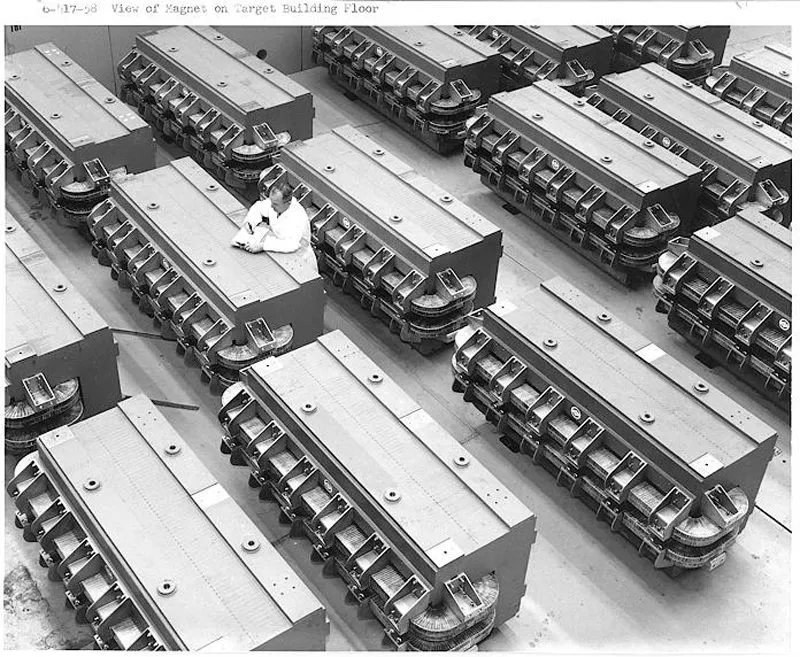
E734 placed a 170 t fine-grained liquid-scintillator and drift-tube detector in the wide-band νμ and ν̄μ beam of the BNL AGS, with mean energies near 1.3 GeV. Its 1987 measurement of νp and ν̄p elastic scattering gave the first hint of a strange-quark contribution to the proton's axial form factor. Its νμ e and ν̄μ e data gave sin²θW close to 0.20.
Compare all experiments → · World map →
In plain words
When a neutrino bounces off a proton or an electron without changing identity, it does so through the neutral current, the process discovered at Gargamelle in 1973. These elastic collisions are rare and leave only a single recoiling particle, so they are hard to pick out. E734 built a large, finely divided detector at Brookhaven that could see such single recoils and measure them precisely, testing the electroweak theory and the inner structure of the proton.
How the detector works
The detector was a target–detector of about 170 t: planes of liquid-scintillator cells, which measured energy deposits, alternated with proportional drift tubes, which tracked charged particles. This fine segmentation allowed a recoil proton or a forward electron to be identified and its angle measured. The neutrino beam came from the Alternating Gradient Synchrotron and was produced with magnetic horns; switching the horn polarity gave neutrino or antineutrino running, with mean energies of about 1.3 and 1.2 GeV.
Key results
In 1987 the collaboration published flux-averaged cross sections for νp → νp and ν̄p → ν̄p, together with their ratio to quasi-elastic νn → μ⁻p scattering, measured as 0.153 ± 0.007 (stat) ± 0.017 (syst). Interpreted with the axial form factor of the nucleon, the data indicated a negative strange-quark contribution to the proton spin. Later reanalyses showed that this conclusion depends strongly on the assumed axial mass, and the question is still being studied. Separately, E734 measured neutrino–electron elastic scattering for both νμ and ν̄μ; the ratio of the two cross sections reduces systematic errors and gave a value of the weak mixing angle close to 0.20, with an uncertainty of roughly 10%.
Why it matters for neutrino physics
E734 remains one of very few direct measurements of neutral-current elastic scattering on protons at GeV energies. Its data are still used in fits of the strange axial form factor and serve as a benchmark for modern liquid-argon and scintillator experiments. The AGS horn system it used was later the starting point for designs of Brookhaven long-baseline proposals.
Frequently asked questions
Why is neutral-current scattering on protons interesting?
It is sensitive to the axial coupling of strange quarks, which electron scattering cannot isolate as cleanly.
How does E734 compare with later experiments?
MiniBooNE measured neutral-current elastic scattering on carbon in 2010 with much larger statistics, but E734's antineutrino data remain distinctive.
Original papers
- MeasurementL. A. Ahrens et al., Measurement of neutrino-proton and antineutrino-proton elastic scattering, Phys. Rev. D 35, 785 (1987)DOI 10.1103/PhysRevD.35.785
- MeasurementL. A. Ahrens et al., Determination of electroweak parameters from the elastic scattering of muon neutrinos and antineutrinos on electrons, Phys. Rev. D 41, 3297 (1990)DOI 10.1103/PhysRevD.41.3297
Related terms
- Neutral-current interaction
- Neutrino-electron elastic scattering
- Weak mixing angle
- Axial form factor and axial mass
- Quasi-elastic scattering
People
Mentioned in 1 page
People 1
Last updated: · Editorial standard
Cite this page
Text
Neutrino Atlas (2026). “BNL E734”. Retrieved 22 November 2026, from https://neutrino-atlas.com/terms/bnl-e734/BibTeX
@misc{neutrinoatlas2026termsbnle734,
  title        = {BNL E734},
  author       = {{Neutrino Atlas}},
  year         = {2026},
  url          = {https://neutrino-atlas.com/terms/bnl-e734/},
  note         = {Accessed 2026-11-22},
  language     = {english}
}