BEBC (Big European Bubble Chamber)
CERN's 3.7 m hydrogen bubble chamber, which photographed neutrino interactions on protons, deuterons and neon from 1973 to 1984.
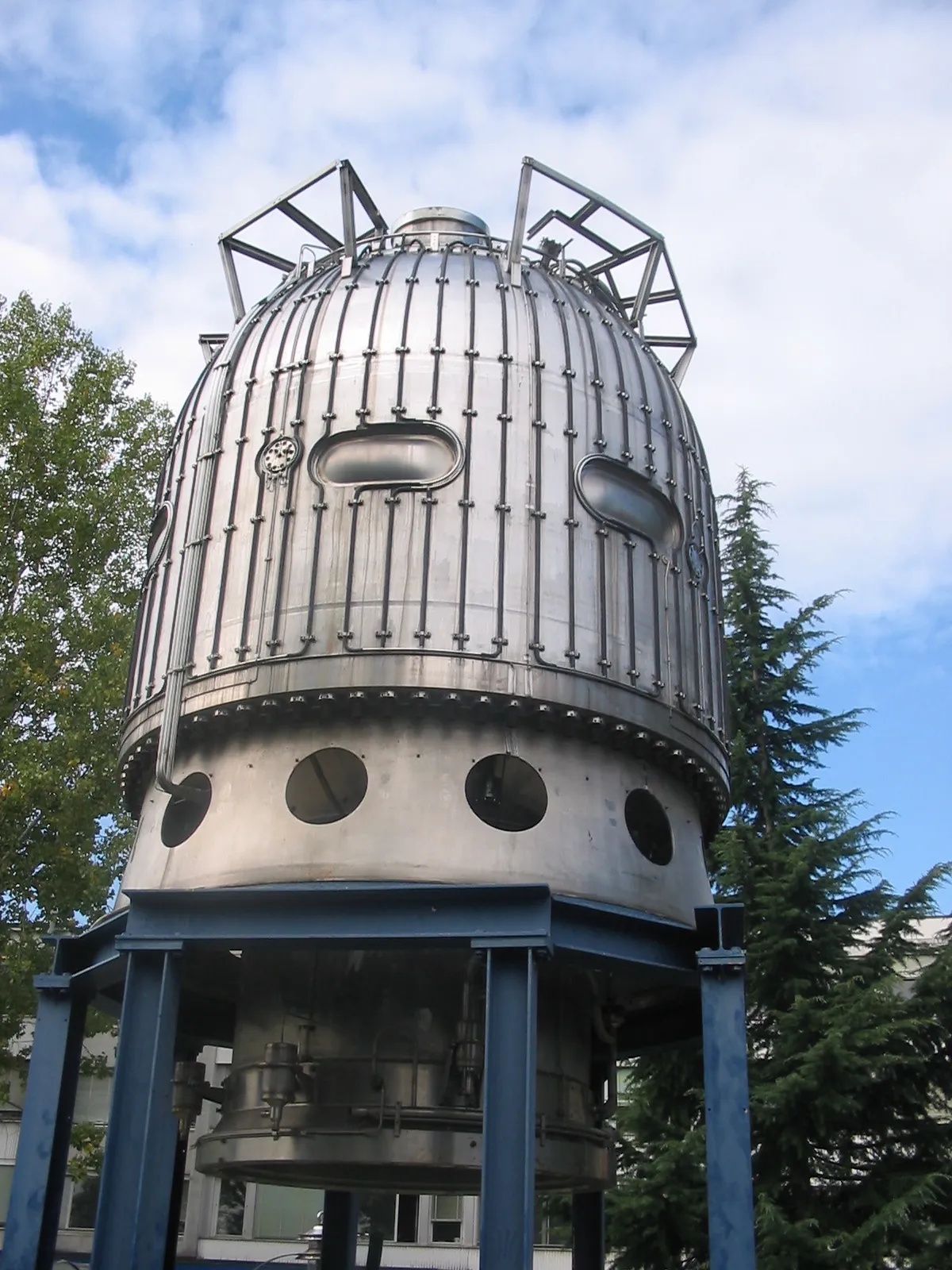
BEBC held 35 m³ of liquid hydrogen, deuterium or a neon–hydrogen mixture inside a 3.5 T superconducting magnet. From 1977 to 1984 it took neutrino and hadron beams in the SPS West Area, delivering 6.3 million photographs to 22 experiments. Its neutrino programme measured interactions on free protons and deuterons, and its 1982 beam-dump run still gives limits on heavy neutral leptons.
Compare all experiments → · World map →
In plain words
A bubble chamber is a tank of superheated liquid in which charged particles leave trails of tiny bubbles that can be photographed. BEBC was one of the largest ever built. Where the heavy-liquid chamber Gargamelle offered many interactions on complex nuclei, BEBC filled with hydrogen showed neutrinos hitting single protons, so every track of the final state could be seen and measured cleanly.
How the detector works
The stainless-steel vessel, 3.7 m in diameter, held 35 m³ of liquid at about 27 K. A two-tonne piston expanded the liquid in step with each beam pulse, making it boil along particle paths, and five cameras recorded the tracks in stereo. A superconducting niobium–titanium magnet produced 3.5 T to bend the tracks for momentum measurement. From 1979 an External Muon Identifier tagged the muon of charged-current events. Depending on the physics goal the chamber was filled with hydrogen, deuterium for neutron targets, or a neon–hydrogen mixture that converts photons and electrons more efficiently.
Key results
BEBC was launched in 1966 by CERN with French and German partners and took its first pictures in 1973. From 1977 to 1984 it served neutrino and hadron beams of the SPS at energies up to 450 GeV. Hydrogen and deuterium runs measured neutrino and antineutrino structure functions and final states on free nucleons, complementing iron calorimeters such as CCFR and CDHS. Beam-dump runs, in which the proton beam is stopped in a solid block, searched for prompt neutrinos from charm decay. The 1982 beam dump also searched for heavy neutral leptons decaying inside the chamber; recent reanalyses still use it to set strong bounds on such particles mixing with the tau neutrino.
Legacy
In total the chamber delivered 6.3 million photographs to 22 experiments, and about 600 physicists from some 50 laboratories scanned 3,000 km of film. BEBC was retired in 1984 as electronic detectors took over. It is now displayed at CERN's Microcosm exhibition.
Frequently asked questions
Why fill a bubble chamber with hydrogen?
Hydrogen gives a target of free protons, so the interaction is not blurred by nuclear effects. Deuterium adds nearly free neutrons.
Can BEBC data still be useful?
Yes. The 1982 beam-dump data have been reinterpreted in 2022 to constrain heavy neutral leptons.
Related terms
Mentioned in 2 pages
Last updated: · Editorial standard
Cite this page
Text
Neutrino Atlas (2026). “BEBC (Big European Bubble Chamber)”. Retrieved 22 November 2026, from https://neutrino-atlas.com/terms/bebc/BibTeX
@misc{neutrinoatlas2026termsbebc,
  title        = {BEBC (Big European Bubble Chamber)},
  author       = {{Neutrino Atlas}},
  year         = {2026},
  url          = {https://neutrino-atlas.com/terms/bebc/},
  note         = {Accessed 2026-11-22},
  language     = {english}
}