MINERvA
A dedicated Fermilab experiment measuring neutrino–nucleus cross sections on various nuclei.
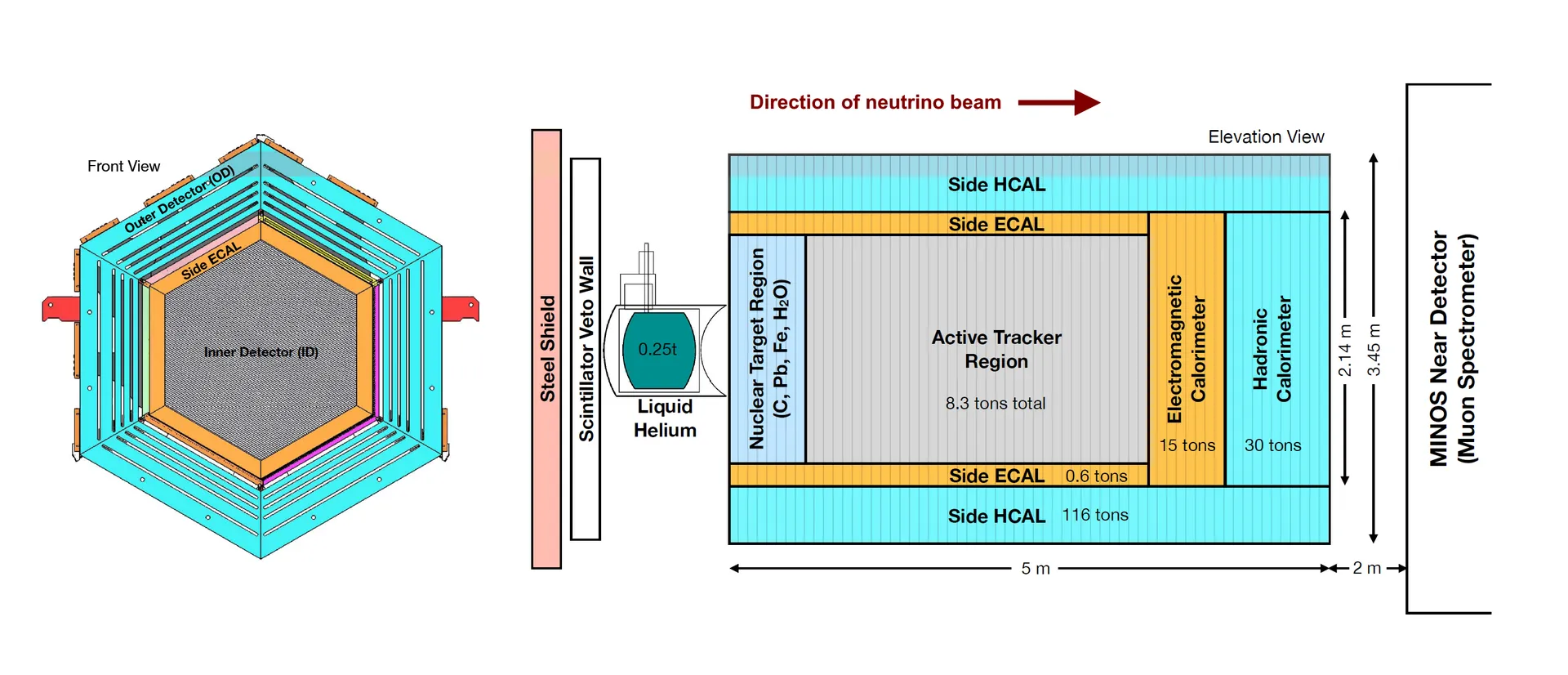
MINERvA sat in the NuMI beam upstream of the MINOS near detector, using fine-grained plastic scintillator with carbon, iron, lead, water and helium targets. Its cross-section and nuclear-effect measurements feed directly into oscillation experiments' systematic error budgets.
Compare all experiments → · World map →
In plain words
To measure neutrino oscillations, an experiment compares how many neutrinos of each energy arrive with how many were expected. That expectation depends on how often neutrinos interact with the nuclei in the detector and how much energy goes missing inside the nucleus. MINERvA was built to measure exactly these interaction details, so that oscillation experiments would not have to guess them.
How the detector works
MINERvA sat in Fermilab's NuMI beam, about 100 metres underground and just upstream of the MINOS near detector, which served as its muon spectrometer. Its core was a stack of 120 hexagonal modules made of triangular plastic scintillator strips read out by wavelength-shifting fibres, giving fine tracking and good energy measurement. Upstream sat passive targets of carbon, iron and lead, a water target and a liquid-helium target, so the same beam could be compared on nuclei of very different size. Electromagnetic and hadronic calorimeters surrounded the tracker.
Key results
Data taking began in 2010 with the lower-energy NuMI configuration, peaking near 3 GeV, and continued from 2013 to 2019 in a higher-energy configuration near 6 GeV. MINERvA published cross sections for quasi-elastic scattering, pion production and deep inelastic scattering on several nuclei, and showed how ratios between lead, iron and carbon change with energy and momentum transfer. In 2023 it reported in Nature the first measurement of the proton's axial form factor from antineutrino scattering on hydrogen. The hydrogen is bound in the plastic scintillator, and the team separated these events from the much larger carbon background by measuring the direction of the outgoing neutron.
Why it matters for neutrino physics
Uncertainties in neutrino–nucleus interactions are among the largest systematic uncertainties in NOvA, T2K and the future DUNE. MINERvA's data are used to tune the interaction models in event generators and to test effects such as multi-nucleon interactions and final-state reinteractions. Because it covered the same energy range as NOvA and DUNE, its measurements feed directly into how those experiments reconstruct neutrino energy.
Frequently asked questions
Did MINERvA measure oscillations?
No. MINERvA was a dedicated interaction experiment. Its purpose was to measure how neutrinos interact with nuclei, which other experiments need to interpret their oscillation data.
Why did MINERvA use several different nuclear targets?
Comparing carbon, water, iron, lead and helium in the same beam shows how nuclear effects grow with the size of the nucleus, which helps extrapolate to the argon of DUNE or the water of Super-Kamiokande.
Original papers
- ProposalL. Aliaga et al. (MINERvA Collaboration), Design, calibration, and performance of the MINERvA detector, Nucl. Instrum. Meth. A 743, 130 (2014)DOI 10.1016/j.nima.2013.12.053
- MeasurementT. Cai et al. (MINERvA Collaboration), Measurement of the axial vector form factor from antineutrino–proton scattering, Nature 614, 48 (2023)DOI 10.1038/s41586-022-05478-3
Related terms
People
Latest research on this topic
- A Surrogate Detector Model for the MINERvA Open DatasetDey, Sparshita, Himmel, Alexander, Last, David et al. · 19 November 2026
- El\ Ascua: An ultra-luminous, radio-loud, Compton-thick AGN at z~ 3.8 hiding in plain sight revealed by MINERVA multi-band MIRI observationsCloonan, Aidan P., Vidal, Edgar P., Pope, Alexandra et al. · 23 October 2026
- First Measurement of the Superscaling Variable as a Function of Visible Kinematics in Charged-Current Quasi-Elastic Neutrino--Nucleus ScatteringMINERvA Collaboration · 29 September 2026
- Toward the Neutrino Discovery Platform: An Auditable, Uncertainty-Bearing Toolchain for MINERvA Open-Data Cross-Section AnalysisDUNE Collaboration · 25 August 2026
- Comparisons of triple-differential cross sections for quasielastic-like νμ-hydrocarbon interactions using \langle Eν\rangle ~ 3~GeV versus ~ 6~GeV beams in MINERvAMINERvA Collaboration · 30 May 2026
- High Statistics Measurements of νμ Charged-Current Single π+ Production with Zero Pion Kinetic Energy Threshold in MINERvAMINERvA Collaboration · 22 May 2026
On the timeline
Mentioned in 28 pages
Lessons 1
Milestones 2
Terms 22
- Accelerator neutrino beams
- Accelerator neutrinos
- Axial form factor and axial mass
- Coherent pion production
- Cross sections
- Cross-section & Nuclear-model uncertainty
- Discovery & precision accelerator experiments
- Interaction cross section
14 more
- Inverse muon decay
- Major neutrino beamlines
- MINOS / MINOS+
- Neutrino communication
- Neutrino energy reconstruction
- Neutrino-nucleus scattering regimes
- Nuclear effects
- Nuclear models for neutrino scattering
- NuMI Beam
- Quasi-elastic scattering
- Resonance production
- Segmented scintillator tracking calorimeter
- Shallow inelastic scattering
- Strong interaction
Last updated: · Editorial standard
Cite this page
Text
Neutrino Atlas (2026). “MINERvA”. Retrieved 22 November 2026, from https://neutrino-atlas.com/terms/minerva/BibTeX
@misc{neutrinoatlas2026termsminerva,
  title        = {MINERvA},
  author       = {{Neutrino Atlas}},
  year         = {2026},
  url          = {https://neutrino-atlas.com/terms/minerva/},
  note         = {Accessed 2026-11-22},
  language     = {english}
}