MINOS / MINOS+
Fermilab's NuMI-beam experiment with magnetised iron detectors at Fermilab and in the Soudan mine, 735 km away.
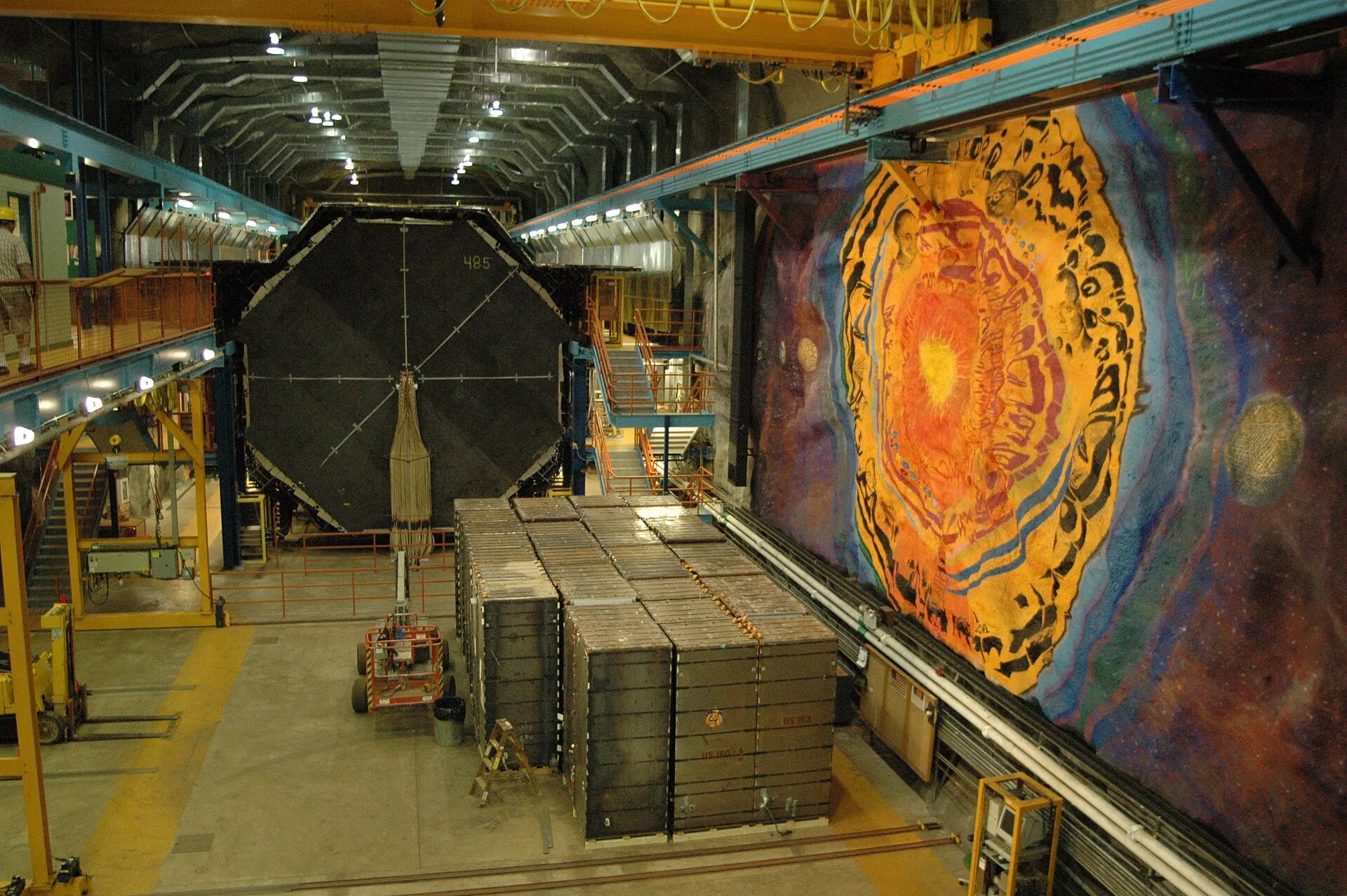
The steel–scintillator tracking calorimeters (5.4 kt far detector) measured νµ and ν̄µ disappearance and gave a precise measurement of Δm²₃₂. The magnetic field separated neutrinos from antineutrinos. MINOS+ continued in the higher-energy NuMI configuration and set strong limits on sterile-neutrino mixing.
Compare all experiments → · World map →
In plain words
MINOS sent muon neutrinos from Fermilab near Chicago through 735 km of rock to an old iron mine in northern Minnesota. Its detectors were stacks of magnetised steel plates and plastic scintillator, a design that could tell a muon from an antimuon by the way its track bent. That allowed MINOS to compare neutrinos and antineutrinos in the same detector.
How the detector works
The NuMI beam, built for MINOS, uses 120 GeV protons from Fermilab's Main Injector. The 0.98-kilotonne near detector, about 1 km from the target, and the 5.4-kilotonne far detector in the Soudan Underground Laboratory, some 700 m below ground, were deliberately similar tracking calorimeters: octagonal steel plates 2.54 cm thick, interleaved with planes of scintillator strips read out by wavelength-shifting fibres. A toroidal magnetic field of about 1.3 tesla bent muon tracks, measuring their momentum and electric charge. The energy of a charged-current event was reconstructed from the muon range or curvature plus the hadronic shower.
Key results
- 2006: first confirmation, with a beam spanning a broad energy range, that muon neutrinos disappear with the energy dependence predicted by oscillation.
- The most precise measurement of the atmospheric mass splitting |Δm²₃₂| for several years, combining beam and atmospheric neutrinos in the far detector.
- A separate measurement of antineutrino disappearance. An early hint, around 2010, that antineutrinos had a different Δm² faded with more data, an instructive example of a statistical fluctuation.
- Limits on νµ → νe appearance and, with MINOS+ (2013–2016) in the higher-energy NuMI beam, some of the strongest constraints on sterile-neutrino mixing via muon-neutrino disappearance, partly combined with Daya Bay and Bugey-3.
Why it matters for neutrino physics
MINOS established the US long-baseline programme and showed that magnetised detectors can separate ν from ν̄. Its precise Δm²₃₂ became a standard input to global fits. The experiment was proposed and long led by Stanley Wojcicki; Regina Rameika and Mark Thomson were among its members who later took leading roles in DUNE. NuMI went on to feed MINERvA and NOvA.
Frequently asked questions
Why use iron instead of water?
Iron is dense, so a compact detector contains many kilotonnes of target, and it can be magnetised to identify the charge of muons. The price is poorer resolution for electrons and low-energy particles.
Is MINOS still running?
No. MINOS+ ended in 2016 and the far detector in Soudan was decommissioned.
Original papers
- First resultD. G. Michael et al. (MINOS Collaboration), Observation of muon neutrino disappearance with the MINOS detectors and the NuMI neutrino beam, Phys. Rev. Lett. 97, 191801 (2006)DOI 10.1103/PhysRevLett.97.191801arXiv:hep-ex/0607088
- Final resultP. Adamson et al. (MINOS Collaboration), Combined analysis of νμ disappearance and νμ→νe appearance in MINOS using accelerator and atmospheric neutrinos, Phys. Rev. Lett. 112, 191801 (2014)DOI 10.1103/PhysRevLett.112.191801arXiv:1403.0867
Related terms
People
- Boris J. Kayser
- Gary J. Feldman
- Stanley Wojcicki
- Mark D. Messier
- Mark Thomson
- Regina A. (Gina) Rameika
- Mary Bishai
- Patricia (Tricia) Vahle
Latest research on this topic
- Probing Quantum Foundations in Long-Baseline Neutrino Oscillations: Wave Packet Approach from MINOS Data to DUNE PredictionsFarooq, Baktiar Wasir, Singh Koranga, Bipin, Blasone, Massimo · 2 September 2026
- Modeling the Effect of the Heliospheric Magnetic Field on Cosmic Ray Muon ShadowsMINOS+ Collaboration · 28 May 2026
- 3-Flavour NOvA-MINOS Joint Analysis Using A Covariance Matrix FrameworkÖzkaynak, Mustafa · 28 March 2026
- Improved instrumentation and analysis for CHIPS and MINOSneutrino detectorsMánek, Petr · 28 December 2025
On the timeline
Mentioned in 37 pages
Milestones 3
People 9
- Gary J. Feldman
- Mark D. Messier
- Mark Thomson
- Mary Bishai
- Patricia (Tricia) Vahle
- Regina A. (Gina) Rameika
- Stanley Wojcicki
- Takaaki Kajita
1 more
Terms 24
- Accelerator Long-baseline experiments
- Accelerator neutrino beams
- Accelerator neutrinos
- Antiparticle
- Appearance vs disappearance
- ArgoNeuT
- Atmospheric mass splitting Δm²31
- Baseline
16 more
- Conventional neutrino beam
- CPT theorem
- Lorentz and CPT violation in neutrinos
- Major neutrino beamlines
- MINERvA
- Mixing angle θ23
- Muon neutrino
- Near and far detectors
- Near-to-far extrapolation
- Neutrino energy reconstruction
- Neutrino speed and time of flight
- NuMI Beam
- Segmented scintillator tracking calorimeter
- Soudan 2
- Soudan Underground Laboratory
- Tracking calorimeter
Last updated: · Editorial standard
Cite this page
Text
Neutrino Atlas (2026). “MINOS / MINOS+”. Retrieved 22 November 2026, from https://neutrino-atlas.com/terms/minos/BibTeX
@misc{neutrinoatlas2026termsminos,
  title        = {MINOS / MINOS+},
  author       = {{Neutrino Atlas}},
  year         = {2026},
  url          = {https://neutrino-atlas.com/terms/minos/},
  note         = {Accessed 2026-11-22},
  language     = {english}
}