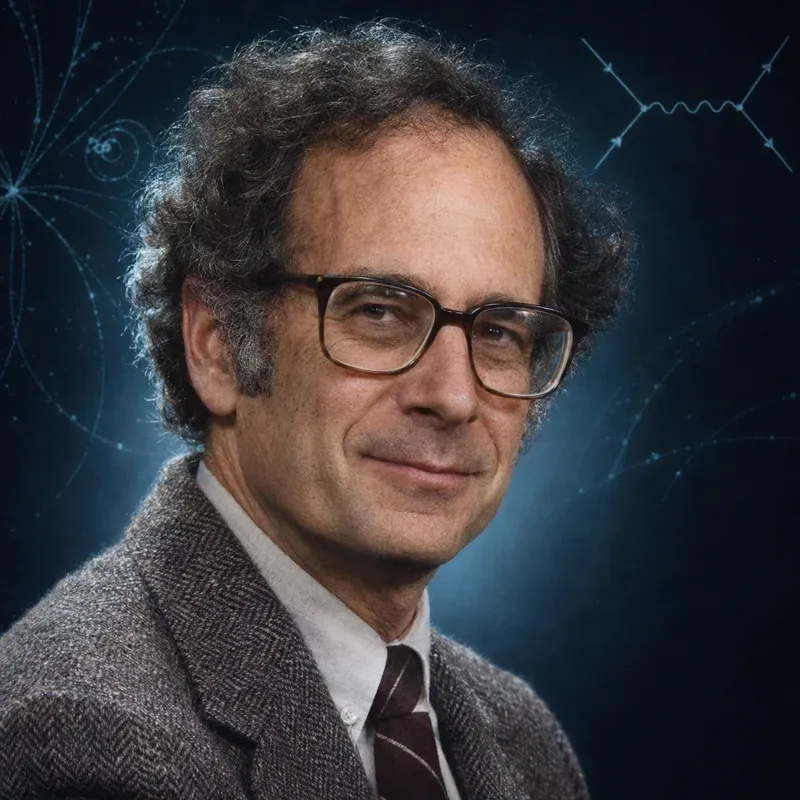
 Illustration
Gary J. Feldman
With Robert Cousins, Feldman introduced in 1998 the 'unified approach' for constructing frequentist confidence intervals near physical boundaries; Feldman–Cousins intervals became the standard statistical method in neutrino-oscillation analyses. He worked on NOMAD at CERN and MINOS at Fermilab and was co-spokesperson of NOvA for 11 years from its design through early data-taking.
- Born
- 1942
Cheyenne, Wyoming, USA - Nationality
- American
- Field
- Experimental particle physics
- Institutions
- University of Chicago (BA), Harvard University (PhD), SLAC
Early life and education
Gary J. Feldman was born in 1942 in Cheyenne, Wyoming. He earned his bachelor's degree at the University of Chicago and his master's and doctorate at Harvard University, with a thesis on the pion form factor supervised by Francis M. Pipkin.
From colliders to neutrinos
In 1971 Feldman moved to SLAC, where he spent almost two decades in electron–positron physics. He was a member of the SLAC–LBL Mark I collaboration at the SPEAR storage ring, whose results in the 1970s included the discovery of the ψ meson, the first particle containing a charm quark, and of the τ lepton – work later recognised with two Nobel Prizes. He then served as co-spokesperson of the Mark II detector at the SLAC Linear Collider. In 1990 he returned to Harvard as a professor and chaired its physics department from 1994 to 1997. At Harvard he moved into neutrino physics, joining NOMAD at CERN, a search for muon-to-tau neutrino oscillations, and MINOS at Fermilab.
Key contributions
Feldman's best-known work is statistical rather than experimental. Neutrino experiments often look for a small signal on top of a known background, and the parameter being measured – an oscillation probability, a mixing angle, a neutrino mass – cannot be negative. The textbook frequentist recipes then misbehave. If an experimenter decides only after seeing the data whether to quote an upper limit or a two-sided interval, the stated confidence level is no longer correct, a problem Feldman and Cousins called ‘flip-flopping’. The standard method can also return an empty interval.
In ‘Unified approach to the classical statistical analysis of small signals’ (Physical Review D, 1998), Feldman and Robert Cousins solved both problems with one construction. For each possible true value of the parameter they rank the possible outcomes by a likelihood ratio, comparing how probable an outcome is under that value with how probable it is under the best physically allowed value. Outcomes are added to the acceptance region in order of this ratio until the desired coverage is reached. The procedure automatically moves from an upper limit to a two-sided interval as the signal grows, never gives an empty interval, and keeps the correct frequentist coverage. Applied with Monte Carlo methods to oscillation fits in two parameters, it became the standard way of drawing allowed regions in neutrino physics and is described on the Feldman–Cousins page.
NOvA
Feldman was co-spokesperson of NOvA, together with Mark Messier, for eleven years, from the experiment's design through its early data-taking. NOvA sends the Fermilab NuMI beam 810 km to a 14,000-tonne far detector in northern Minnesota, placed off-axis to receive a narrow band of neutrino energies near 2 GeV. Its long baseline makes it sensitive to matter effects and thus to the neutrino mass ordering and to CP violation. The first oscillation results appeared in 2016. Feldman remains a member of the collaboration as Frank B. Baird, Jr. Professor of Science, Emeritus, at Harvard.
Honours
Feldman is a Fellow of the American Physical Society and a member of the American Academy of Arts and Sciences.
Known for
- Feldman–Cousins unified approach to confidence intervals (1998)
- Co-spokesperson of NOvA
- MINOS and NOMAD
- Mark I at SPEAR (charm and tau era)
Chronology
- 1971Joins SLAC
- 1990Professor at Harvard
- 1998Feldman–Cousins paper
- 2016NOvA first oscillation results (co-spokesperson for 11 years from design through early data-taking)
Original papers
- G. J. Feldman and R. D. Cousins, Unified approach to the classical statistical analysis of small signals, Phys. Rev. D 57, 3873 (1998)DOI 10.1103/PhysRevD.57.3873
Experiments
Connected people
Frequently asked questions
What is the Feldman–Cousins method?
A frequentist way of building confidence intervals that orders possible outcomes by a likelihood ratio. It switches smoothly from an upper limit to a measured interval, never gives an empty result near a physical boundary, and keeps correct coverage. It is the standard tool for oscillation contours (see statistics methods).
What was Gary Feldman's role in NOvA?
He was one of the two co-spokespeople for eleven years, from the design of the experiment through early data-taking, and he continues to work on it.
Did Feldman take part in Nobel Prize-winning work?
He was a member of the Mark I collaboration at SPEAR, whose discoveries of the ψ and the τ lepton were recognised with Nobel Prizes for Burton Richter (1976) and Martin Perl (1995). He did not receive a Nobel Prize himself.
On the timeline
Mentioned in 6 pages
Last updated: · Editorial standard
Cite this page
Text
Neutrino Atlas (2026). “Gary J. Feldman”. Retrieved 22 November 2026, from https://neutrino-atlas.com/people/gary-feldman/BibTeX
@misc{neutrinoatlas2026peoplegaryfeldman,
  title        = {Gary J. Feldman},
  author       = {{Neutrino Atlas}},
  year         = {2026},
  url          = {https://neutrino-atlas.com/people/gary-feldman/},
  note         = {Accessed 2026-11-22},
  language     = {english}
}