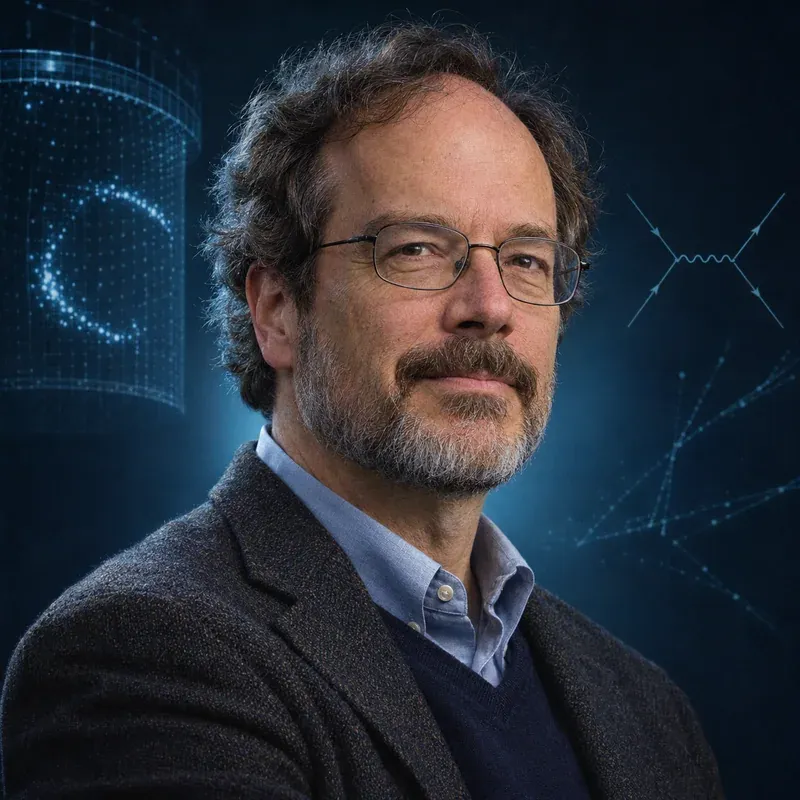
 Illustration
Mark D. Messier
As a Boston University graduate student Messier analysed Super-Kamiokande atmospheric neutrino data and was a primary author of the 1998 paper 'Evidence for oscillation of atmospheric neutrinos'. He coordinated NuMI beam simulation for MINOS and has been co-spokesperson of the NOvA long-baseline experiment since 2006, overseeing its prototype detector.
- Nationality
- American
- Field
- Experimental neutrino physics
- Institutions
- MIT (BS 1993), Boston University (PhD 1999), Harvard University, Indiana University
Education
Mark D. Messier is an American experimental particle physicist who has spent his whole career on accelerator and atmospheric neutrinos. He earned a BS in physics at MIT in 1993, spent a year at the Congressional Research Service of the Library of Congress, and then moved to Boston University, where he did his doctorate under James Stone. His 1999 thesis carried the title of the result it helped to establish: evidence for oscillations of atmospheric neutrinos with Super-Kamiokande.
Super-Kamiokande and the 1998 discovery
Atmospheric neutrinos are produced when cosmic rays hit the upper atmosphere. Those coming from above travel about 15 km to the detector, those coming from below cross the whole Earth, some 13,000 km. Super-Kamiokande found that upward-going muon neutrinos were clearly missing while downward-going ones were not, a zenith-angle dependence that only neutrino oscillations could explain. As a student in the atmospheric neutrino and proton decay group, Messier was a primary author of the 1998 paper that presented this result, the first convincing evidence that neutrinos have mass. The discovery was recognised with the 2015 Nobel Prize to Takaaki Kajita.
MINOS, MIPP and NOvA
After a postdoctoral position at Harvard (1999–2002), Messier joined Indiana University, where he became a full professor in 2010 and later Distinguished Professor and department chair. At MINOS he coordinated the Monte Carlo simulation of the NuMI beam and the working group on beam systematics, the input that every oscillation measurement depends on. In the hadron-production experiment MIPP (Fermilab E907) he looked after the ring-imaging Cherenkov counter and installed the NuMI target, measurements that improved the flux predictions.
Since 2006 he has been co-spokesperson of NOvA, together with Gary Feldman among others. NOvA sends the NuMI beam 810 km from Fermilab to a 14-kiloton detector in Minnesota, placed off-axis to obtain a narrow energy spectrum. It searches for electron-neutrino appearance to study the mass ordering and CP violation. Messier worked on the near-detector design, flux and cosmic-ray background calculations and reconstruction software, and helped build the prototype detector during a sabbatical at Fermilab in 2010–2011. NOvA reported its first electron-neutrino appearance measurement in 2016.
Known for
- Super-Kamiokande atmospheric neutrino analysis (1998 oscillation discovery)
- MINOS NuMI beam simulation
- Co-spokesperson of NOvA (from 2006)
Chronology
- 1998Super-K evidence for atmospheric neutrino oscillation
- 1999PhD, Boston University
- 2002Joins Indiana University
- 2003DOE Outstanding Junior Investigator
- 2006NOvA co-spokesperson
- 2016NOvA first electron-neutrino appearance measurement
Original papers
- Super-Kamiokande Collaboration (Y. Fukuda et al.), Evidence for oscillation of atmospheric neutrinos, Phys. Rev. Lett. 81, 1562 (1998)DOI 10.1103/PhysRevLett.81.1562
- NOvA Collaboration (P. Adamson et al.), First measurement of electron neutrino appearance in NOvA, Phys. Rev. Lett. 116, 151806 (2016)DOI 10.1103/PhysRevLett.116.151806
Experiments
Connected people
Frequently asked questions
What was Mark Messier's role in the discovery of neutrino oscillation?
As a Boston University graduate student on Super-Kamiokande he analysed atmospheric neutrino data and was a primary author of the 1998 paper 'Evidence for oscillation of atmospheric neutrinos'.
Which experiment does Mark Messier lead?
He has been co-spokesperson of the long-baseline experiment NOvA at Fermilab since 2006.
On the timeline
- 1998Super-Kamiokande discovers neutrino oscillation
- 2016NOvA reports its first oscillation results
- 2025NOvA and T2K publish a joint analysis
Mentioned in 6 pages
Last updated: · Editorial standard
Cite this page
Text
Neutrino Atlas (2026). “Mark D. Messier”. Retrieved 22 November 2026, from https://neutrino-atlas.com/people/mark-messier/BibTeX
@misc{neutrinoatlas2026peoplemarkmessier,
  title        = {Mark D. Messier},
  author       = {{Neutrino Atlas}},
  year         = {2026},
  url          = {https://neutrino-atlas.com/people/mark-messier/},
  note         = {Accessed 2026-11-22},
  language     = {english}
}