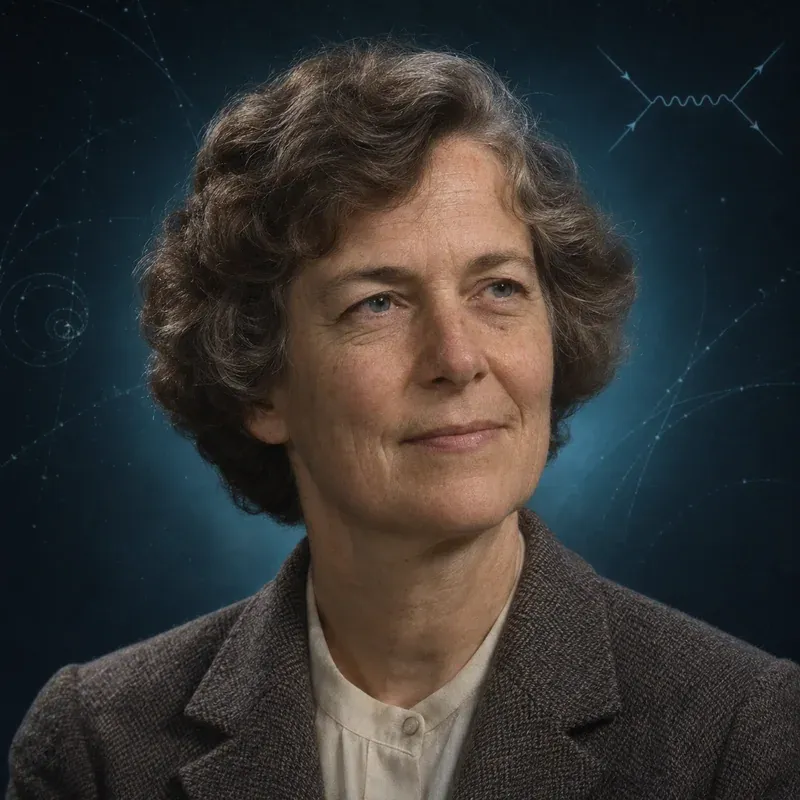
 Illustration
Patricia (Tricia) Vahle
Vahle has spent her career on long-baseline accelerator experiments at Fermilab, first MINOS and then NOvA, which send a muon-neutrino beam through the Earth to a distant far detector. At NOvA she helped found a data-analysis group, later served as analysis coordinator, and in 2018 was elected co-spokesperson alongside Peter Shanahan, succeeding Mark Messier. Her APS fellowship cites leading contributions to the measurement of neutrino oscillations with MINOS and NOvA.
- Nationality
- American
- Field
- Experimental neutrino physics
- Institutions
- New Mexico State University, University of Texas at Austin (PhD), University College London, William & Mary
Path to neutrino physics
Patricia "Tricia" Vahle began studying physics at New Mexico State University and earned her PhD in particle physics at the University of Texas at Austin. After a postdoctoral position at University College London she joined the physics faculty of William & Mary in Virginia, where she is the Mansfield Professor of Physics. Her research has centred on two long-baseline experiments that use Fermilab's NuMI beam.
MINOS and NOvA
MINOS compared the muon-neutrino rate and energy spectrum in a near detector at Fermilab with those in a far detector about 735 km away in the Soudan mine, using the near/far method to cancel much of the uncertainty in beam flux and cross sections. Its disappearance measurements pinned down the atmospheric mass splitting Δm²₃₁.
NOvA was designed for the next question. Its 14-kilotonne far detector in Ash River, Minnesota, sits 810 km from Fermilab and slightly off the beam axis, so it receives a narrow band of energies near the oscillation maximum. Built from plastic cells filled with liquid scintillator, it is optimised to separate electron showers from muon tracks and thus to see electron-neutrino appearance. Because the neutrinos travel through 810 km of rock, matter effects make the appearance rate sensitive to the mass ordering and to δCP.
Vahle worked on NOvA for about a decade before it started full operation in 2014. She was one of the founders of an analysis group, became the experiment's analysis coordinator overseeing its analysis teams, and served as a public face of the project. In March 2018 the collaboration elected her co-spokesperson, together with Peter Shanahan, succeeding Mark Messier, who had led NOvA for more than twelve years. In 2019 NOvA published its first joint analysis of neutrino and antineutrino data, including evidence for electron-antineutrino appearance.
Recognition
In 2020 the American Physical Society named Vahle a Fellow "for leading contributions to the measurements of neutrino oscillations using the MINOS and NOvA experiments".
Known for
- NOvA co-spokesperson (elected 2018)
- NOvA analysis coordinator
- Neutrino oscillation measurements with MINOS
- Electron-neutrino appearance and mass-ordering analyses at NOvA
- APS Fellow (2020)
Chronology
- 2012Explains NOvA's goals in a Fermilab video as the experiment nears completion
- 2014NOvA far detector completed; data taking begins
- 2018Elected NOvA co-spokesperson (from 21 March)
- 2020Named APS Fellow
Original papers
- MINOS Collaboration (P. Adamson et al.), Measurement of neutrino oscillations with the MINOS detectors in the NuMI beam, Phys. Rev. Lett. 101, 131802 (2008)DOI 10.1103/PhysRevLett.101.131802
- NOvA Collaboration (M. A. Acero et al.), First measurement of neutrino oscillation parameters using neutrinos and antineutrinos by NOvA, Phys. Rev. Lett. 123, 151803 (2019)DOI 10.1103/PhysRevLett.123.151803
Experiments
Connected people
Frequently asked questions
What is Tricia Vahle known for?
Leading analyses and, from 2018, co-leading the NOvA long-baseline experiment, after earlier work on MINOS.
What does NOvA measure?
How often muon neutrinos and antineutrinos turn into electron neutrinos over 810 km, which constrains the mass ordering, δCP and θ₂₃.
Last updated: · Editorial standard
Cite this page
Text
Neutrino Atlas (2026). “Patricia (Tricia) Vahle”. Retrieved 22 November 2026, from https://neutrino-atlas.com/people/patricia-vahle/BibTeX
@misc{neutrinoatlas2026peoplepatriciavahle,
  title        = {Patricia (Tricia) Vahle},
  author       = {{Neutrino Atlas}},
  year         = {2026},
  url          = {https://neutrino-atlas.com/people/patricia-vahle/},
  note         = {Accessed 2026-11-22},
  language     = {english}
}