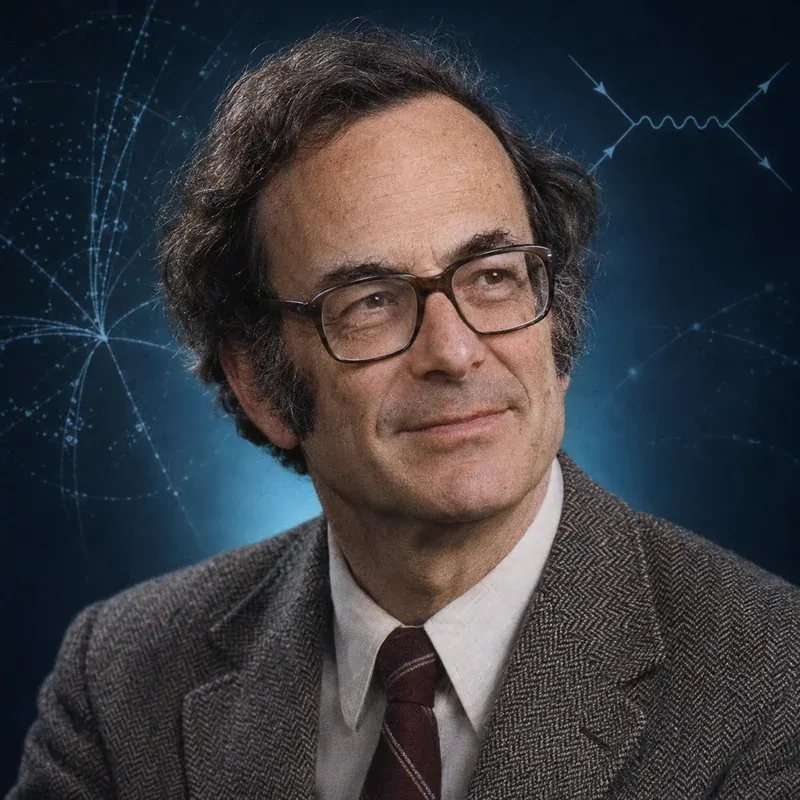
 Illustration
Stanley Wojcicki
After the cancellation of the Superconducting Super Collider, Wojcicki turned to neutrino oscillations and proposed and led MINOS, which sent the NuMI muon-neutrino beam from Fermilab to a detector in the Soudan mine in Minnesota, 735 km away. MINOS confirmed and precisely measured the atmospheric oscillation parameters first established by Super-Kamiokande.
- Born
- 30 March 1937
Warsaw, Poland - Died
- 31 May 2023
Los Altos, California, USA - Nationality
- American (Polish-born)
- Field
- Experimental particle physics
- Institutions
- Stanford University, Lawrence Berkeley National Laboratory, Fermilab (MINOS)
Early life and education
Stanisław Jerzy Wójcicki was born on 30 March 1937 in Warsaw. When the communists took power after the Second World War, his mother fled with him and his brother, then about twelve, to Sweden and eventually to the United States; his father, a member of the main opposition party, was imprisoned in Poland. After a Franciscan boarding school near Buffalo, New York, Wojcicki studied physics at Harvard on a scholarship and went on to the University of California, Berkeley, where he completed his PhD in 1962 with a thesis on pion–hyperon resonances. As a graduate student at Berkeley he helped discover several short-lived particles.
Kaon physics and the Superconducting Super Collider
After a year at CERN and the Collège de France in 1964–65, Wojcicki joined the Stanford physics faculty in 1966, became full professor in 1974 and chaired the department in 1982–85 and 2004–07. For two decades his research centred on K mesons, whose decays had revealed parity and CP violation; his group's experiments helped clarify the structure of the weak interaction within the emerging Standard Model.
Wojcicki also became one of the main planners of American particle physics. He chaired the subpanel of the High Energy Physics Advisory Panel (HEPAP) that in 1983 recommended building the Superconducting Super Collider (SSC), later chaired HEPAP itself, and served as deputy director of the SSC Central Design Group in Berkeley. When Congress cancelled the half-built collider in Texas in 1993, he documented the project in a two-volume history.
MINOS
After the SSC, Wojcicki turned to neutrino oscillations. In the mid-1990s the atmospheric-neutrino anomaly seen by Kamiokande and IMB suggested that muon neutrinos disappear over distances of hundreds of kilometres. A controlled test needed an accelerator beam of known energy and a detector at the right baseline. Wojcicki proposed and led MINOS, the Main Injector Neutrino Oscillation Search, which used the new NuMI beam from Fermilab.
MINOS had two functionally identical detectors of magnetised steel plates interleaved with plastic scintillator: a near detector at Fermilab that measured the unoscillated beam, and a 5,400-tonne far detector in the Soudan mine in northern Minnesota, 735 kilometres away. Comparing the two (near–far extrapolation) cancelled most uncertainties in the beam flux and cross sections. The magnetic field distinguished μ⁻ from μ⁺ and so neutrinos from antineutrinos.
Key results
In 2006 MINOS reported the disappearance of muon neutrinos with an energy-dependent deficit matching oscillations, giving a mass-squared difference of about 2.7 × 10⁻³ eV². The experiment went on to provide the most precise measurement of the atmospheric mass-squared difference of its time, compared neutrino and antineutrino oscillations, and searched for electron-neutrino appearance that hinted at a non-zero θ₁₃. MINOS laid the groundwork for NOvA and the DUNE programme.
Recognition
Wojcicki received the Bruno Pontecorvo Prize in 2011 and the APS Panofsky Prize in 2015 for his leadership of MINOS. He retired from Stanford in 2015 and died at his home in Los Altos, California, on 31 May 2023, aged 86.
Known for
- Proposed and led MINOS
- Fermilab-to-Soudan 735 km long-baseline beam
- Panofsky Prize 2015
- Pontecorvo Prize 2011
Chronology
- 2006First MINOS oscillation result
- 2011Bruno Pontecorvo Prize
- 2015APS Panofsky Prize
- 2023Dies in Los Altos
Original papers
- MINOS Collaboration (D. G. Michael et al.), Observation of muon neutrino disappearance with the MINOS detectors in the NuMI neutrino beam, Phys. Rev. Lett. 97, 191801 (2006)DOI 10.1103/PhysRevLett.97.191801
Experiments
Connected people
Frequently asked questions
What was MINOS?
A long-baseline experiment that sent the NuMI muon-neutrino beam 735 km from Fermilab to a detector in the Soudan mine. Starting in 2006, it measured muon-neutrino disappearance and the atmospheric oscillation parameters.
What was Wojcicki's role in the Superconducting Super Collider?
He chaired the 1983 HEPAP subpanel that recommended building it and was deputy director of its Central Design Group. After its cancellation in 1993 he moved to neutrino physics.
Did Stanley Wojcicki win a Nobel Prize?
No. His main honours were the Bruno Pontecorvo Prize (2011) and the Panofsky Prize (2015).
On the timeline
Mentioned in 4 pages
Terms 1
Last updated: · Editorial standard
Cite this page
Text
Neutrino Atlas (2026). “Stanley Wojcicki”. Retrieved 22 November 2026, from https://neutrino-atlas.com/people/stanley-wojcicki/BibTeX
@misc{neutrinoatlas2026peoplestanleywojcicki,
  title        = {Stanley Wojcicki},
  author       = {{Neutrino Atlas}},
  year         = {2026},
  url          = {https://neutrino-atlas.com/people/stanley-wojcicki/},
  note         = {Accessed 2026-11-22},
  language     = {english}
}