DUNE
The flagship next-generation experiment: a 1300-km beam from Fermilab to huge liquid-argon detectors in South Dakota.
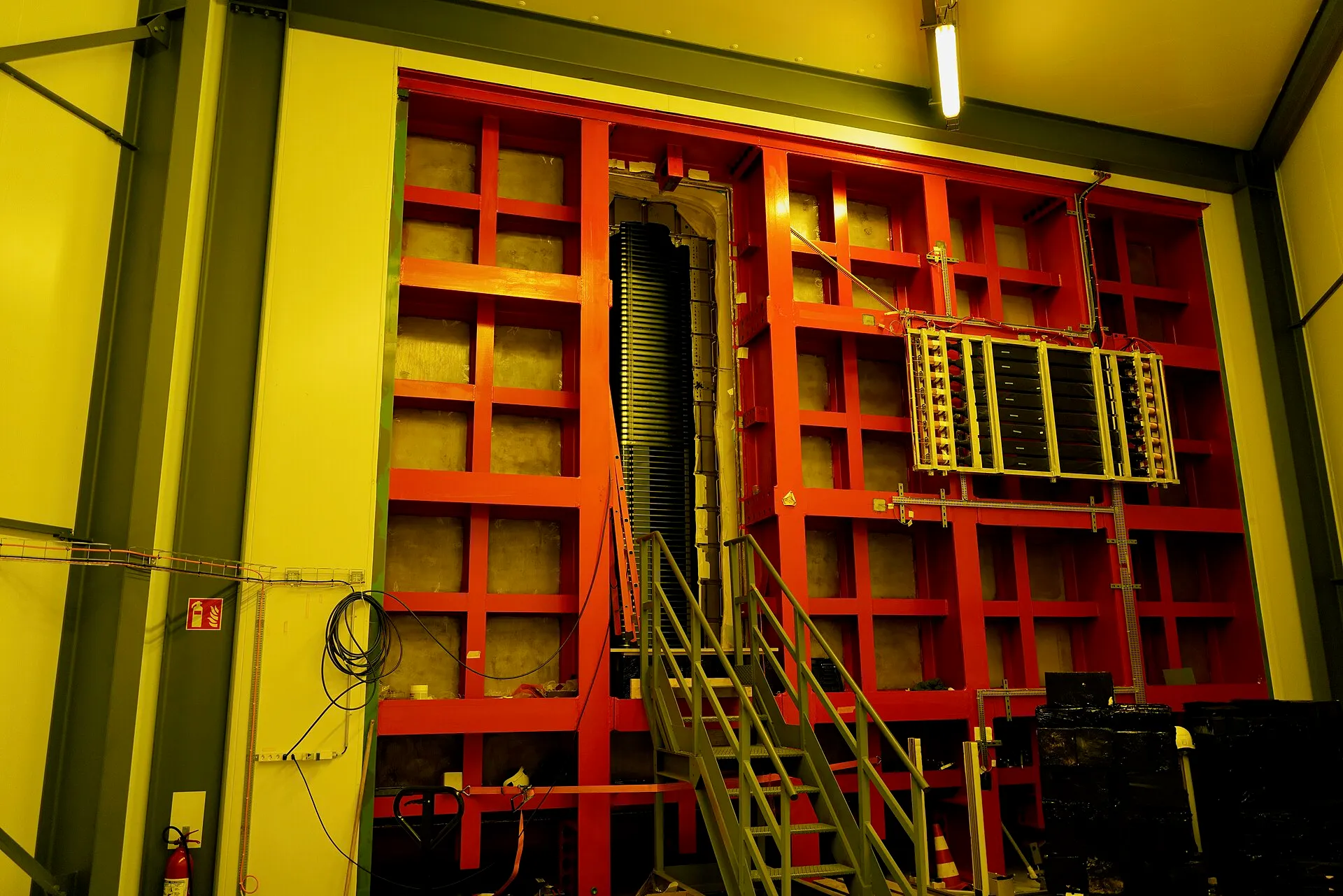
The Deep Underground Neutrino Experiment will use the LBNF wide-band beam and a near detector complex at Fermilab, plus far-detector modules of about 17 kt of liquid argon each, about 1.5 km underground at SURF. Goals include determining the mass ordering, discovering CP violation, measuring supernova νe bursts and searching for proton decay. Cavern excavation finished in early 2024 and detector installation began in 2026. Fermilab expects far-detector data taking to start in early 2030 and aims to deliver the first neutrino beam to DUNE by 2031.
Compare all experiments → · World map →
In plain words
DUNE will shoot the most intense neutrino beam ever built from Fermilab near Chicago through 1300 km of the Earth to detectors a mile underground in a former gold mine in South Dakota. The detectors are enormous tanks of liquid argon that photograph each interaction in fine detail. By comparing neutrinos with antineutrinos over this long path, DUNE aims to answer two open questions at once: the order of the neutrino masses and whether neutrinos violate CP symmetry.
How the experiment works
- Beam: the LBNF beamline will use 60–120 GeV protons from Fermilab's upgraded accelerator complex at 1.2 MW, with a path to more than 2 MW. It produces a wide-band beam covering roughly 0.5 to 5 GeV, so both the first and second oscillation maxima are visible.
- Near detector: a movable liquid-argon detector, a muon spectrometer and an on-axis beam monitor measure the unoscillated flux and argon cross sections.
- Far detector: up to four cryostats, each holding about 17,000 tonnes of liquid argon, at the 4850-foot level (about 1.5 km) of the Sanford Underground Research Facility. The first two modules use the horizontal-drift and vertical-drift liquid-argon TPC designs tested in ProtoDUNE.
Physics goals
- Determine the mass ordering at more than 5σ for any value of δCP, thanks to the strong matter effect over 1300 km.
- Discover leptonic CP violation if δCP is far from 0 and π, and measure δCP precisely.
- Record the electron-neutrino component of a galactic supernova burst through νe + ⁴⁰Ar → e⁻ + ⁴⁰K*, a channel complementary to water and scintillator detectors.
- Search for proton decay modes such as p → K⁺ν̄, predicted by grand unified theories.
Status today
Excavation of the far-site caverns, about 800,000 tonnes of rock, was completed in early 2024, and cryostat and detector installation followed. The first far-detector module is planned to be commissioned around 2028, with beam physics expected in the early 2030s. The collaboration counts more than 1400 scientists from over 30 countries; Mark Thomson and Regina Rameika are among its former co-spokespersons.
Frequently asked questions
How does DUNE differ from Hyper-Kamiokande?
Hyper-K uses water Cherenkov detection, a shorter baseline and a narrow off-axis beam, so it measures CP violation with little matter effect. DUNE uses liquid argon, a longer baseline and a wide-band beam, which gives stronger mass-ordering sensitivity. Together they cross-check each other.
Why a mile underground?
The rock overburden reduces cosmic-ray muons enough for supernova, solar and proton-decay searches; for the beam alone, a shallower site would suffice.
Original papers
- ProposalB. Abi et al. (DUNE Collaboration), Deep Underground Neutrino Experiment (DUNE), Far Detector Technical Design Report, Volume I: Introduction to DUNE, JINST 15, T08008 (2020)DOI 10.1088/1748-0221/15/08/T08008arXiv:2002.02967
- ProposalB. Abi et al. (DUNE Collaboration), Deep Underground Neutrino Experiment (DUNE), Far Detector Technical Design Report, Volume II: DUNE Physics (2020)arXiv:2002.03005
- ProposalB. Abi et al. (DUNE Collaboration), Long-baseline neutrino oscillation physics potential of the DUNE experiment, Eur. Phys. J. C 80, 978 (2020)DOI 10.1140/epjc/s10052-020-08456-zarXiv:2006.16043
Go deeper
- ProtoDUNETwo large prototype liquid-argon TPCs at CERN that validated DUNE far-detector designs in test beams.
Related terms
- CP-Violation sensitivity (δ_CP)
- LBNF (Long-Baseline Neutrino Facility)
- Liquid argon time projection chamber
- Mass-ordering sensitivity
- Sanford Underground Research Facility (SURF)
People
- Lincoln Wolfenstein
- Masataka Fukugita
- Boris J. Kayser
- Carlo Rubbia
- Hans-Thomas Janka
- Herbert H. Chen
- Kate Scholberg
- Serguey Todorov Petcov
- Vernon Duane Barger
- M. Belén Gavela
- Edward Blucher
- Silvia Pascoli
- Stephen J. Parke
- Bonnie T. Fleming
- Henry W. Sobel
- Mark Thomson
Latest research on this topic
- Cosmic ray muon seasonal variations with the ProtoDUNE-SP DetectorDUNE Collaboration · 13 November 2026
- Nuclear medium and final state interaction effects in η production induced by νμ(\barνμ) at SBN and DUNE energiesFatima, A., Alam, S.K. Noor, Sajjad Athar, M. et al. · 10 November 2026
- Sensitivity to Sterile Neutrinos with Elastic Neutrino-Electron and Highly Elastic Neutrino-Nucleus Scattering in the DUNE Near DetectorDUNE Collaboration · 6 November 2026
- Earthquake Forecast via Neutrino Tomography at the DUNE BaselineSingh Koranga, Bipin, Vashisht, Samrat, Nautiyal, Vivek Kumar · 4 November 2026
- DUNE High Band-Width Data Processing PipelineWang, Michael · 20 October 2026
- Numerical shock broadening and supernova neutrino conversion: implications for DUNEde Lima, Rafael C.R., Bailer, Pedro Martins · 19 October 2026
On the timeline
- 1977Rubbia proposes the liquid-argon TPC
- 2017Groundbreaking for LBNF and DUNE
- 2024DUNE's underground caverns are completed
- 2026DUNE begins installing detector support structures
- 2026SBND releases its first neutrino results
Mentioned in 202 pages
Lessons 11
FAQ 9
Comparisons 7
Milestones 26
- 1960 · Proposals for accelerator neutrino beams
- 1962 · Maki, Nakagawa and Sakata introduce neutrino mixing
- 1977 · Rubbia proposes the liquid-argon TPC
- 1978 · Wolfenstein: matter changes neutrino oscillations
- 1986 · Fukugita and Yanagida propose leptogenesis
- 1987 · Neutrinos from supernova SN 1987A
- 1988 · Nobel Prize for the muon neutrino
- 1998 · Homestake publishes its final solar result
18 more
- 1999 · K2K starts the first long-baseline experiment
- 2011 · T2K finds hints of electron-neutrino appearance
- 2012 · Daya Bay discovers a non-zero θ₁₃
- 2012 · RENO confirms θ₁₃
- 2015 · Breakthrough Prize honours five oscillation experiments
- 2015 · OPERA establishes tau-neutrino appearance
- 2016 · NOvA reports its first oscillation results
- 2017 · Groundbreaking for LBNF and DUNE
- 2020 · Hyper-Kamiokande construction is approved
- 2020 · T2K constrains CP violation in neutrinos
- 2021 · MicroBooNE finds no electron-neutrino excess
- 2024 · DUNE's underground caverns are completed
- 2025 · Hyper-Kamiokande cavern excavation completed
- 2025 · JUNO begins data taking
- 2025 · MicroBooNE finds no evidence for a sterile neutrino
- 2025 · NOvA and T2K publish a joint analysis
- 2026 · DUNE begins installing detector support structures
- 2026 · SBND releases its first neutrino results
People 41
- Adam Burrows
- André Rubbia
- Antonio Ereditato
- Bonnie T. Fleming
- Boris J. Kayser
- Carlo Rubbia
- David Bruce Cline
- Edward Blucher
33 more
- Georg G. Raffelt
- Hans-Thomas Janka
- Henry W. Sobel
- Hitoshi Murayama
- James Ricker Wilson
- Kam-Biu Luk
- Kate Scholberg
- Kenneth Lande
- Leon M. Lederman
- Lev Landau
- Lincoln Wolfenstein
- M. Belén Gavela
- M. Concepción (Concha) González-García
- Makoto Kobayashi
- Mark Thomson
- Mary Bishai
- Masataka Fukugita
- Melvin Schwartz
- Nicola Cabibbo
- Raymond Davis Jr.
- Regina A. (Gina) Rameika
- Silvia Pascoli
- Simon van der Meer
- Soo-Bong Kim
- Stanislav Pavlovich Mikheyev
- Stanley Wojcicki
- Stephen J. Parke
- Thomas Schwetz
- Toshihide Maskawa
- Tsutomu Yanagida
- Vernon Duane Barger
- Wang Yifang
- Wick C. Haxton
Terms 108
- Accelerator Long-baseline experiments
- Accelerator neutrino beams
- Accelerator neutrinos
- Appearance measurement
- Appearance vs disappearance
- ArgoNeuT
- Axial form factor and axial mass
- Baseline
100 more
- Beta beam
- Beyond three neutrinos
- Charge conjugation
- Coherent pion production
- Conventional neutrino beam
- Core-collapse supernova mechanism
- Cosmological neutrino mass bounds
- CP violation
- CP-Violating phase δCP
- CP-Violation sensitivity (δCP)
- Cross sections
- Cross-section & Nuclear-model uncertainty
- Daya Bay
- Decay pipe & beam absorber
- Deep inelastic scattering
- Earth matter effects
- Electron–Photon separation (dE/dx)
- Electronvolt
- ESSnuSB
- Event reconstruction & identification
- Experiments & detectors
- Flavour symmetries
- GeV scale
- Grand unification
- Heavy neutral lepton
- Homestake Chlorine Experiment
- Hybrid Cherenkov–scintillation detectors
- Hyper-Kamiokande
- ICARUS
- Interaction cross section
- Inverted ordering
- Ionisation charge collection
- J-PARC Neutrino Beam
- Jarlskog invariant
- L/E (baseline over energy)
- LBNF (Long-Baseline Neutrino Facility)
- Lepton generation
- Leptonic CP violation
- Liquid argon time projection chamber
- Major neutrino beamlines
- Mass eigenstates
- Mass-ordering sensitivity
- Matter effects
- Matter-antimatter asymmetry
- MicroBooNE
- MINERvA
- MINOS / MINOS+
- Mixing angle θ13
- Mixing angle θ23
- Monte Carlo simulation & event generators
- NA61/SHINE
- Near and far detectors
- Near-to-far extrapolation
- Neutrino energy reconstruction
- Neutrino factory
- Neutrino mass ordering
- Neutrino oscillation physics
- Neutrino tomography
- Neutrino trident production
- Neutrino vs antineutrino mode
- Neutrino-nucleus scattering regimes
- Neutronization burst
- Non-standard interactions
- NOvA
- Nuclear effects
- Nuclear models for neutrino scattering
- NuMI Beam
- Off-axis beam
- Off-axis beam (facility)
- Open questions in oscillations
- Oscillation observables
- Oscillation parameter degeneracies
- Parametric resonance in the Earth
- PMNS unitarity tests
- Production target
- ProtoDUNE
- Proton decay
- Protons on target (POT)
- Quark
- Resonance production
- Sanford Underground Research Facility (SURF)
- SBND (Short-Baseline Near Detector)
- Sensitivity
- Shallow inelastic scattering
- Silicon photomultiplier (SiPM)
- SNEWS (SuperNova Early Warning System)
- Solar neutrino experiments
- Soudan Underground Laboratory
- Strong interaction
- Supernova neutrino detection
- Supernova neutrino signal phases
- Supernova neutrinos
- Symmetries and their violation
- Systematic uncertainty
- T2K
- Theia
- Trigger & data acquisition
- Underground laboratories
- Wavelength shifter
- θ23 octant
Last updated: · Editorial standard
Cite this page
Text
Neutrino Atlas (2026). “DUNE”. Retrieved 22 November 2026, from https://neutrino-atlas.com/terms/dune/BibTeX
@misc{neutrinoatlas2026termsdune,
  title        = {DUNE},
  author       = {{Neutrino Atlas}},
  year         = {2026},
  url          = {https://neutrino-atlas.com/terms/dune/},
  note         = {Accessed 2026-11-22},
  language     = {english}
}