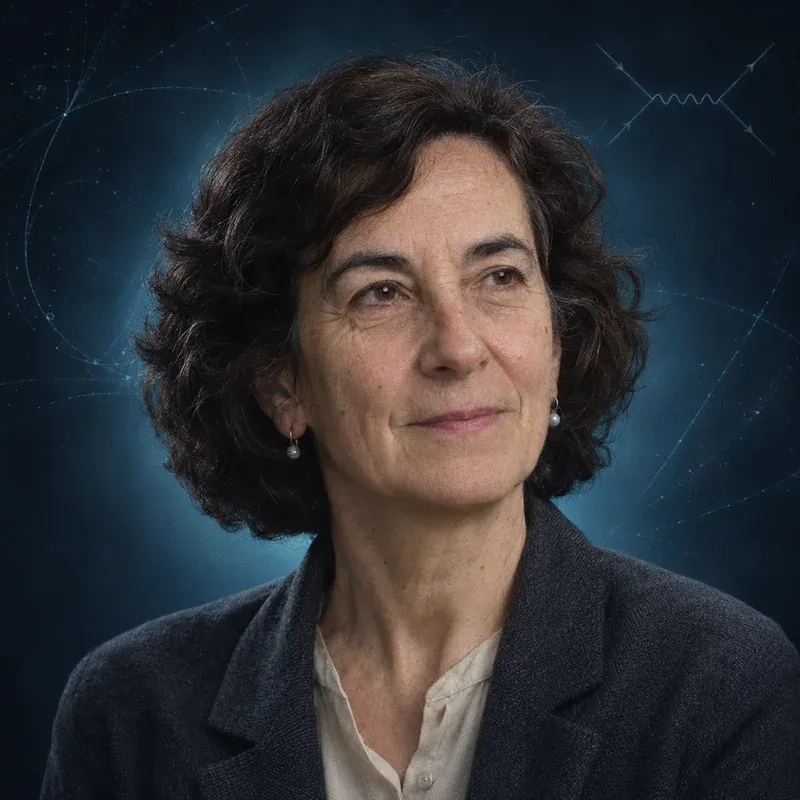
 Illustration
M. Belén Gavela
In 2000 Gavela and her collaborators showed how a neutrino factory, a muon storage ring producing pure electron- and muon-neutrino beams, could measure θ13, leptonic CP violation and the sign of the atmospheric mass splitting through "wrong-sign" muons, the so-called golden channel. The analysis identified an optimal baseline of roughly 3000 km and set the template for later studies of CP sensitivity at long-baseline facilities. She has also worked on the effective-field-theory description of the seesaw mechanism, on minimal flavour seesaw models and on the low-energy effects of heavy neutrinos, and she coordinated the European Invisibles training networks on neutrinos and dark matter.
- Nationality
- Spanish
- Field
- Theoretical particle physics
- Institutions
- Universidad Autónoma de Madrid (PhD 1981), Université Paris-Sud, Orsay (LPT), Harvard University and Brandeis University, CERN Theory Division
Education and career
María Belén Gavela studied physics at the Universidad Autónoma de Madrid (UAM), graduating in 1976. She earned a doctorat de troisième cycle at the Université Paris-Sud in Orsay in 1979 and her PhD at UAM in 1981. After postdoctoral years at Harvard and Brandeis and a CERN fellowship, she was a CNRS researcher at the theory laboratory in Orsay until 1996. From 1995 to 2001 she held a staff position in the CERN Theory Division, the first woman to do so. She became full professor of theoretical physics at UAM in 1996 and was a founding member of the Instituto de Física Teórica (IFT) UAM-CSIC in 2003.
CP violation, from quarks to the early universe
Much of Gavela's work concerns CP violation and flavour. In the 1990s she and collaborators analysed whether the CP violation of the quark CKM matrix could generate the matter–antimatter asymmetry during the electroweak phase transition, and concluded that it is far too weak. This is one of the reasons why the CP properties of leptons, and mechanisms such as leptogenesis, attracted so much attention once neutrino masses were established. She is also counted among the founders of lattice calculations of weak matrix elements.
The golden channel
In 2000, with A. Cervera, A. Donini, J. J. Gómez Cadenas, P. Hernández, O. Mena and S. Rigolin, Gavela studied the physics reach of a neutrino factory, in which muons circulating in a storage ring decay into an intense, well-understood beam of muon neutrinos and electron antineutrinos (or the charge conjugates). A far detector that identifies muons of the "wrong" sign picks out the oscillation νe → νμ, which is sensitive at the same time to θ13, to δCP and, through matter effects, to the mass ordering. The paper analysed baselines of 732, 3500 and 7332 km with realistic backgrounds and efficiencies and found an optimum near 3000 km. The term "golden channel" and the way the study separated the correlated parameters shaped later work on parameter degeneracies and CP sensitivity, including at superbeam experiments such as DUNE and Hyper-Kamiokande.
Seesaw models and invisible sectors
Gavela has worked on the effective-field-theory description of the seesaw mechanism, in which heavy states leave at low energy the dimension-five Weinberg operator that gives neutrinos mass together with dimension-six operators that can produce other observable effects, and on minimal flavour seesaw models with right-handed neutrinos light enough to matter for experiments. Later research has extended to effective theories of the Higgs and to axion-like particles. She coordinated the European training networks Invisibles (2012–2016), Elusives and InvisiblesPlus (2016–2020) and chaired the Invisibles workshop series.
Gavela has been a member of the CERN Scientific Policy Committee since 2014 and represented it in the 2018–2020 update of the European Strategy for Particle Physics. In 2023 the KIT Center for Elementary Particle and Astroparticle Physics gave her the Julius Wess Award.
Known for
- Leptonic CP violation at neutrino factories ("golden" channel, 2000)
- Effective field theory of the seesaw mechanism
- Standard Model CP violation and electroweak baryogenesis
- Coordinator of the Invisibles and Elusives networks
- Member of the CERN Scientific Policy Committee
Chronology
- 1981PhD, Universidad Autónoma de Madrid (after a 1979 doctorate in Orsay)
- 1995Staff member of the CERN Theory Division (to 2001)
- 1996Full professor of theoretical physics at UAM
- 2000"Golden measurements at a neutrino factory"
- 2003Founding member of the IFT UAM-CSIC
- 2012Coordinator of the Invisibles network (to 2016)
- 2014Member of the CERN Scientific Policy Committee
- 2023Julius Wess Award (KIT)
Original papers
- A. Cervera, A. Donini, M. B. Gavela, J. J. Gómez Cadenas, P. Hernández, O. Mena, S. Rigolin, Golden measurements at a neutrino factory, Nucl. Phys. B 579, 17 (2000)DOI 10.1016/S0550-3213(00)00221-2
Experiments
- Neutrino factory studies
- DUNE
- Hyper-Kamiokande
Connected people
Frequently asked questions
What is the "golden channel" at a neutrino factory?
The oscillation of electron neutrinos into muon neutrinos, detected through muons of the opposite charge to those produced by the beam's own muon neutrinos. It is very sensitive to θ13, δCP and the mass ordering.
What award did Belén Gavela receive in 2023?
The Julius Wess Award of KIT's Center for Elementary Particle and Astroparticle Physics, for research on the fundamental nature of particles and their interactions.
Mentioned in 2 pages
Last updated: · Editorial standard
Cite this page
Text
Neutrino Atlas (2026). “M. Belén Gavela”. Retrieved 22 November 2026, from https://neutrino-atlas.com/people/belen-gavela/BibTeX
@misc{neutrinoatlas2026peoplebelengavela,
  title        = {M. Belén Gavela},
  author       = {{Neutrino Atlas}},
  year         = {2026},
  url          = {https://neutrino-atlas.com/people/belen-gavela/},
  note         = {Accessed 2026-11-22},
  language     = {english}
}