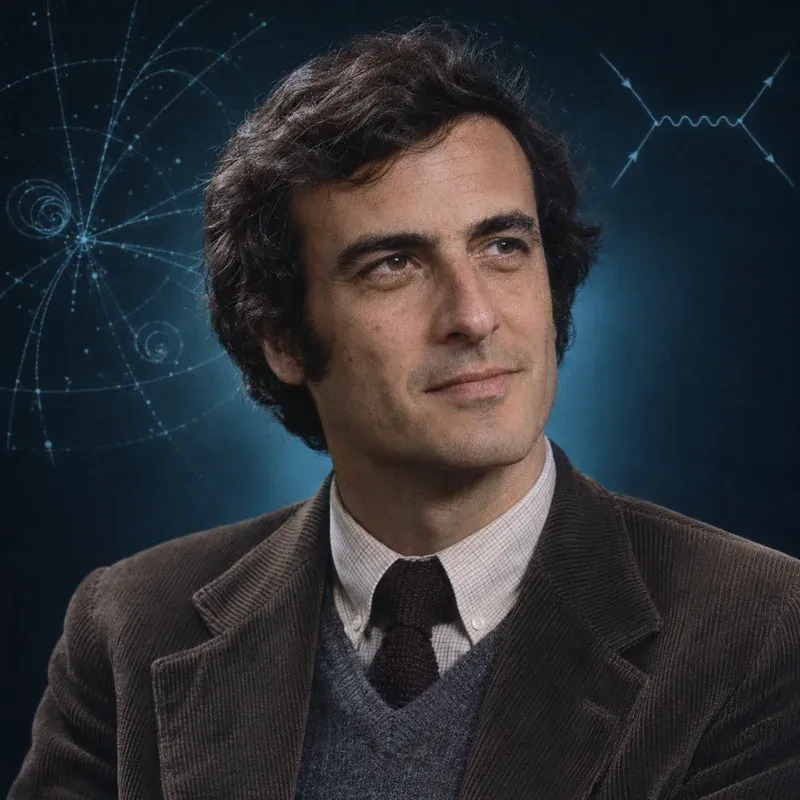
 Illustration
Álvaro De Rújula
In 1983, with Sheldon Glashow, Robert R. Wilson and Georges Charpak, De Rújula published 'Neutrino exploration of the Earth', a detailed study of using intense man-made neutrino beams for geotomography, mineral and oil prospecting and communication through the Earth. It followed the first neutrino-tomography proposals of Placci and Zavattini (1973) and Volkova and Zatsepin (1974).
- Born
- 29 January 1944
Madrid, Spain - Nationality
- Spanish
- Field
- Theoretical particle physics
- Institutions
- Complutense University of Madrid (PhD 1968), CERN, Harvard University, Boston University
Career
Álvaro De Rújula took his PhD in theoretical physics at the Complutense University of Madrid in 1968. He was a visiting scientist at CERN (1969–1971), at Orsay and at the IHES near Paris, and from 1972 to 1978 held positions up to associate professor at Harvard, where he worked closely with Sheldon Glashow and Howard Georgi. He joined the CERN staff in 1977, was professor at Boston University from 1985, directed the CERN Theory Division from 1996 to 1999, and since 2009 has been associated with IFT (UAM/CSIC) and CIEMAT in Madrid. He was elected to the Academia Europaea in 1991.
Charm and the quark model
In 1975, shortly after the discovery of the J/ψ, De Rújula and Glashow interpreted it as a bound state of a charm quark and its antiquark and predicted the spectrum of charmed states. With Georgi and Glashow he computed hadron masses from quantum chromodynamics in 'Hadron masses in a gauge theory' (1975). This work helped establish the quark model and the Standard Model.
Neutrino contributions
In 1981 he proposed a new way to measure the electron neutrino mass: measuring the total energy released in the electron capture of holmium-163 in a calorimeter, then examining the shape of the spectrum near its endpoint (with Maurizio Lusignoli, 1982). Because holmium-163 releases only about 2.8 keV, the effect of a small neutrino mass is relatively large. This idea is the basis of today's ECHo and HOLMES experiments.
In 1983, with Glashow, Robert R. Wilson and Georges Charpak, he published 'Neutrino exploration of the Earth' (Phys. Rep. 99, 341). The study examined how intense, high-energy neutrino beams could be sent through the planet for neutrino tomography, for prospecting for oil and minerals, and for communication through the Earth. It followed the first tomography proposals of Placci and Zavattini (1973) and of Volkova and Zatsepin (1974).
In 1998, with Belén Gavela and Pilar Hernández, he analysed the physics of a neutrino factory, an accelerator neutrino source based on a muon storage ring. They showed that 'wrong-sign' muons in a distant detector would be a clean signature of oscillations and a route to the mixing angles and CP-violating phase.
Known for
- Charmonium phenomenology
- Neutrino exploration of the Earth (1983, with Glashow, Wilson and Charpak)
- Director of CERN Theory Division (1996–1999)
Chronology
- 1968PhD, Complutense University of Madrid
- 1977CERN staff member
- 1983'Neutrino exploration of the Earth' (Phys. Rep.)
- 1991Member of Academia Europaea
- 1996Director of CERN Theory Division (to 1999)
Original papers
- A. De Rújula, S. L. Glashow, R. R. Wilson and G. Charpak, Neutrino exploration of the Earth, Phys. Rep. 99, 341 (1983)
Connected people
Frequently asked questions
What did De Rújula propose for measuring neutrino mass?
He suggested a calorimetric measurement of the electron capture of holmium-163, where the spectrum near the endpoint reveals the neutrino mass. ECHo and HOLMES follow this approach.
What is 'Neutrino exploration of the Earth'?
It is a 1983 study by De Rújula, Glashow, Wilson and Charpak on using artificial neutrino beams to image the Earth's interior, search for resources and transmit signals through rock.
Mentioned in 6 pages
Last updated: · Editorial standard
Cite this page
Text
Neutrino Atlas (2026). “Álvaro De Rújula”. Retrieved 22 November 2026, from https://neutrino-atlas.com/people/alvaro-de-rujula/BibTeX
@misc{neutrinoatlas2026peoplealvaroderujula,
  title        = {Álvaro De Rújula},
  author       = {{Neutrino Atlas}},
  year         = {2026},
  url          = {https://neutrino-atlas.com/people/alvaro-de-rujula/},
  note         = {Accessed 2026-11-22},
  language     = {english}
}