ESSnuSB
Proposed European long-baseline experiment that would send a neutrino superbeam from the ESS in Lund to a mine 360 km away to measure δCP.
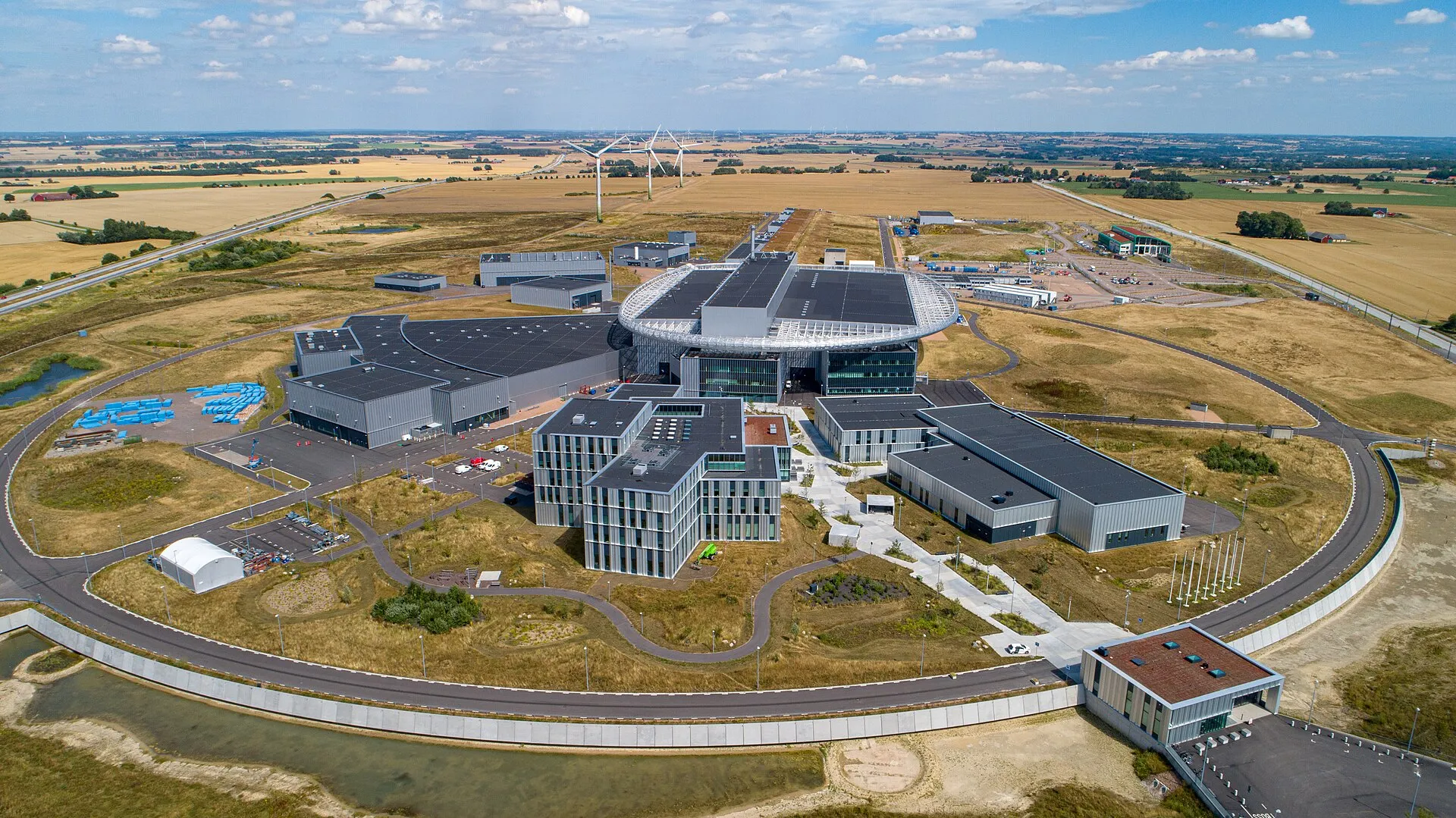
ESSnuSB would double the power of the European Spallation Source linac to 10 MW, using 5 MW at 2.5 GeV to drive four target–horn systems. A far detector of two water Cherenkov tanks of about 270 kt each in the Zinkgruvan mine, 360 km away, would sit near the second oscillation maximum. The 2022 conceptual design report projects δCP precision better than 8° after ten years.
Compare all experiments → · World map →
In plain words
Whether neutrinos and antineutrinos oscillate differently, a sign of leptonic CP violation, is one of the main open questions in the field. DUNE and Hyper-Kamiokande will measure it near the first oscillation maximum. ESSnuSB proposes a different approach: use the very intense proton linac being built for neutron science in Lund, Sweden, and place a giant water detector so far away that the neutrinos arrive near the second maximum, where the difference between neutrinos and antineutrinos is about 2.5 times larger.
How the facility would work
The European Spallation Source linac is designed for 5 MW at 2 GeV. ESSnuSB would raise the energy to 2.5 GeV, double the pulse rate from 14 to 28 Hz, and accelerate H⁻ ions in the extra pulses. An accumulator ring would compress each 2.86 ms pulse into four 1.2 μs bunches, sent to four identical targets with magnetic horns to share the heat load. A near detector complex with a water Cherenkov detector, a fine-grained scintillator detector and an emulsion detector would measure the unoscillated beam and cross sections. The far detector, two water Cherenkov tanks of about 270 kt each, would be built about 1 km underground in the Zinkgruvan mine, 360 km from Lund.
Projected performance
With five years of neutrino and five years of antineutrino running, the conceptual design report published in 2022 projects that CP conservation could be excluded at 5σ for about 72% of possible δCP values, with a precision on δCP better than 8° across the full range. Working at the second maximum also reduces the influence of matter effects and of the unknown mass ordering on the CP measurement.
Status today
ESSnuSB is a design study funded by the European Union. The follow-up ESSnuSB+ project (2023–2026) studies low-energy beam facilities for cross-section measurements between 0.2 and 0.6 GeV and a short-baseline option for sterile neutrinos. The facility has not been approved for construction.
Frequently asked questions
Why the second oscillation maximum?
There the CP-violating difference between neutrinos and antineutrinos is larger relative to the total rate, which reduces the impact of systematic uncertainties.
Would ESSnuSB affect neutron science at ESS?
The plan is to add pulses so that the neutron and neutrino programmes each receive 5 MW.
Original papers
- ProposalE. Baussan et al. (ESSnuSB Collaboration), A very intense neutrino super beam experiment for leptonic CP violation discovery based on the European spallation source linac, Nucl. Phys. B 885, 127 (2014)arXiv:1309.7022
- ProposalA. Alekou et al. (ESSnuSB Collaboration), The European Spallation Source neutrino super-beam conceptual design report, Eur. Phys. J. Spec. Top. 231, 3779 (2022)DOI 10.1140/epjs/s11734-022-00664-warXiv:2206.01208
Related terms
Latest research on this topic
- Solar Neutrinos at the ESSnuSB experimentESSnuSB Collaboration · 12 November 2026
- An Analytical Model for Fast Design Optimization and Performance Studies of nuSTORMESSnuSB Collaboration · 11 November 2026
- Exploring ESSνSB near water Cherenkov detector designs through Graph Neural Network flavour identificationESSnuSB Collaboration · 24 August 2026
- Resolving Lorentz-violating new physics at ESSnuSB using high-statistics complementarity with T2HKBora, Himanshu, Dutta, Debajyoti, Medhi, Abinash et al. · 24 July 2026
- Study of Supernova Neutrinos at ESSnuSBESSnuSB Collaboration · 25 June 2026
- The ESSnuSB ExperimentGhosh, Monojit · 16 June 2026
Last updated: · Editorial standard
Cite this page
Text
Neutrino Atlas (2026). “ESSnuSB”. Retrieved 22 November 2026, from https://neutrino-atlas.com/terms/essnusb/BibTeX
@misc{neutrinoatlas2026termsessnusb,
  title        = {ESSnuSB},
  author       = {{Neutrino Atlas}},
  year         = {2026},
  url          = {https://neutrino-atlas.com/terms/essnusb/},
  note         = {Accessed 2026-11-22},
  language     = {english}
}