OPERA
A Gran Sasso emulsion experiment that observed νµ → ντ oscillation by directly detecting tau leptons.
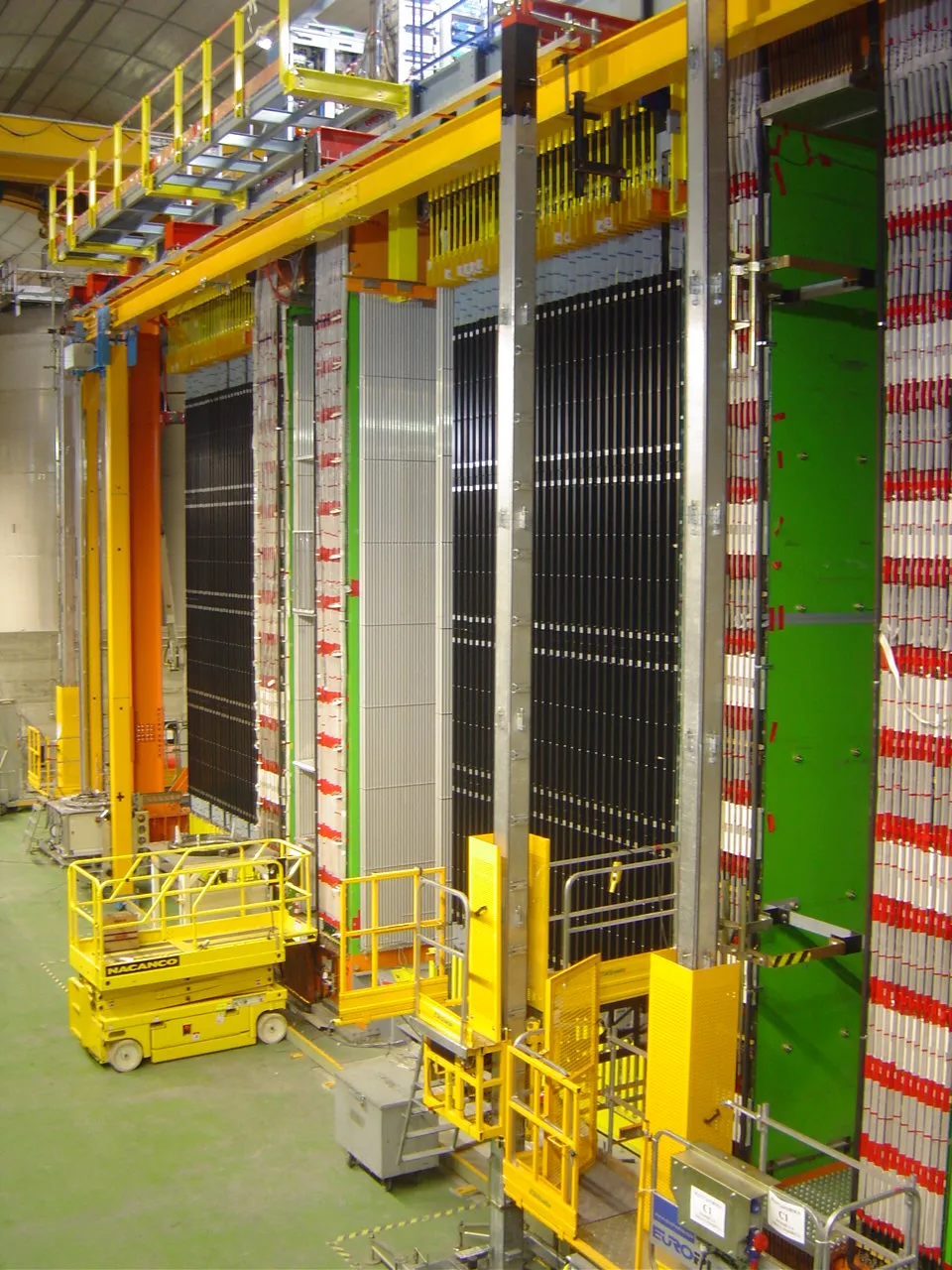
Using the CNGS beam from CERN (730 km), OPERA's 1.25 kt target of about 150,000 lead–emulsion bricks recorded 10 ντ candidates, establishing ντ appearance at 6.1σ (2018). In 2011 it reported an apparent faster-than-light neutrino speed, later traced to a loose fibre-optic connector.
Compare all experiments → · World map →
In plain words
By 2000 it was clear that muon neutrinos from the atmosphere vanish, and the most likely explanation was that they turn into tau neutrinos. Nobody had seen it happen. OPERA was designed to catch the tau lepton that such a neutrino produces, a particle that lives for less than a trillionth of a second and travels only about a millimetre before it decays.
How the detector works
The CNGS beam from CERN carried muon neutrinos with a mean energy of about 17 GeV, well above the threshold for producing tau leptons, 730 km to Hall C of the Gran Sasso laboratory. The target consisted of about 150,000 "bricks", each a stack of 56 one-millimetre lead plates interleaved with 57 sheets of nuclear emulsion, weighing 8.3 kg; together about 1.25 kilotonnes. Walls of plastic scintillator between the bricks located the interaction, a robot extracted the brick, and automated microscopes scanned the emulsion with sub-micrometre precision. Two magnetic spectrometers measured muon charge and momentum. A tau showed up as a short track with a characteristic kink or a decay into several particles a fraction of a millimetre from the primary vertex.
Key results
Beam ran from 2008 to 2012, delivering about 1.8 × 10²⁰ protons on target. The first tau candidate was reported in 2010. With five candidates the collaboration claimed discovery at 5.1σ in 2015, and the final analysis in 2018 found 10 candidates on an expected background of about 2, establishing νµ → ντ appearance at 6.1σ. OPERA also published a measurement of Δm²₃₂ from tau appearance and searches for νµ → νe. In 2011 it reported an apparent faster-than-light neutrino speed, later traced to equipment faults.
Why it matters for neutrino physics
OPERA closed the logical loop of atmospheric oscillation: the missing muon neutrinos really do become tau neutrinos. Its emulsion techniques, developed by the Nagoya group of Kimio Niwa and refined after DONUT, set the standard for tau identification. Antonio Ereditato was spokesperson until 2012.
Frequently asked questions
Why so few tau events?
Tau neutrinos interact rarely at these energies, only a small fraction of muon neutrinos oscillate over 730 km at 17 GeV, and tau decays must be found and reconstructed in the emulsion.
Did Super-Kamiokande not already see tau neutrinos?
Super-K found a statistical excess of tau-like atmospheric events, but OPERA identified individual tau decays event by event.
Original papers
- First resultN. Agafonova et al. (OPERA Collaboration), Observation of a first ντ candidate event in the OPERA experiment in the CNGS beam, Phys. Lett. B 691, 138 (2010)DOI 10.1016/j.physletb.2010.06.022
- DiscoveryN. Agafonova et al. (OPERA Collaboration), Discovery of τ Neutrino Appearance in the CNGS Neutrino Beam with the OPERA Experiment, Phys. Rev. Lett. 115, 121802 (2015)DOI 10.1103/PhysRevLett.115.121802
- Final resultN. Agafonova et al. (OPERA Collaboration), Final Results of the OPERA Experiment on ντ Appearance in the CNGS Neutrino Beam, Phys. Rev. Lett. 120, 211801 (2018)DOI 10.1103/PhysRevLett.120.211801arXiv:1804.04912
Go deeper
- OPERA Faster-than-Light anomalyA 2011 measurement that suggested neutrinos arrived about 60 ns early, later explained by equipment faults.
Related terms
People
Latest research on this topic
- Case Study: The Neutrinos That Challenged EinsteinA critical reflection on the OPERA neutrino anomaly and its scientificRota, Luciano M.R. · 16 March 2026
- Report on Opera-3D hands-on session in the 7th International School on Beam Dynamics and Accelerator Technology (ISBA24)Sunwong, Prapaiwan, Tangyotkhajorn, Warissara · 5 November 2025
On the timeline
- 2010OPERA sees the first tau from oscillation
- 2011OPERA neutrino-speed anomaly and its resolution
- 2015OPERA establishes tau-neutrino appearance
Mentioned in 47 pages
Lessons 4
Milestones 6
People 9
- Antonino Zichichi
- Antonio Ereditato
- Byron G. Lundberg
- Carlo Rubbia
- Kimio Niwa
- Klaus Winter
- Koichi Kodama
- Luciano Maiani
1 more
Terms 26
- Accelerator Long-baseline experiments
- Accelerator neutrino beams
- Accelerator neutrinos
- Appearance measurement
- Appearance vs disappearance
- Charged-current interaction
- CHORUS (WA95)
- CNGS (CERN Neutrinos to Gran Sasso)
18 more
- DONUT
- Double Bang
- Energy-momentum relation
- ICARUS
- Laboratori Nazionali del Gran Sasso (LNGS)
- Lorentz and CPT violation in neutrinos
- LVD (Large Volume Detector)
- Major neutrino beamlines
- Neutrino communication
- Neutrino speed and time of flight
- Nuclear emulsion
- OPERA Faster-than-Light anomaly
- PMNS unitarity tests
- Statistical significance (σ)
- Statistics & inference
- Systematic uncertainty
- Tau neutrino
- Tau neutrino appearance
Last updated: · Editorial standard
Cite this page
Text
Neutrino Atlas (2026). “OPERA”. Retrieved 22 November 2026, from https://neutrino-atlas.com/terms/opera/BibTeX
@misc{neutrinoatlas2026termsopera,
  title        = {OPERA},
  author       = {{Neutrino Atlas}},
  year         = {2026},
  url          = {https://neutrino-atlas.com/terms/opera/},
  note         = {Accessed 2026-11-22},
  language     = {english}
}