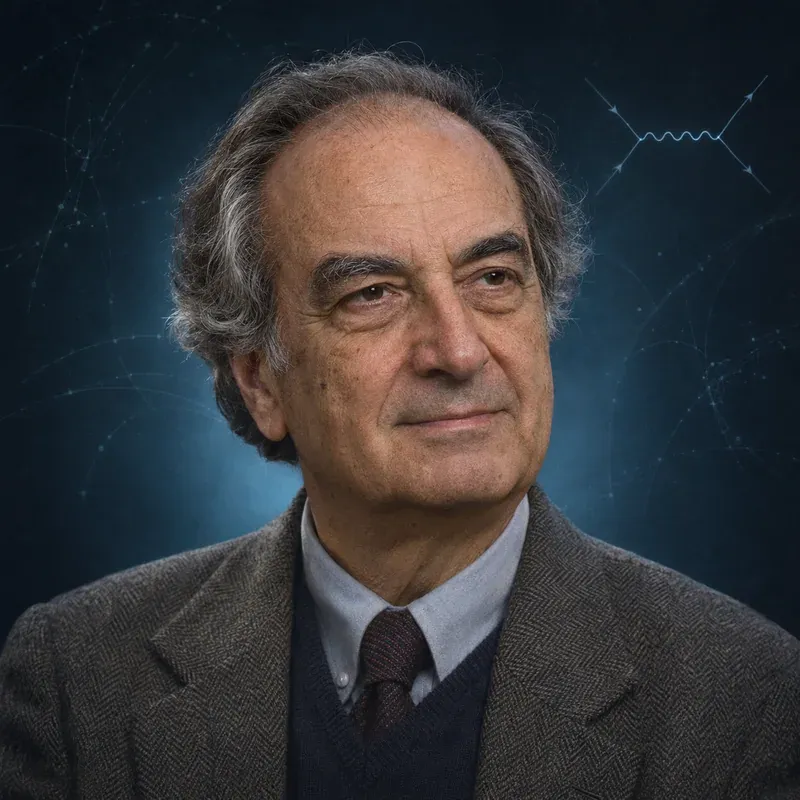
 Illustration
Luciano Maiani
With Sheldon Glashow and John Iliopoulos, Maiani showed in 1970 that a fourth quark, charm, pairs with the strange quark so that weak neutral currents cannot change quark flavour at lowest order. This made neutral currents of the kind later observed in neutrino scattering compatible with the strong suppression of strangeness-changing neutral decays, and it predicted that neutrinos would produce charmed particles, seen as opposite-sign dimuon events in neutrino beams. The same mechanism explains why lepton-flavour-violating decays such as μ → eγ are tiny when the only new ingredient is light neutrino masses. As CERN Director-General he oversaw the start of the CNGS beam to Gran Sasso, and in 2013 he received the Bruno Pontecorvo Prize for contributions to neutrino and weak-interaction physics.
- Born
- 16 July 1941
Rome, Italy - Nationality
- Italian
- Field
- Theoretical particle physics
- Institutions
- Sapienza University of Rome, Istituto Superiore di Sanità, Rome, Harvard University (Lyman Laboratory), INFN (president 1993–1998)
Education and early work
Luciano Maiani was born in Rome in 1941 and studied physics at the Sapienza University of Rome, graduating in 1964. He began his research at the Istituto Superiore di Sanità in Rome and worked closely with Nicola Cabibbo, whose description of quark mixing in the weak current was the starting point of much of his later work. In 1969 he went as a postdoctoral fellow to the Lyman Laboratory at Harvard.
The GIM mechanism
With only three quarks, the Cabibbo theory had a problem. The weak current couples the up quark to a mixture of down and strange, and loop processes then generate neutral currents that change strangeness, for example in the decay of the long-lived neutral kaon into two muons. The measured rate was far smaller than such estimates. At Harvard, Maiani, Sheldon Glashow and John Iliopoulos proposed in 1970 a fourth quark, charm, coupled to the orthogonal combination of down and strange. The contributions of the up and charm quarks then cancel, exactly if their masses were equal and approximately otherwise. The weak neutral current becomes flavour-diagonal, and strangeness-changing neutral processes are pushed to higher order.
The proposal mattered for neutrino physics in two ways. It made the electroweak theory consistent with the hadronic neutral currents that Gargamelle found in 1973, and Maiani later recalled hearing the first muonless neutrino events presented in Rome. It also predicted that neutrinos hitting nuclei would produce charmed particles; opposite-sign dimuon events in Fermilab and CERN neutrino beams and the discovery of the J/ψ in 1974 confirmed charm. In the lepton sector the same mechanism, applied to light neutrinos in the PMNS framework, is why lepton flavour violation such as μ → eγ is predicted at an unobservably small rate unless new particles exist.
CP violation and QCD
In 1974, with Guido Altarelli, Maiani showed how gluon exchange in quantum chromodynamics enhances non-leptonic weak decays. In 1976 he analysed CP violation in the six-quark Kobayashi–Maskawa theory and noted that it predicts a very small electric dipole moment of the neutron. In the 1980s he was among those who pioneered lattice QCD calculations of weak decay constants.
Leadership
Maiani became professor in Rome in 1976, was president of the Italian National Institute for Nuclear Physics (INFN) from 1993 to 1998 and Director-General of CERN from 1999 to 2003. During his term LEP was closed in 2000 to make way for the LHC, and the CNGS beam from CERN to Gran Sasso, built to observe tau neutrinos with OPERA, was approved and constructed. He later served as president of the National Research Council of Italy. With Glashow and Iliopoulos he received the Sakurai Prize in 1987, with Iliopoulos the ICTP Dirac Medal in 2007, and in 2013 the Bruno Pontecorvo Prize.
Known for
- GIM mechanism and the prediction of the charm quark (1970, with Glashow and Iliopoulos)
- Analysis of CP violation in the six-quark theory (1976)
- QCD enhancement of non-leptonic weak decays (1974, with Altarelli)
- Director-General of CERN during LHC construction and the approval of CNGS
Chronology
- 1964Physics degree in Rome
- 1970GIM mechanism with Glashow and Iliopoulos
- 1976Professor of theoretical physics in Rome
- 1987Sakurai Prize, with Glashow and Iliopoulos
- 1993President of INFN (to 1998)
- 1999Director-General of CERN (to 2003)
- 2013Bruno Pontecorvo Prize
Original papers
- S. L. Glashow, J. Iliopoulos, L. Maiani, Weak interactions with lepton-hadron symmetry, Phys. Rev. D 2, 1285 (1970)DOI 10.1103/PhysRevD.2.1285
- L. Maiani, The charm of theoretical physics (1958–1993), arXiv:1707.01833arXiv:1707.01833
Experiments
Connected people
Frequently asked questions
What is the GIM mechanism?
The cancellation, proposed by Glashow, Iliopoulos and Maiani in 1970, that keeps weak neutral currents from changing quark flavour at lowest order. It required a fourth quark, charm, discovered in 1974.
Why did Maiani receive the Pontecorvo Prize?
The 2013 prize recognised his contributions to particle physics, in particular to neutrino physics and the physics of the weak interaction.
Mentioned in 1 page
People 1
Last updated: · Editorial standard
Cite this page
Text
Neutrino Atlas (2026). “Luciano Maiani”. Retrieved 22 November 2026, from https://neutrino-atlas.com/people/luciano-maiani/BibTeX
@misc{neutrinoatlas2026peoplelucianomaiani,
  title        = {Luciano Maiani},
  author       = {{Neutrino Atlas}},
  year         = {2026},
  url          = {https://neutrino-atlas.com/people/luciano-maiani/},
  note         = {Accessed 2026-11-22},
  language     = {english}
}