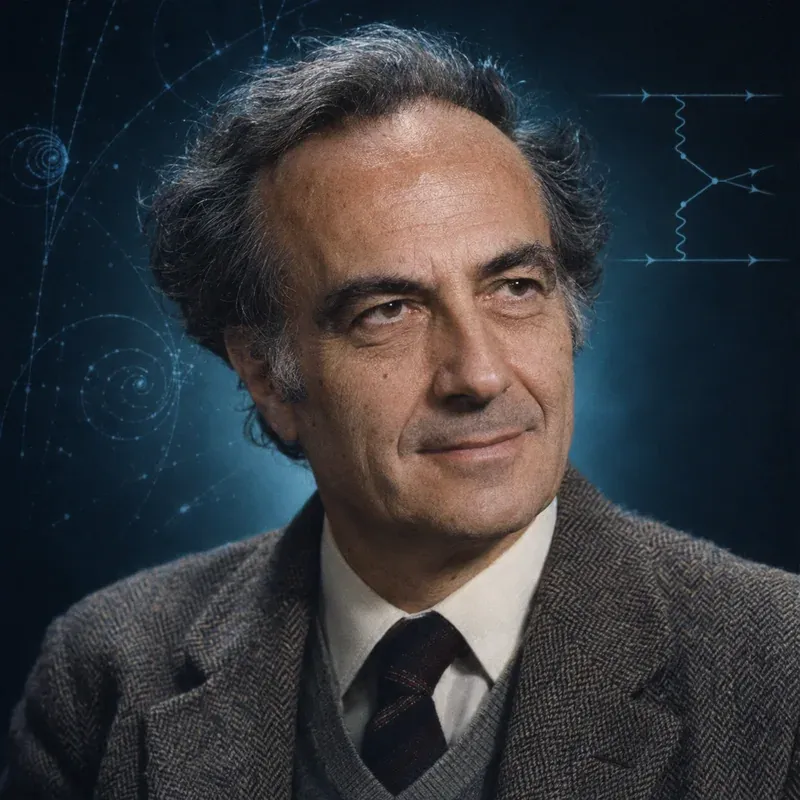
 Illustration
Ettore Fiorini
In 1967 Fiorini and colleagues made the first search for neutrinoless double beta decay of ⁷⁶Ge using germanium diodes as both source and detector, the technique later used by Heidelberg–Moscow and GERDA. He helped develop the Gargamelle bubble chamber with André Lagarrigue, whose neutrino runs discovered weak neutral currents, directed the NUSEX experiment at Mont Blanc, contributed to GALLEX's observation of pp solar neutrinos, and pioneered ¹³⁰Te bolometers for double beta decay (CUORICINO, CUORE) at Gran Sasso.
- Born
- 19 April 1933
Verona, Italy - Died
- 9 April 2023
Milan, Italy - Nationality
- Italian
- Field
- Experimental particle and nuclear physics
- Institutions
- University of Milan, Duke University, CERN, University of Milano-Bicocca
Early life and education
Ettore Fiorini was born in Verona in 1933, the son of a surgeon. He studied physics at the University of Milan and graduated in 1955. From 1959 to 1969 he worked as a research associate at Duke University in the United States, before returning to Milan, where he stayed for the rest of his career apart from a period at CERN from 1979 to 1982. He later held the chair of nuclear and subnuclear physics at the University of Milano-Bicocca and became a corresponding member of the Accademia dei Lincei in 1988.
Path to neutrino physics
Fiorini's career touched almost every branch of experimental neutrino physics, but one question ran through it for more than fifty years: is lepton number conserved? A positive answer to the search for neutrinoless double beta decay would show that the neutrino is its own antiparticle, a Majorana neutrino. Early searches used separate source foils and detectors, which limited the amount of isotope.
Key contributions
In 1967 Fiorini and his Milan colleagues had the decisive idea of making the source and the detector the same object. Natural germanium contains about 8 percent of the double-beta isotope ⁷⁶Ge, and germanium crystals are also excellent semiconductor detectors with very sharp energy resolution. A neutrinoless decay inside the crystal would appear as a narrow peak at the Q-value of 2039 keV. Their paper in Physics Letters B, ‘A search for lepton non-conservation in double beta decay with a germanium detector’, introduced the method that later carried Heidelberg–Moscow, GERDA and LEGEND (see germanium detectors).
In the early 1970s Fiorini worked with André Lagarrigue on the Gargamelle heavy-liquid bubble chamber at CERN. Its neutrino exposures produced the 1973 discovery of weak neutral currents, a key confirmation of the electroweak theory. In the 1980s he directed NUSEX, a proton-decay experiment in the Mont Blanc tunnel, and then joined the move of Italian astroparticle physics to the new Gran Sasso laboratory. There he contributed to GALLEX, led by Till Kirsten, which observed the low-energy pp neutrinos from the first step of solar fusion.
His most lasting technical legacy is the cryogenic bolometer. Instead of collecting charge, a bolometer measures the tiny temperature rise that a particle produces in a crystal cooled to about 10 millikelvin. Fiorini's group chose tellurium dioxide crystals, because ¹³⁰Te has a high natural abundance of about 34 percent and needs no costly enrichment. The approach grew via CUORICINO to CUORE, a ton-scale array of 988 crystals at Gran Sasso, and it continues in the planned CUPID experiment.
Later work and legacy
Fiorini also applied low-background techniques outside particle physics. With neutron activation analysis he showed that hair samples of Napoleon did not contain enough arsenic to support the poisoning theory, and he arranged for ancient Roman lead, whose radioactivity had decayed over two millennia, to shield CUORE. He received the Enrico Fermi Prize of the Italian Physical Society in 2007 for his work on neutral currents and solar neutrinos and the Bruno Pontecorvo Prize in 2012 for his work on double beta decay. He died in Milan in April 2023, aged 89. His germanium method was later used by Hans Klapdor-Kleingrothaus.
Known for
- First germanium-detector search for neutrinoless double beta decay of ⁷⁶Ge (1967)
- Gargamelle bubble chamber and weak neutral currents
- Director of NUSEX proton-decay experiment at Mont Blanc
- GALLEX solar neutrinos
- Tellurium cryogenic bolometers (CUORICINO, CUORE)
Chronology
- 1955Graduates from the University of Milan
- 1959Research associate at Duke University (to 1969)
- 1967First ⁷⁶Ge double beta decay search with Ge diode
- 1973Gargamelle neutral currents
- 1979At CERN (1979–1982)
- 2007Enrico Fermi Prize (Italian Physical Society)
- 2012Bruno Pontecorvo Prize
Original papers
- E. Fiorini, A. Pullia, G. Bertolini, F. Cappellani, G. Restelli, A search for lepton non-conservation in double beta decay with a germanium detector, Phys. Lett. B 25, 602 (1967)DOI 10.1016/0370-2693(67)90127-X
Experiments
Connected people
- André Lagarrigue
- Hans Volker Klapdor-Kleingrothaus
- Till A. Kirsten
- Stefan Schönert
- Antonino Zichichi
- Luciano Maiani
- Stuart Jay Freedman
Frequently asked questions
What was Ettore Fiorini's most important idea?
Using a germanium crystal as both the source of the double-beta isotope ⁷⁶Ge and the detector that records the decay. This ‘source equals detector’ principle, first applied in 1967, still underlies the most sensitive germanium searches for neutrinoless double beta decay.
Why did Fiorini use tellurium in his bolometers?
The isotope ¹³⁰Te makes up about a third of natural tellurium, so large detectors can be built without enrichment, and tellurium dioxide crystals work well as bolometers at millikelvin temperatures. This made ton-scale experiments such as CUORE affordable.
Did Fiorini win a Nobel Prize?
No. His main honours were the Enrico Fermi Prize of the Italian Physical Society (2007) and the Bruno Pontecorvo Prize (2012).
On the timeline
- 1967Germanium detector searches for 0νββ
- 1973Gargamelle discovers weak neutral currents
- 2025CUORE completes two tonne-years without a signal
Mentioned in 15 pages
Lessons 1
Milestones 4
People 6
Last updated: · Editorial standard
Cite this page
Text
Neutrino Atlas (2026). “Ettore Fiorini”. Retrieved 22 November 2026, from https://neutrino-atlas.com/people/ettore-fiorini/BibTeX
@misc{neutrinoatlas2026peopleettorefiorini,
  title        = {Ettore Fiorini},
  author       = {{Neutrino Atlas}},
  year         = {2026},
  url          = {https://neutrino-atlas.com/people/ettore-fiorini/},
  note         = {Accessed 2026-11-22},
  language     = {english}
}