2025Experiment
CUORE completes two tonne-years without a signal
In Science in October 2025, CUORE at Gran Sasso reported its analysis of more than two tonne-years of tellurium dioxide exposure collected between 2017 and 2023. It found no neutrinoless double beta decay and set a lower half-life limit for tellurium-130 of 3.5 × 10²⁵ years, the most stringent for this isotope. Nearly 1,000 cryogenic bolometers ran stably for five years, showing that the technique scales for its successor CUPID.
- Date
- 17 October 2025
- Kind of event
- Experiment
- People involved
- Ettore Fiorini
- Experiments
- CUORE, CUPID, Laboratori Nazionali del Gran Sasso (LNGS)
The situation before
Neutrinoless double beta decay would violate lepton number and show that neutrinos are their own antiparticles. Tellurium-130 is an attractive isotope: it makes up about a third of natural tellurium, and its decay energy of about 2.53 MeV lies above most natural gamma backgrounds. In the 1980s Ettore Fiorini proposed reading out tellurium dioxide crystals as bolometers, calorimeters that register a decay as a tiny temperature rise.
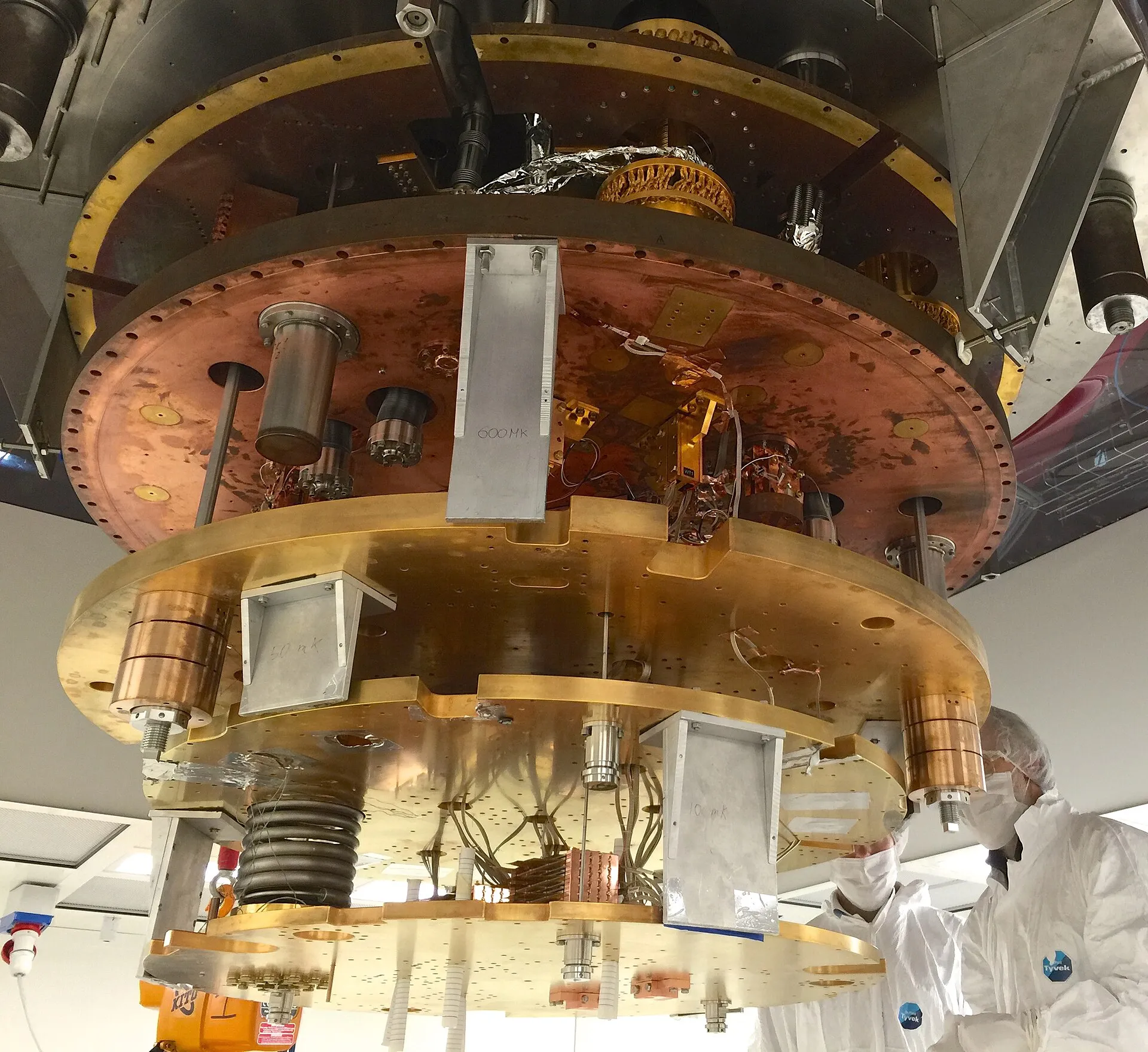
CUORE, in the Gran Sasso underground laboratory in Italy, scaled this idea to 988 crystals with about 742 kg of tellurium dioxide, cooled to about 10 millikelvin. It began data taking in 2017. In April 2022 it published a half-life limit of 2.2 × 10²⁵ years from its first tonne-year of exposure.
What happened
After early interruptions to optimise the cryogenics, CUORE collected data continuously from 2019 with a duty cycle above 90 percent. On 17 October 2025 the collaboration published in Science "Constraints on lepton number violation with the 2 tonne·year CUORE dataset", based on more than two tonne-years of tellurium dioxide exposure accumulated from 2017 to mid-2023.
No signal appeared at the decay energy. The new limit is about 1.6 times stronger than the 2022 value and the most stringent ever reached for tellurium-130. Because the exposure in the isotope itself is smaller than in the largest xenon experiments, the corresponding limit on the effective Majorana mass is weaker than KamLAND-Zen's, but it is an independent test with a different isotope and different nuclear physics (see half-life limit).
What it shows
The result is as much a technical as a physics milestone. The collaboration described five years of stable operation of nearly 1,000 detectors at millikelvin temperatures. In the words of the paper, the tools and techniques developed "demonstrate crucial infrastructure for a future-generation experiment capable of searching for 0νββ across multiple isotopes". The search is also a test of lepton number violation in general.
Consequences
The main background in CUORE came from alpha particles depositing part of their energy on crystal surfaces. Its successor CUPID is designed to reuse the CUORE cryostat with lithium molybdate crystals enriched in molybdenum-100, each viewed by a light detector so that alpha events can be rejected. CUORE's long, stable run is the main evidence that tonne-scale bolometer arrays can work for years, which CUPID depends on.
Frequently asked questions
What did CUORE report in 2025?
No neutrinoless double beta decay in more than two tonne-years of tellurium dioxide data, and a lower half-life limit for tellurium-130 of 3.5 × 10²⁵ years.
Why is the result important for CUPID?
Nearly 1,000 cryogenic bolometers ran stably for five years, showing that the technique works at the tonne scale. CUPID will reuse the CUORE cryostat.
Is CUORE's limit stronger than KamLAND-Zen's?
Not in terms of the neutrino mass, because its isotope exposure is smaller, but it tests a different isotope independently.
Concepts
- Cryogenic bolometers
- Neutrinoless double beta decay
- Half-life limit & effective Majorana mass
- Lepton number violation
Last updated: · Editorial standard
Cite this page
Text
Neutrino Atlas (2026). “2025: CUORE completes two tonne-years without a signal”. Retrieved 22 November 2026, from https://neutrino-atlas.com/timeline/2025-cuore-two-tonne-years/BibTeX
@misc{neutrinoatlas2026ne2025cuoretwotonneyears,
  title        = {2025: CUORE completes two tonne-years without a signal},
  author       = {{Neutrino Atlas}},
  year         = {2026},
  url          = {https://neutrino-atlas.com/timeline/2025-cuore-two-tonne-years/},
  note         = {Accessed 2026-11-22},
  language     = {english}
}