2025Experiment
JUNO's first results set precision records
On 19 November 2025, less than three months after starting, JUNO presented its first physics results from 59 days of data. It measured the solar oscillation parameters θ₁₂ and Δm²₂₁ with reactor antineutrinos to a precision 1.6 times better than all previous experiments combined. The result confirmed a mild 1.5σ tension between solar and reactor determinations of Δm²₂₁. It demonstrated that the detector performs as designed for the mass-ordering measurement. The analysis was published as a cover article in Nature on 10 June 2026.
- Date
- 19 November 2025
- Kind of event
- Experiment
- People involved
- Wang Yifang, Cao Jun (Jun Cao)
- Experiments
- JUNO
The situation before
The two "solar" oscillation parameters, the mixing angle θ12 and the small mass splitting Δm²21, had been measured in two independent ways. Solar neutrino experiments such as SNO and Super-Kamiokande constrain them through matter effects in the Sun. The reactor experiment KamLAND measured them directly from the oscillation of reactor antineutrinos over about 180 km. The two methods agreed on θ12 but differed mildly, by about 1.5σ, on Δm²21, a long-standing curiosity sometimes called the solar tension.
JUNO, which began physics data taking on 26 August 2025, was designed for a different main target, the mass ordering. But its baseline of about 52.5 km sits near the first maximum of the slow solar oscillation, so it was expected to measure θ12 and Δm²21 with unprecedented precision early on.
What happened
On 19 November 2025, at a press conference in Jiangmen, the collaboration presented its first physics results, less than three months after the start. The analysis used 59.1 days of data from 26 August to 2 November 2025, with 2,379 identified reactor antineutrino candidates from inverse beta decay.
The precision on both parameters was 1.6 times better than that of all previous measurements combined. The Δm²21 value agrees with KamLAND and confirms its difference from the solar determination at the same mild 1.5σ level.
Reaction
Spokesperson Wang Yifang said: "Achieving such precision within only two months of operation shows that JUNO is performing exactly as designed". He added: "With this level of accuracy, JUNO will soon determine the neutrino mass ordering". IHEP director and deputy spokesperson Cao Jun stressed that JUNO "will continue to produce important results and train new generations of physicists for decades to come".
Why it matters
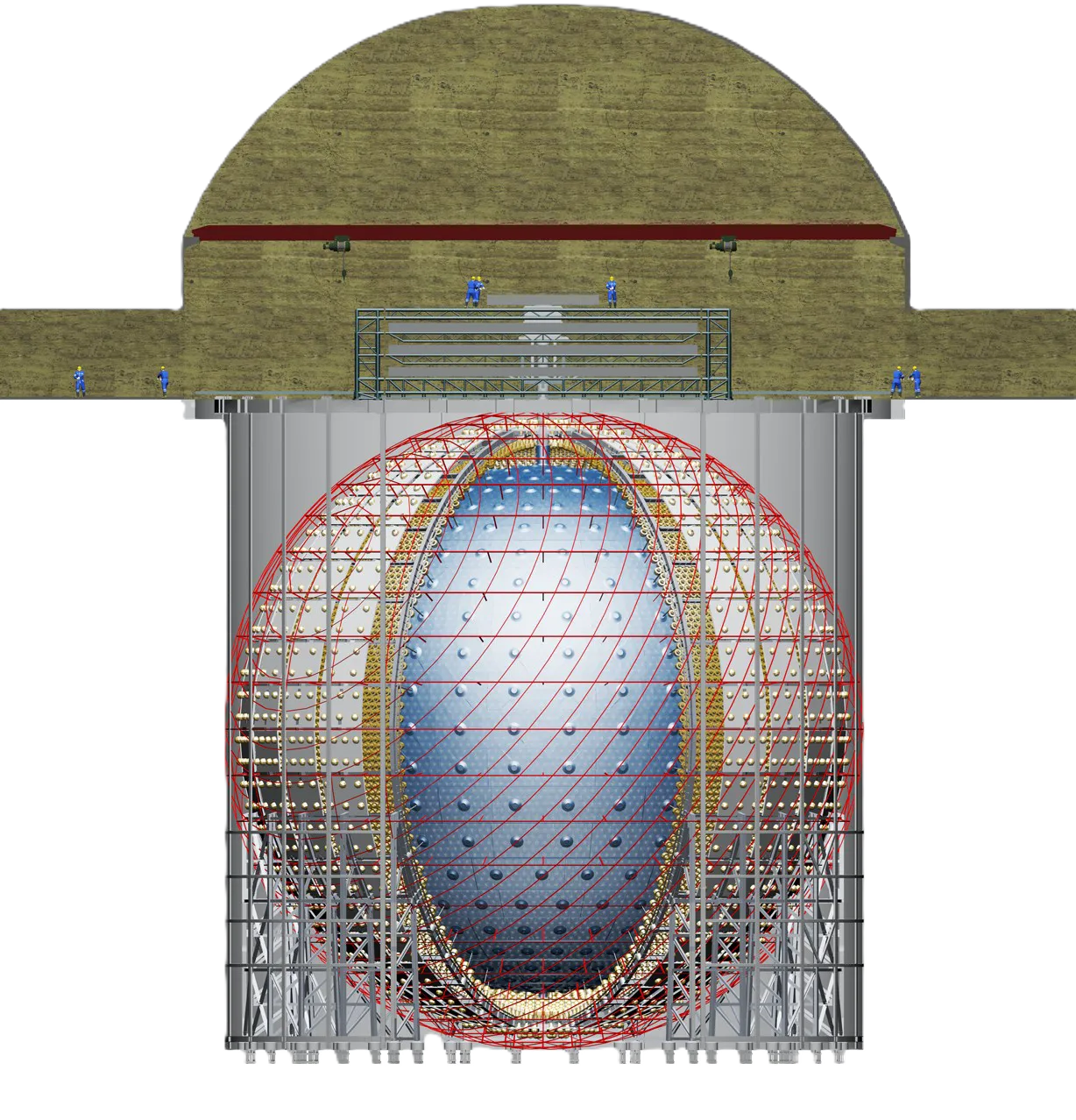
The speed of the result showed that the 20,000-tonne detector, its photomultipliers and calibration systems work as planned, which is the precondition for the subtle spectral analysis that the ordering requires. The improved solar parameters also feed directly into global fits and into predictions for solar neutrino experiments and neutrinoless double beta decay.
The persistent difference in Δm²21 is now a sharper question. JUNO can address it from both sides, measuring reactor antineutrinos and, in the coming years, boron-8 solar neutrinos in the same detector. If the tension survives, it could point to new effects in solar neutrino propagation; if it fades, it will have been a statistical fluctuation.
Frequently asked questions
When did JUNO publish its first results?
On 19 November 2025, based on 59.1 days of data taken between 26 August and 2 November 2025.
What did JUNO measure first?
The solar oscillation parameters sin²θ12 = 0.3092 ± 0.0087 and Δm²21 = (7.50 ± 0.12) × 10⁻⁵ eV², 1.6 times more precisely than all previous experiments combined.
Has JUNO determined the mass ordering yet?
No. That measurement needs several years of data; the first results showed that the detector performs as required for it.
Original papers
- First resultA. Abusleme et al. (JUNO Collaboration), First measurement of reactor neutrino oscillations at JUNO, arXiv:2511.14593 (2025)arXiv:2511.14593
Concepts
Mentioned in 2 pages
Last updated: · Editorial standard
Cite this page
Text
Neutrino Atlas (2026). “2025: JUNO's first results set precision records”. Retrieved 22 November 2026, from https://neutrino-atlas.com/timeline/2025-juno-first-results/BibTeX
@misc{neutrinoatlas2026line2025junofirstresults,
  title        = {2025: JUNO's first results set precision records},
  author       = {{Neutrino Atlas}},
  year         = {2026},
  url          = {https://neutrino-atlas.com/timeline/2025-juno-first-results/},
  note         = {Accessed 2026-11-22},
  language     = {english}
}