2024Experiment
DUNE's underground caverns are completed
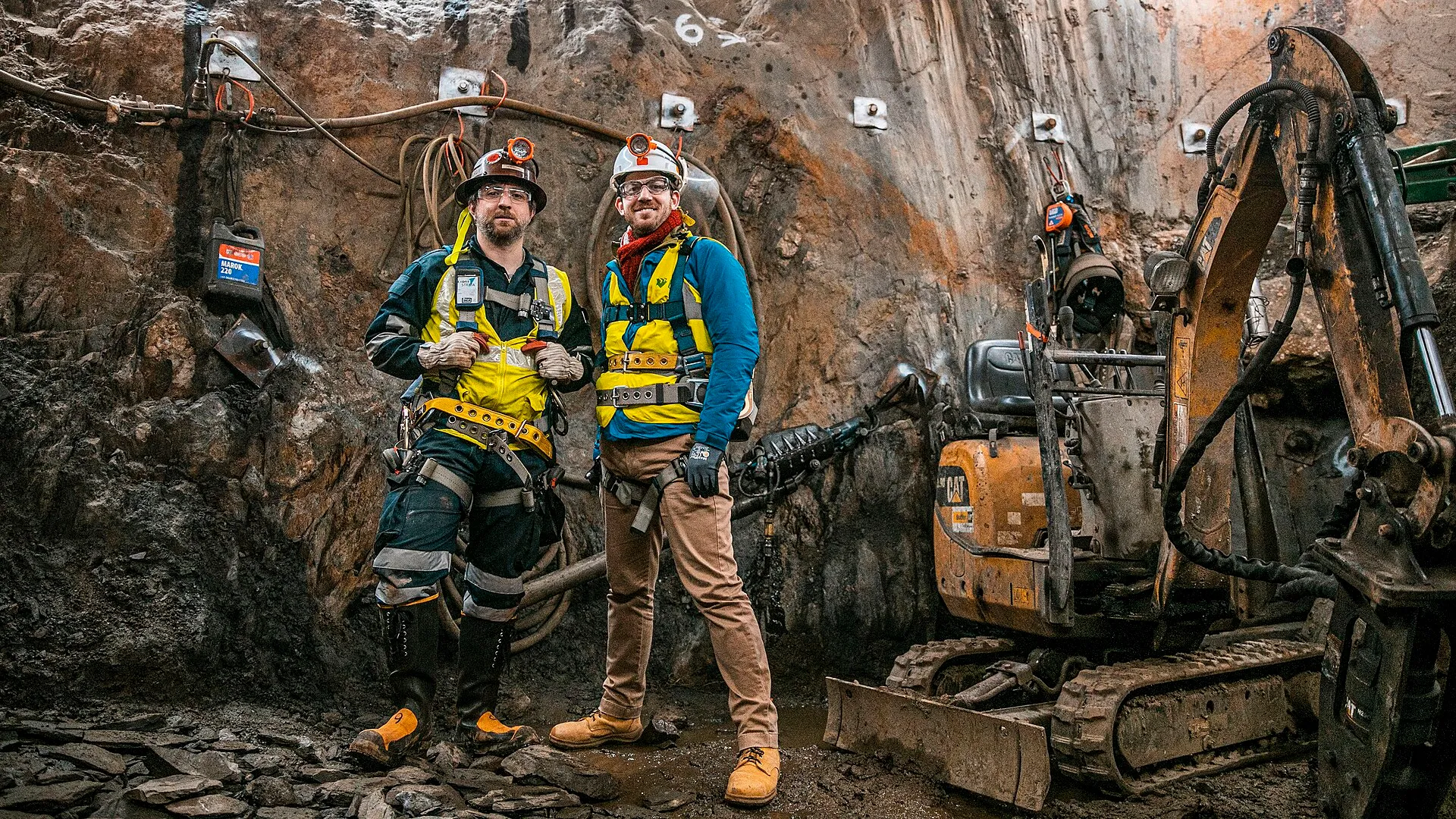
In February 2024 excavation of the caverns for DUNE's far detectors was completed about 1.5 km underground at the Sanford Underground Research Facility. Some 800,000 tonnes of rock were removed since underground excavation began in 2021. Each of the two main caverns is about 150 m long and seven storeys high and will house two 17,000-tonne liquid-argon detectors. The milestone cleared the way for detector installation.
- Date
- 2024
- Kind of event
- Experiment
The situation before
The Deep Underground Neutrino Experiment is designed to send a neutrino beam from Fermilab near Chicago about 1,300 km through the Earth to giant detectors in South Dakota. Its goals are to determine the mass ordering, to measure CP violation in neutrino oscillations and to watch for supernova neutrinos. The far site is the former Homestake gold mine, where Raymond Davis Jr. ran his chlorine experiment, now the Sanford Underground Research Facility.
Before any detector could be built, enormous spaces had to be carved out of the rock at the 4,850-foot level, about 1.5 km below the surface. A groundbreaking ceremony took place in July 2017, and preparatory work, including refurbishing the Ross Shaft and building a rock-handling system, filled the following years.
What happened
Underground excavation by the contractor Thyssen Mining began in 2021. Mining equipment was dismantled at the surface, lowered piece by piece through the existing shaft and reassembled underground. Over about two years crews drilled, blasted and removed rock, which was hauled to the surface and conveyed into the Open Cut, the former open-pit mine next to the town of Lead.
At the start of February 2024 Fermilab announced that excavation was complete. In total about 800,000 tons of rock had been removed. The result is three caverns and their connecting tunnels: two detector halls, each more than 500 feet (about 150 m) long and roughly seven storeys high, and a central utility cavern for cryogenics and services. Together the underground area is about the size of eight football pitches.
- Two detector caverns, each about 150 m long, to hold two far-detector modules each
- One central utility cavern for cryogenic plants and services
- About 800,000 tons of rock removed since 2021
- More than a million working hours without a lost-time accident, according to the project
Reaction
US project director Chris Mossey called the completion "a significant achievement for this project". Michael Gemelli of Fermilab, who managed the excavation, said that finishing the three caverns and all interconnecting drifts "marks the end of a really big dig." The project later received an industry award as project of the year.
What followed
With the rock gone, work shifted to outfitting: concrete, ventilation, power and the installation of the first insulated steel cryostat structure. Each far-detector module will be a liquid-argon time projection chamber holding about 17,000 tonnes of argon at 88 K. Prototypes of both detector technologies were being tested with particle beams at CERN's ProtoDUNE facility.
The next visible step came in May 2026, when a ceremony at Sanford Lab marked the start of moving steel underground for the detector support structures. The project aims to have a first far-detector module operating near the end of the decade, with the full DUNE-LBNF facility scheduled for completion in 2031.
Frequently asked questions
When were DUNE's caverns completed?
Fermilab announced the completion of excavation at the beginning of February 2024, about three years after underground excavation began in 2021.
How big are the DUNE caverns?
The two detector halls are each about 150 m long and roughly seven storeys high; about 800,000 tons of rock were removed in total.
Why are DUNE's detectors deep underground?
About 1.5 km of rock shields the detectors from cosmic rays, which is essential for rare-event searches such as supernova neutrinos and proton decay.
Concepts
Last updated: · Editorial standard
Cite this page
Text
Neutrino Atlas (2026). “2024: DUNE's underground caverns are completed”. Retrieved 22 November 2026, from https://neutrino-atlas.com/timeline/2024-dune-excavation-complete/BibTeX
@misc{neutrinoatlas202624duneexcavationcomplete,
  title        = {2024: DUNE's underground caverns are completed},
  author       = {{Neutrino Atlas}},
  year         = {2026},
  url          = {https://neutrino-atlas.com/timeline/2024-dune-excavation-complete/},
  note         = {Accessed 2026-11-22},
  language     = {english}
}