2023Experiment
KamLAND-Zen 800 reaches 2.3 × 10²⁶ years
With about 745 kg of enriched xenon, KamLAND-Zen 800 published a lower limit of 2.3 × 10²⁶ years on the neutrinoless double beta decay half-life of xenon-136. The corresponding upper limit on the effective Majorana mass, 36–156 meV, was the first search to probe the region expected for the inverted mass ordering. Future upgrades aim to cover that region fully.
- Date
- 2023
- Kind of event
- Experiment
- People involved
- Kunio Inoue
- Experiments
- KamLAND-Zen
The situation before
If neutrinos are Majorana particles, neutrinoless double beta decay must occur, at a rate set by the effective Majorana mass mββ. In the inverted ordering of neutrino masses, mββ cannot fall below roughly 15–50 meV, so reaching that band became the benchmark for the field. By 2016 the best limits, from KamLAND-Zen 400 and GERDA, still stopped at about 60–160 meV.
What happened
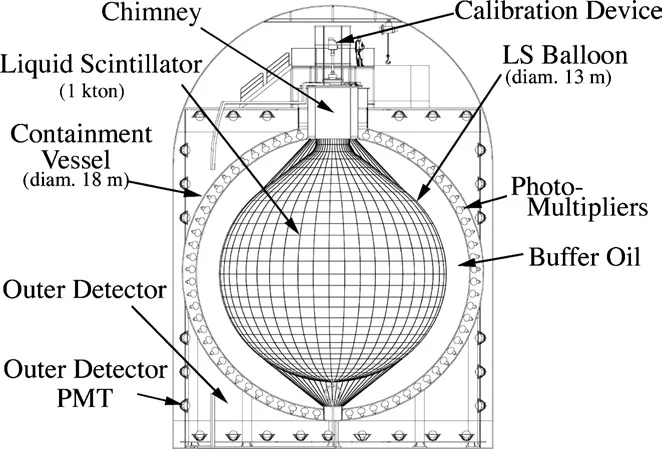
KamLAND-Zen, led by Kunio Inoue at Tohoku University, dissolves xenon enriched to about 91 percent in xenon-136 in a liquid scintillator held in a thin nylon balloon at the centre of the KamLAND detector in the Kamioka mine. For the second phase the team built a larger, cleaner balloon and loaded it with about 745 kg of enriched xenon, nearly twice the 381 kg of the earlier phase.
KamLAND-Zen 800 took data from 5 February 2019 to 8 May 2021, an exposure of 970 kg·yr of xenon-136. No excess appeared at the decay energy of 2.46 MeV. Combined with the KamLAND-Zen 400 data, the result was a lower half-life limit of 2.3 × 10²⁶ years at 90 percent confidence.
The preprint appeared in March 2022 and the paper, titled "Search for the Majorana Nature of Neutrinos in the Inverted Mass Ordering Region with KamLAND-Zen", was published in Physical Review Letters in January 2023.
Reaction
The title stated the achievement: for the most favourable nuclear matrix elements, the limit dipped below 50 meV and thus into the inverted-ordering band for the first time. It also began to exclude some theoretical models that predict mββ values in this range. Because the conversion from half-life to mass depends on nuclear physics uncertain by a factor of two to three, the band was only partly covered, a caveat the community emphasised.
Consequences
An updated analysis of the full KamLAND-Zen 800 data set, released in 2024, raised the limit to about 3.8 × 10²⁶ years, corresponding to mββ below roughly 28–122 meV. The main remaining background comes from spallation products of cosmic muons and from the irreducible tail of ordinary two-neutrino double beta decay. The planned KamLAND2-Zen, with better light collection and energy resolution, aims to cover the inverted-ordering region completely, in competition with LEGEND and nEXO.
Frequently asked questions
What did KamLAND-Zen 800 achieve?
It set a lower limit of 2.3 × 10²⁶ years on the neutrinoless double beta decay half-life of xenon-136, the first search to reach the inverted-ordering mass region.
How much xenon did it use?
About 745 kg of xenon enriched in xenon-136, dissolved in liquid scintillator inside a nylon balloon.
Does the result rule out Majorana neutrinos?
No. It only excludes larger effective Majorana masses; much of the inverted-ordering band and the whole normal-ordering region remain open.
Original papers
- MeasurementS. Abe et al. (KamLAND-Zen Collaboration), Search for the Majorana Nature of Neutrinos in the Inverted Mass Ordering Region with KamLAND-Zen, Phys. Rev. Lett. 130, 051801 (2023)DOI 10.1103/PhysRevLett.130.051801
- Final resultS. Abe et al. (KamLAND-Zen Collaboration), Search for Majorana Neutrinos with the Complete KamLAND-Zen DatasetDOI 10.1103/jkf6-48j8
Concepts
Mentioned in 2 pages
Last updated: · Editorial standard
Cite this page
Text
Neutrino Atlas (2026). “2023: KamLAND-Zen 800 reaches 2.3 × 10²⁶ years”. Retrieved 22 November 2026, from https://neutrino-atlas.com/timeline/2023-kamland-zen-800/BibTeX
@misc{neutrinoatlas2026imeline2023kamlandzen800,
  title        = {2023: KamLAND-Zen 800 reaches 2.3 × 10²⁶ years},
  author       = {{Neutrino Atlas}},
  year         = {2026},
  url          = {https://neutrino-atlas.com/timeline/2023-kamland-zen-800/},
  note         = {Accessed 2026-11-22},
  language     = {english}
}