2020Experiment
Gadolinium is added to Super-Kamiokande
In summer 2020 about 13 tonnes of gadolinium sulphate were dissolved in Super-Kamiokande's water, the first step of the SK-Gd project championed by John Beacom and Mark Vagins. Gadolinium captures neutrons and emits an 8 MeV gamma cascade, allowing inverse beta decay events to be tagged. The main goal is the first detection of the diffuse supernova neutrino background from all past supernovae. The concentration was later increased.
- Date
- 2020
- Kind of event
- Experiment
- People involved
- Masayuki Nakahata
- Experiments
- Super-Kamiokande
Background
Every core-collapse supernova in the universe emits about 10⁵⁸ neutrinos. Together, all past supernovae should have filled space with a faint diffuse supernova neutrino background. Super-Kamiokande could in principle see its electron antineutrinos through inverse beta decay, but in pure water the signal is buried under backgrounds. In 2004 John Beacom and Mark Vagins proposed a remedy in Physical Review Letters, under the playful name GADZOOKS!: dissolve a gadolinium salt in the water. Gadolinium captures the neutron from inverse beta decay much more efficiently than hydrogen and releases a gamma cascade of about 8 MeV instead of a single 2.2 MeV photon, so the delayed signal can be tagged reliably.
What happened
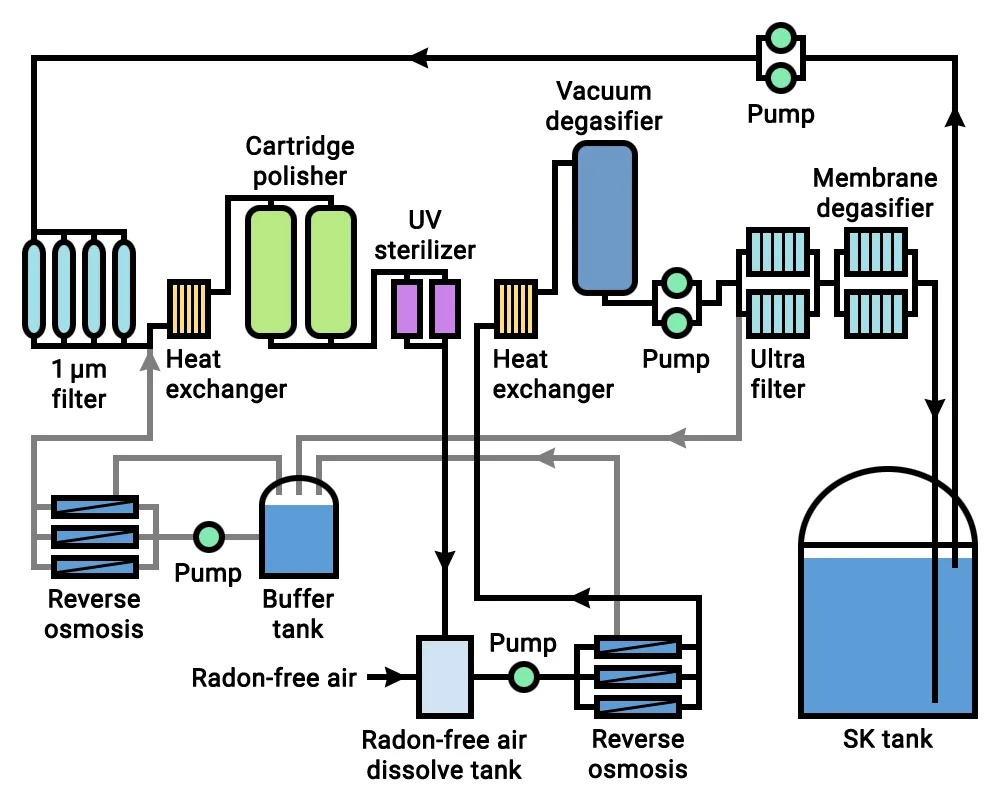
Before risking the 50,000-tonne detector, the idea was tested from the early 2010s in EGADS, a 200-tonne prototype tank in the Kamioka mine, to show that gadolinium does not spoil the water's transparency and can be kept clean by a dedicated filtration system. In 2015 the Super-Kamiokande collaboration approved the upgrade. From May 2018 to January 2019 the tank was opened and refurbished, its small leak was sealed and failed photomultipliers were replaced.
Between 14 July and 17 August 2020 about 13 tonnes of gadolinium sulphate octahydrate were dissolved into the water, giving a gadolinium concentration of about 0.01 percent by mass. About half of the neutrons from inverse beta decay were then captured on gadolinium. The work took place under the direction of the Kamioka Observatory, led at the time by Masayuki Nakahata. In June and July 2022 a further 26 tonnes raised the concentration to about 0.03 percent and the capture fraction to about 75 percent.
Reaction
The loading was the first time gadolinium had been added to a very large water Cherenkov detector, an idea that many had considered too risky when it was first proposed. The detector kept running normally, and the water quality remained good.
Consequences
The SK-Gd data improved the search for the DSNB. Analyses of the gadolinium phases improved the limits on the diffuse flux at low energies and approached the range of theoretical predictions; a first detection may be possible within a few more years, especially in combination with JUNO. Neutron tagging also helps separate neutrinos from antineutrinos in atmospheric and beam data, reduces backgrounds in proton-decay searches and enables an early warning for nearby stars approaching core collapse. Gadolinium loading has since become a standard technique, planned also for parts of the next generation of water detectors.
Frequently asked questions
Why was gadolinium added to Super-Kamiokande?
To tag the neutrons from inverse beta decay. This separates electron antineutrinos from backgrounds and makes a search for the diffuse supernova neutrino background possible.
When was it added?
About 13 tonnes of gadolinium sulphate were dissolved between July and August 2020, and a further 26 tonnes in 2022.
Has the diffuse supernova neutrino background been detected?
Not yet. SK-Gd has improved the limits at low energies, which now approach theoretical predictions.
Original papers
- ProposalJ. F. Beacom and M. R. Vagins, GADZOOKS! Antineutrino Spectroscopy with Large Water Čerenkov Detectors, Phys. Rev. Lett. 93, 171101 (2004)DOI 10.1103/PhysRevLett.93.171101
- First resultK. Abe et al. (Super-Kamiokande Collaboration), First gadolinium loading to Super-Kamiokande, Nucl. Instrum. Meth. A 1027, 166248 (2022)DOI 10.1016/j.nima.2021.166248
Concepts
Mentioned in 2 pages
Last updated: · Editorial standard
Cite this page
Text
Neutrino Atlas (2026). “2020: Gadolinium is added to Super-Kamiokande”. Retrieved 22 November 2026, from https://neutrino-atlas.com/timeline/2020-super-k-gadolinium/BibTeX
@misc{neutrinoatlas2026line2020superkgadolinium,
  title        = {2020: Gadolinium is added to Super-Kamiokande},
  author       = {{Neutrino Atlas}},
  year         = {2026},
  url          = {https://neutrino-atlas.com/timeline/2020-super-k-gadolinium/},
  note         = {Accessed 2026-11-22},
  language     = {english}
}