2018Experiment
MiniBooNE's excess grows to 4.8σ
After 15 years of running, MiniBooNE reported an excess of electron-like events in neutrino and antineutrino modes at a combined 4.7σ (4.8σ in the 2020 update), and about 6σ when combined with LSND. If interpreted as oscillation, it points to a sterile neutrino near 1 eV, but this is in tension with muon-neutrino disappearance data. MicroBooNE was built with liquid-argon technology to distinguish electrons from photons and test the excess.
- Date
- 2018
- Kind of event
- Experiment
- People involved
- Janet M. Conrad, William C. Louis
- Experiments
- MiniBooNE, LSND, MicroBooNE
Background
In the 1990s the LSND experiment at Los Alamos, with William Louis among its leaders, reported an excess of electron antineutrinos in a muon-antineutrino beam at about 3.8σ. Interpreted as oscillation, it required a mass splitting near 1 eV², far larger than the solar and atmospheric ones, and thus at least one additional, sterile neutrino. MiniBooNE at Fermilab was built to test this with a different beam, different energies and different systematic uncertainties, but the same ratio of distance to energy. Janet Conrad and Louis were among its founding spokespersons.
What happened
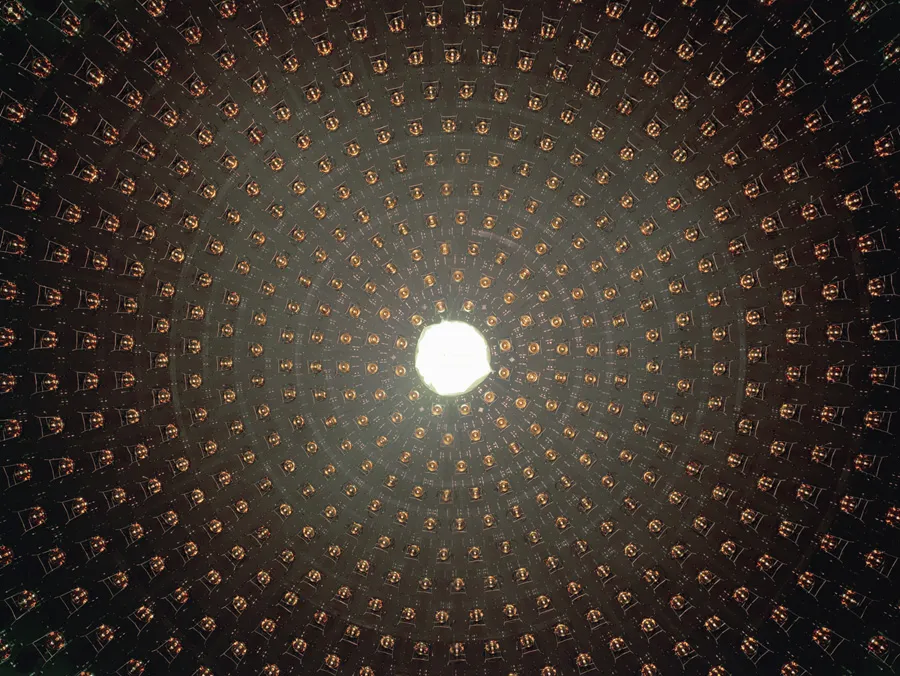
MiniBooNE was an 818-tonne mineral-oil Cherenkov detector 541 m from the target of the Booster Neutrino Beam. It began running in 2002. Its first result in 2007 found no excess in the energy region designed to test LSND, but revealed an unexpected excess at lower energies. Antineutrino running followed, and the excess persisted.
In May 2018 the collaboration posted an analysis of the full data then available: 12.84 × 10²⁰ protons on target in neutrino mode and 11.27 × 10²⁰ in antineutrino mode. In the energy range from 200 to 1,250 MeV it found 381 ± 85 excess electron-like events in neutrino mode, at 4.5σ, and a combined excess of 460.5 ± 99.0 events, at 4.7σ. Combined with LSND, the significance reached 6.0σ. The paper appeared in Physical Review Letters in November 2018. A 2020 update with more neutrino-mode data raised the MiniBooNE significance to 4.8σ.
Reaction
The result revived the sterile-neutrino debate. In a simple 3+1 model, an appearance signal also requires muon neutrinos to disappear at a similar rate, but experiments such as MINOS, IceCube and Super-Kamiokande saw no such disappearance. Global fits therefore found strong tension between appearance and disappearance data. Many physicists also pointed out a key weakness of the detector: a Cherenkov detector cannot distinguish an electron from a single photon, so a poorly understood photon background could mimic the signal.
Consequences
The question passed to liquid-argon detectors with electron-photon separation. MicroBooNE, in the same beam, presented its first tests in October 2021 and found no excess of electron neutrinos. SBND and ICARUS form the Short-Baseline Neutrino programme that continues the search. The MiniBooNE excess remains one of the short-baseline anomalies whose origin is still debated.
Frequently asked questions
What is the MiniBooNE excess?
An excess of electron-like events at low energies in Fermilab's Booster Neutrino Beam, seen in both neutrino and antineutrino mode. In 2018 it reached 4.7σ.
Does it prove a sterile neutrino exists?
No. The sterile-neutrino interpretation conflicts with muon-neutrino disappearance data, and the detector cannot tell electrons from photons, so other explanations remain possible.
How was the excess tested?
MicroBooNE, a liquid-argon detector in the same beam, can separate electrons from photons. Its first results in 2021 found no electron-neutrino excess.
Original papers
- MeasurementA. A. Aguilar-Arevalo et al. (MiniBooNE Collaboration), Significant Excess of Electronlike Events in the MiniBooNE Short-Baseline Neutrino Experiment, Phys. Rev. Lett. 121, 221801 (2018)DOI 10.1103/PhysRevLett.121.221801arXiv:1805.12028
- Final resultA. A. Aguilar-Arevalo et al. (MiniBooNE Collaboration), Updated MiniBooNE neutrino oscillation results with increased data and new background studies, Phys. Rev. D 103, 052002 (2021)DOI 10.1103/PhysRevD.103.052002
Concepts
Mentioned in 2 pages
Last updated: · Editorial standard
Cite this page
Text
Neutrino Atlas (2026). “2018: MiniBooNE's excess grows to 4.8σ”. Retrieved 22 November 2026, from https://neutrino-atlas.com/timeline/2018-miniboone-excess/BibTeX
@misc{neutrinoatlas2026eline2018minibooneexcess,
  title        = {2018: MiniBooNE's excess grows to 4.8σ},
  author       = {{Neutrino Atlas}},
  year         = {2026},
  url          = {https://neutrino-atlas.com/timeline/2018-miniboone-excess/},
  note         = {Accessed 2026-11-22},
  language     = {english}
}