2015Discovery
OPERA establishes tau-neutrino appearance
With its fifth tau-neutrino candidate, announced in June 2015, OPERA reached a significance of 5.1σ for the appearance of tau neutrinos in a pure muon-neutrino beam. It was the first direct observation of muon-to-tau oscillation in appearance mode, complementing the disappearance measurements of Super-Kamiokande, K2K and MINOS. It confirmed that the atmospheric oscillation is predominantly into tau neutrinos.
- Date
- 2015
- Kind of event
- Discovery
- Experiments
- OPERA, CNGS (CERN Neutrinos to Gran Sasso)
Background
Super-Kamiokande's 1998 discovery showed that atmospheric muon neutrinos disappear on their way through the Earth. The most natural explanation was oscillation into tau neutrinos, but disappearance alone could not prove what the muon neutrinos turned into. A direct proof required catching the new flavour: seeing tau neutrinos appear in a beam that originally contained almost none. This was the goal of OPERA, proposed in the late 1990s, with Antonio Ereditato as its long-time spokesperson and a strong Japanese emulsion group around Kimio Niwa.
What happened
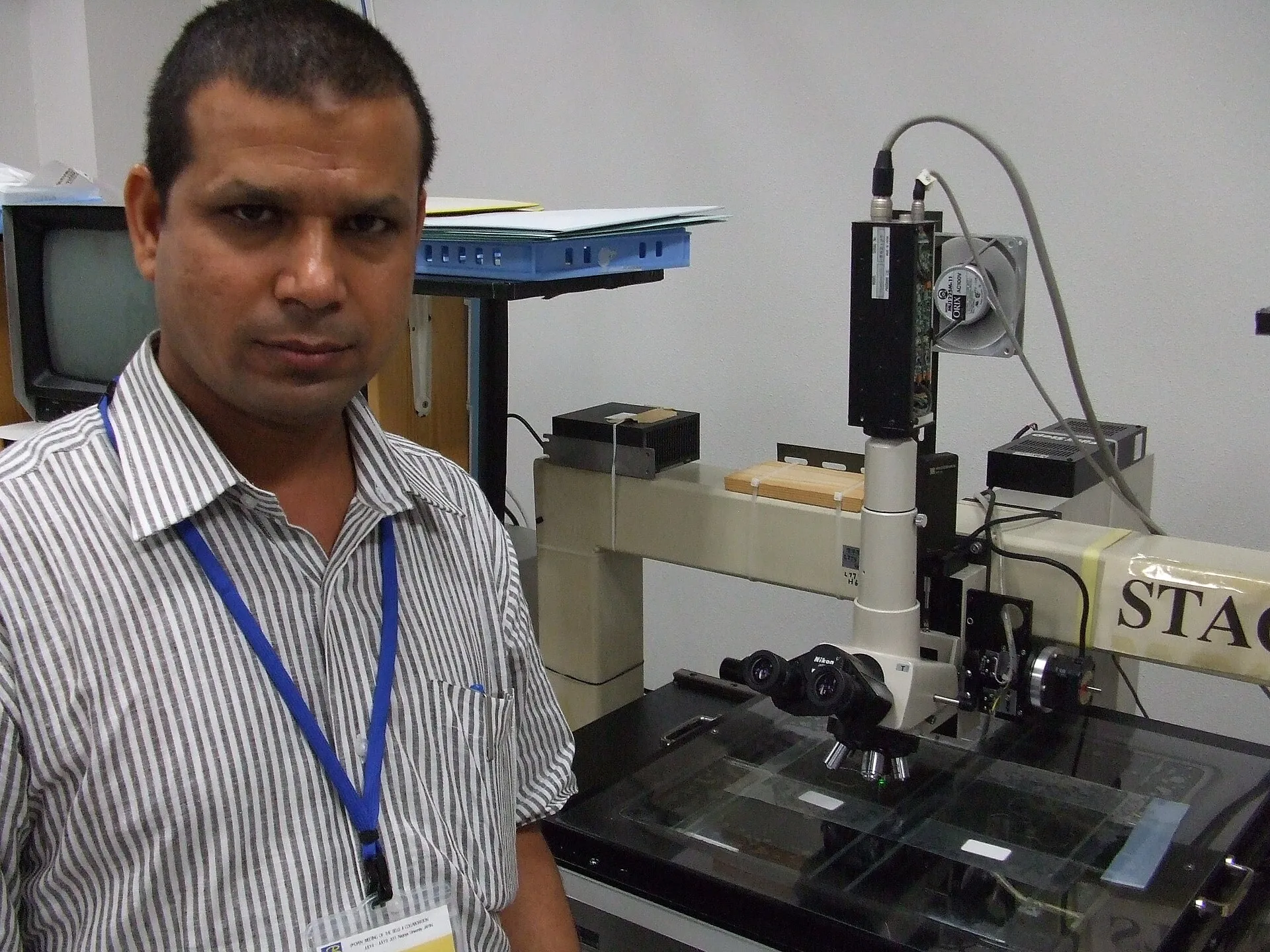
From 2008 to 2012 the CNGS beam sent muon neutrinos 730 km from CERN to the OPERA detector at LNGS. Over the baseline only a few in a thousand oscillated into tau neutrinos, and only a small fraction of those interacted in the detector. A tau lepton produced in a charged-current interaction travels less than a millimetre before it decays, so OPERA used about 150,000 bricks of lead plates interleaved with nuclear emulsion films, roughly 1.25 kilotonnes in total, which can resolve such short tracks. Electronic detectors located the bricks with neutrino interactions; the films were then developed and scanned with automated microscopes in Europe and Japan.
Finding a tau candidate was slow work. For each located interaction the films were followed back to the vertex, and the scanners looked for a short parent track with a kink or a split into several particles a fraction of a millimetre downstream. To avoid bias, the kinematic criteria for a tau decay, such as the kink angle, the decay length and the missing transverse momentum, had been fixed in advance, and charm-particle decays and hadron interactions were the main backgrounds. The candidates covered several decay channels, including decays into one hadron, into three hadrons and into a muon.
The first tau-neutrino candidate was announced in 2010, the second in 2012, the third in 2013 and the fourth in 2014. The fifth was presented at Gran Sasso in June 2015. With about 2.6 expected signal events and a background of only about 0.25 events, five candidates excluded the no-oscillation hypothesis at 5.1σ. The result was published in Physical Review Letters in September 2015.
Reaction
The announcement completed a long and painstaking effort and was received as the conclusive appearance-mode confirmation of the atmospheric oscillation picture. It came only a few months before the 2015 Nobel Prize for the discovery of neutrino oscillations. The collaboration also had a turbulent episode behind it: its 2011 report of apparently faster-than-light neutrinos, later traced to a faulty fibre connection, had drawn worldwide attention (see OPERA FTL).
Why it matters
OPERA showed directly that muon neutrinos turn into tau neutrinos, complementing the disappearance measurements of Super-Kamiokande, K2K and MINOS. Super-Kamiokande had reported statistical evidence for tau appearance in atmospheric neutrinos at 3.8σ in 2013, and IceCube later added further evidence, but OPERA identified individual events. A final analysis with looser selection criteria in 2018 found ten candidates and a significance of 6.1σ. Tau-neutrino measurements remain among the least precise in neutrino physics, and they are a test of the three-flavour picture in DUNE and Hyper-Kamiokande.
Frequently asked questions
What did OPERA observe?
OPERA saw tau neutrinos appear in a beam of muon neutrinos sent from CERN to Gran Sasso. The fifth candidate, announced in June 2015, raised the significance to 5.1σ.
Why did OPERA need nuclear emulsions?
A tau lepton decays after travelling less than a millimetre. Only emulsion films with micrometre resolution could record its short track and the kink of its decay.
How many tau neutrinos did OPERA find in the end?
Its final 2018 analysis reported ten candidates with an expected background of about two events, a significance of 6.1σ.
Original papers
- DiscoveryN. Agafonova et al. (OPERA Collaboration), Discovery of τ Neutrino Appearance in the CNGS Neutrino Beam with the OPERA Experiment, Phys. Rev. Lett. 115, 121802 (2015)DOI 10.1103/PhysRevLett.115.121802
- Final resultN. Agafonova et al. (OPERA Collaboration), Final Results of the OPERA Experiment on ντ Appearance in the CNGS Neutrino Beam, Phys. Rev. Lett. 120, 211801 (2018)DOI 10.1103/PhysRevLett.120.211801arXiv:1804.04912
Concepts
Mentioned in 1 page
Lessons 1
Last updated: · Editorial standard
Cite this page
Text
Neutrino Atlas (2026). “2015: OPERA establishes tau-neutrino appearance”. Retrieved 22 November 2026, from https://neutrino-atlas.com/timeline/2015-opera-tau-appearance/BibTeX
@misc{neutrinoatlas2026ne2015operatauappearance,
  title        = {2015: OPERA establishes tau-neutrino appearance},
  author       = {{Neutrino Atlas}},
  year         = {2026},
  url          = {https://neutrino-atlas.com/timeline/2015-opera-tau-appearance/},
  note         = {Accessed 2026-11-22},
  language     = {english}
}