2012Discovery
Borexino finds first evidence of pep solar neutrinos
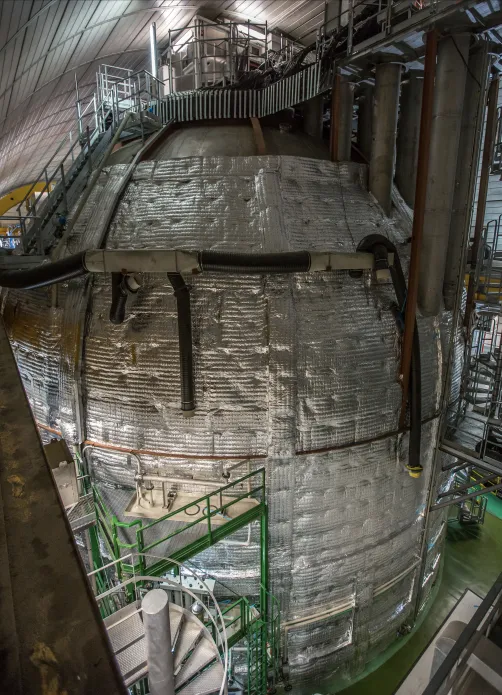
Using techniques to suppress the cosmogenic carbon-11 background, Borexino found the first evidence (at 98% confidence) for the monoenergetic 1.44 MeV pep neutrinos from the proton-electron-proton fusion reaction. It also set the strongest limit at the time on neutrinos from the CNO cycle. The measurement supported the predicted energy dependence of the solar electron-neutrino survival probability.
- Date
- 2012
- Kind of event
- Discovery
- People involved
- Gianpaolo Bellini
- Experiments
- Borexino
Background
The Sun makes most of its energy through the pp chain. Its first step usually fuses two protons into deuterium, emitting a low-energy pp neutrino. In about 0.2 percent of cases the same step happens with an electron taking part, the proton–electron–proton or pep reaction, and the neutrino carries a fixed energy of 1.44 MeV. Because the pep and pp rates are tied together by nuclear physics, the solar model predicts the pep flux to about one percent. That makes pep neutrinos an excellent probe of oscillation: their energy lies right in the transition region between the low-energy beryllium-7 line, measured by Borexino in 2007, and the boron-8 neutrinos above 5 MeV.
A second goal was the CNO cycle, the fusion route that dominates in heavier stars and contributes about one percent of the Sun's energy. CNO neutrinos have a continuous spectrum in the same energy range as pep, and no experiment had detected them.
The obstacle
In the 1–2 MeV window the dominant background in Borexino was carbon-11, a radioactive isotope produced when cosmic muons, which still reach the laboratory under 1,400 m of rock, break up carbon nuclei in the scintillator. Carbon-11 decays by positron emission with a half-life of about 20 minutes, producing a spectrum that overlaps the pep signal and is about ten times stronger. This cosmogenic activation had made the measurement look impossible.
What happened
The collaboration, led by Gianpaolo Bellini, combined two techniques. In the threefold coincidence method, the muon, the neutron knocked out in the same reaction and the subsequent carbon-11 decay were linked in space and time, and regions of the detector around such muon tracks were vetoed for a while; this removed most carbon-11 while keeping about half the exposure. The remaining positrons were partly distinguished from electrons by pulse shape, because positrons briefly form ortho-positronium, which delays the scintillation light by a few nanoseconds.
Using data from January 2008 to May 2010, Borexino reported its result in October 2011; it was published in Physical Review Letters 108, 051302 in February 2012 as „First evidence of pep solar neutrinos by direct detection in Borexino“.
- pep interaction rate: 3.1 ± 0.6 (stat) ± 0.3 (syst) counts per day per 100 tonnes.
- The absence of a pep signal was rejected at 98 percent confidence.
- Upper limit on CNO neutrinos: below 7.9 counts per day per 100 tonnes at 95 percent confidence, the strongest constraint at the time.
The pep flux, about 1.6 × 10⁸ cm⁻² s⁻¹, agreed with the solar model combined with large-mixing-angle MSW oscillation. The electron-neutrino survival probability at 1.44 MeV, about 0.6, fitted the predicted curve between beryllium-7 and boron-8.
What followed
The 2012 paper described its signal as first evidence, not as a discovery. After a purification campaign that further reduced backgrounds, Borexino's Phase-II data established pep neutrinos at more than 5σ, published in Nature in 2018 as part of a comprehensive measurement of the pp-chain neutrinos. The carbon-11 suppression techniques developed for pep were essential for the next goal: in 2020 Borexino reported the first detection of CNO neutrinos, confirming that this cycle operates in the Sun.
Frequently asked questions
What are pep neutrinos?
Neutrinos with a fixed energy of 1.44 MeV produced in the Sun when two protons and an electron fuse into deuterium. They make up a small but very precisely predicted part of the solar flux.
When were pep neutrinos first detected?
Borexino reported first evidence in late 2011, published in February 2012, at 98 percent confidence. Its Phase-II data established them at more than 5σ in 2018.
Why was the measurement difficult?
A background from carbon-11, produced by cosmic muons in the scintillator, was about ten times stronger than the signal and had to be suppressed with coincidence tagging and pulse-shape analysis.
Original papers
- DiscoveryG. Bellini et al. (Borexino), First evidence of pep solar neutrinos by direct detection in Borexino, Phys. Rev. Lett. 108, 051302 (2012)DOI 10.1103/PhysRevLett.108.051302arXiv:1110.3230
Concepts
Last updated: · Editorial standard
Cite this page
Text
Neutrino Atlas (2026). “2012: Borexino finds first evidence of pep solar neutrinos”. Retrieved 22 November 2026, from https://neutrino-atlas.com/timeline/2012-borexino-pep/BibTeX
@misc{neutrinoatlas2026timeline2012borexinopep,
  title        = {2012: Borexino finds first evidence of pep solar neutrinos},
  author       = {{Neutrino Atlas}},
  year         = {2026},
  url          = {https://neutrino-atlas.com/timeline/2012-borexino-pep/},
  note         = {Accessed 2026-11-22},
  language     = {english}
}