2010Discovery
Borexino confirms geoneutrinos
Borexino reported a 4.2σ observation of geoneutrinos in 2010. Because few reactors operate near Gran Sasso, the reactor background was much smaller than at KamLAND. Measurements at two sites on different crust types began to constrain models of Earth's composition, and later Borexino data rejected the hypothesis of no radiogenic heat from the mantle at 99% confidence (2020 analysis).
- Date
- 2010
- Kind of event
- Discovery
- People involved
- Gianpaolo Bellini
- Experiments
- Borexino, Laboratori Nazionali del Gran Sasso (LNGS)
The situation before
KamLAND had reported the first evidence for geoneutrinos in 2005, but its result rested on a difficult subtraction. Japan's dense network of nuclear power plants produced several times more antineutrinos in the detector than the Earth did, and a second background from (α,n) reactions in the scintillator was hard to pin down. A confirmation from a different site, with a different crust beneath it and fewer reactors nearby, was the natural next step. Such a result would also start to separate the contribution of the local crust from that of the deep mantle.
What happened
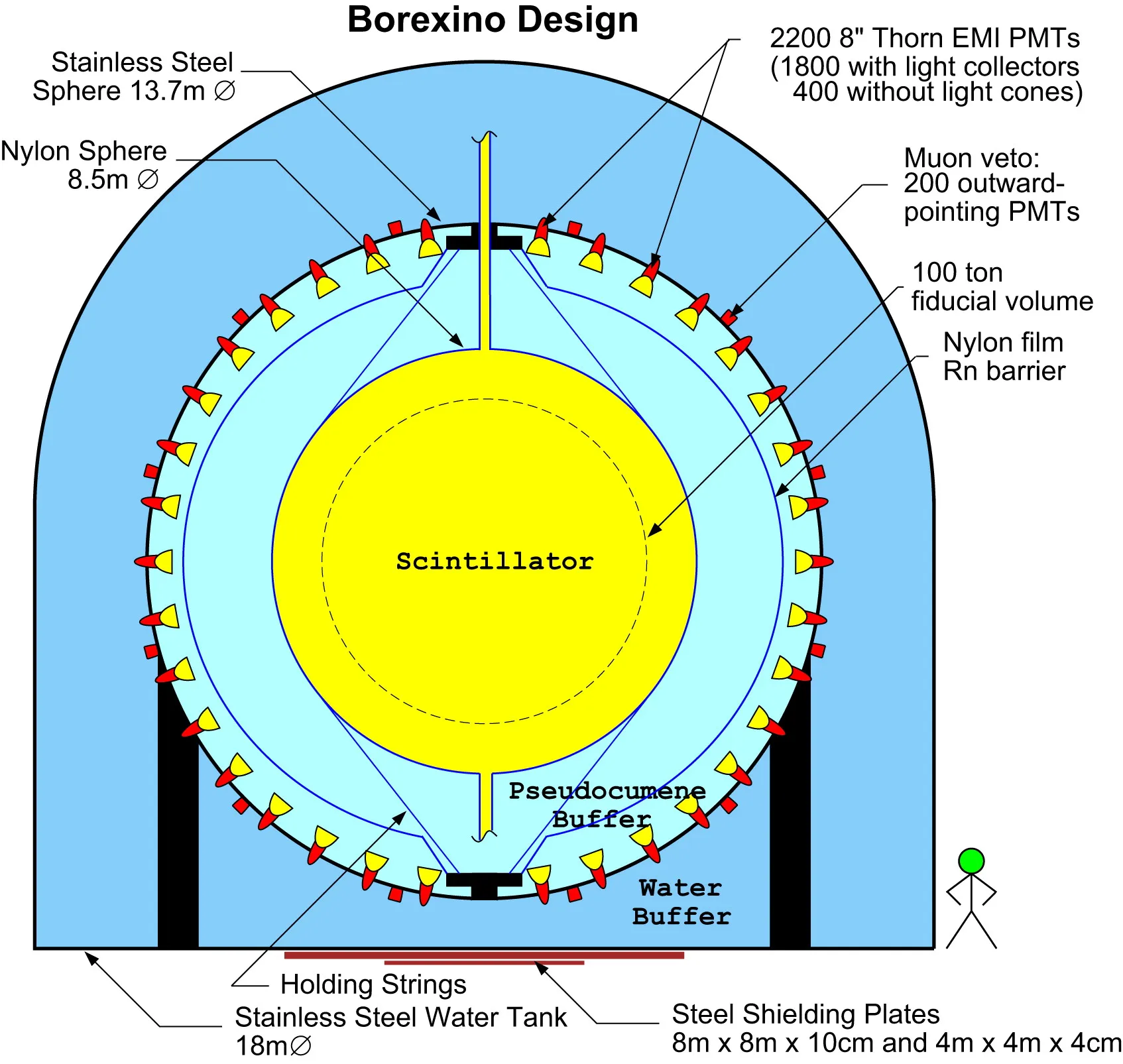
Borexino at the Gran Sasso laboratory had been built for solar neutrinos, but its extremely pure scintillator also made it a sensitive antineutrino detector through inverse beta decay. Italy has no operating nuclear reactors, and the nearest European plants are hundreds of kilometres away. The collaboration, with Gianpaolo Bellini as spokesperson, analysed data from December 2007 to December 2009, 537 live days with an exposure of 252.6 tonne-years after cuts.
- 21 antineutrino candidates passed the selection.
- The fit gave 9.9 (+4.1 −3.4) geoneutrino events and 10.7 (+4.3 −3.4) reactor events.
- Backgrounds other than reactor antineutrinos were estimated at only about 0.4 events, thanks to the radiopurity of the scintillator.
- The hypothesis of no geoneutrino signal was rejected at 99.997 percent confidence, about 4.2σ.
The paper „Observation of geo-neutrinos“ was published in Physics Letters B 687, 299 (2010). Although the sample was small, the ratio of geoneutrinos to reactor antineutrinos was about one to one, far better than at KamLAND, and the signal was nearly free of non-antineutrino background.
Reaction
The result was received as the independent confirmation that neutrino geophysics needed. The measured rate was consistent with the prediction of the bulk silicate Earth model, a standard description of the planet's composition based on meteorites. With two detectors on different crust types, geophysicists could for the first time compare measured geoneutrino rates at two places on the globe. Gran Sasso lies on continental crust in the Apennines, while Kamioka sits on the crust of an island arc, so the two rates were expected to differ, and the comparison became a direct test of crustal models.
Consequences
- Borexino's 2013 and 2015 updates pushed the significance beyond 5σ and measured the uranium and thorium signal with growing precision.
- Its comprehensive analysis of 2020, with 3,263 days of data, found 52.6 events and excluded the absence of a mantle signal at 99 percent confidence, with a mantle contribution of about 25 TW of radiogenic heat.
- KamLAND, after Japan's reactors shut down in 2011, also improved its measurement, and combined results began to constrain Earth models.
Next-generation detectors such as SNO+ in Canada and JUNO in China are expected to collect geoneutrino samples many times larger, adding sites on old continental crust and testing how uranium and thorium are distributed between crust and mantle.
Frequently asked questions
When did Borexino detect geoneutrinos?
Borexino reported its observation of geoneutrinos in 2010, using data taken from December 2007 to December 2009, with a significance of about 4.2σ.
Why was Borexino's measurement cleaner than KamLAND's?
Italy has no nuclear power plants, so far fewer reactor antineutrinos reach Gran Sasso, and Borexino's very pure scintillator produced almost no other background.
Do geoneutrinos show that the mantle is radioactive?
Borexino's 2020 analysis excluded the absence of a mantle signal at 99 percent confidence, which indicates radiogenic heat from the mantle, though the uncertainty is still large.
Original papers
- DiscoveryG. Bellini et al. (Borexino), Observation of geo-neutrinos, Phys. Lett. B 687, 299 (2010)arXiv:1003.0284
Concepts
Mentioned in 2 pages
Last updated: · Editorial standard
Cite this page
Text
Neutrino Atlas (2026). “2010: Borexino confirms geoneutrinos”. Retrieved 22 November 2026, from https://neutrino-atlas.com/timeline/2010-borexino-geoneutrinos/BibTeX
@misc{neutrinoatlas20262010borexinogeoneutrinos,
  title        = {2010: Borexino confirms geoneutrinos},
  author       = {{Neutrino Atlas}},
  year         = {2026},
  url          = {https://neutrino-atlas.com/timeline/2010-borexino-geoneutrinos/},
  note         = {Accessed 2026-11-22},
  language     = {english}
}