2010Experiment
IceCube is completed at the South Pole
On 18 December 2010 the 86th and final string was deployed, completing the IceCube Neutrino Observatory. Its 5,160 optical sensors instrument about one cubic kilometre of ice between 1,450 and 2,450 m depth, with the DeepCore infill for lower energies and the IceTop surface array. Funded mainly by the US National Science Foundation with international partners, IceCube became the world's largest neutrino detector.
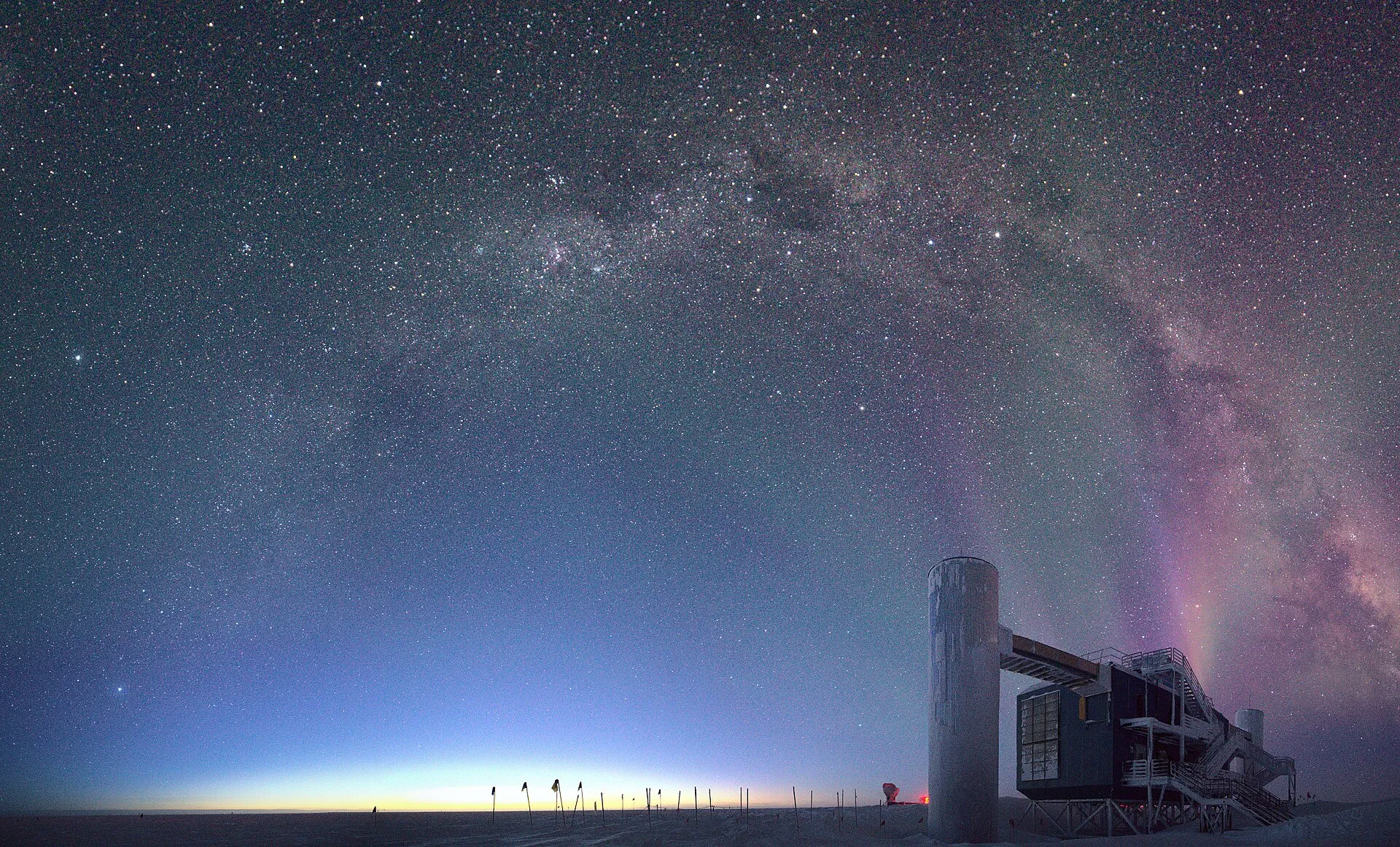
- Date
- 18 December 2010
- Kind of event
- Experiment
- People involved
- Francis Halzen, Thomas K. Gaisser, Christian Spiering
- Experiments
- IceCube Neutrino Observatory
The situation before
When the last construction season began in November 2010, IceCube was already the largest neutrino detector on Earth. Seventy-nine strings were frozen into the ice under the South Pole, and partial configurations had been taking data for years. But the original design called for 86 strings, including a dense inner core, and the physics case for cosmic sources rested on the full cubic kilometre. The construction programme begun in 2005 had been planned for six or seven seasons; finishing on time depended on the drill and on the weather at the Pole.
What happened
During the 2010–2011 austral summer the team drilled the last seven holes with the Enhanced Hot Water Drill. On 18 December 2010 the 86th string was lowered into the ice, completing the in-ice array. The finished observatory consisted of:
- 5,160 digital optical modules on 86 strings, between 1,450 and 2,450 m depth, instrumenting about one cubic kilometre of ice.
- DeepCore, a group of eight densely instrumented strings near the centre with high-efficiency photomultipliers, lowering the energy threshold to about 10 GeV for oscillation studies.
- IceTop, an array of 81 surface stations with two ice-filled tanks each, measuring cosmic-ray air showers and serving as a veto.
- The IceCube Laboratory at the surface, where data are filtered and sent north by satellite.
The project had cost about 279 million US dollars, most of it from the National Science Foundation, with major contributions from Germany, Sweden and Belgium. Francis Halzen remained principal investigator; Christian Spiering of DESY and Thomas Gaisser of the University of Delaware were among the leading figures of the collaboration of several hundred scientists. Regular operation with the full detector, called IC86, started in May 2011.
Reaction and early years
Completion was a logistical as much as a scientific milestone: all components had been flown to one of the most remote places on Earth over seven seasons, and once frozen in, none could be repaired. More than 98 percent of the modules worked. The scientific payoff took time. The first year of the full detector produced no point source, but in 2012 two events with energies around 1 PeV, nicknamed Bert and Ernie, were found in data from the partly and fully completed array.
Why it matters
The full detector enabled the discoveries for which IceCube is known: the first flux of high-energy astrophysical neutrinos in 2013, the association of a neutrino with the blazar TXS 0506+056 in 2017–2018, evidence for neutrinos from the galaxy NGC 1068 in 2022 and from the plane of the Milky Way in 2023. DeepCore made IceCube a competitive atmospheric oscillation experiment. Planned extensions, the IceCube Upgrade and IceCube-Gen2, build on the same holes and design.
Frequently asked questions
When was IceCube completed?
The 86th and final string was deployed on 18 December 2010. Full-detector operation began in May 2011.
How big is IceCube?
It has 5,160 optical sensors on 86 strings in about one cubic kilometre of ice, between 1,450 and 2,450 m below the surface at the South Pole.
Original papers
- MeasurementM. G. Aartsen et al. (IceCube), The IceCube Neutrino Observatory: Instrumentation and Online Systems, JINST 12, P03012 (2017)
Concepts
Mentioned in 5 pages
Last updated: · Editorial standard
Cite this page
Text
Neutrino Atlas (2026). “2010: IceCube is completed at the South Pole”. Retrieved 22 November 2026, from https://neutrino-atlas.com/timeline/2010-icecube-completed/BibTeX
@misc{neutrinoatlas2026line2010icecubecompleted,
  title        = {2010: IceCube is completed at the South Pole},
  author       = {{Neutrino Atlas}},
  year         = {2026},
  url          = {https://neutrino-atlas.com/timeline/2010-icecube-completed/},
  note         = {Accessed 2026-11-22},
  language     = {english}
}