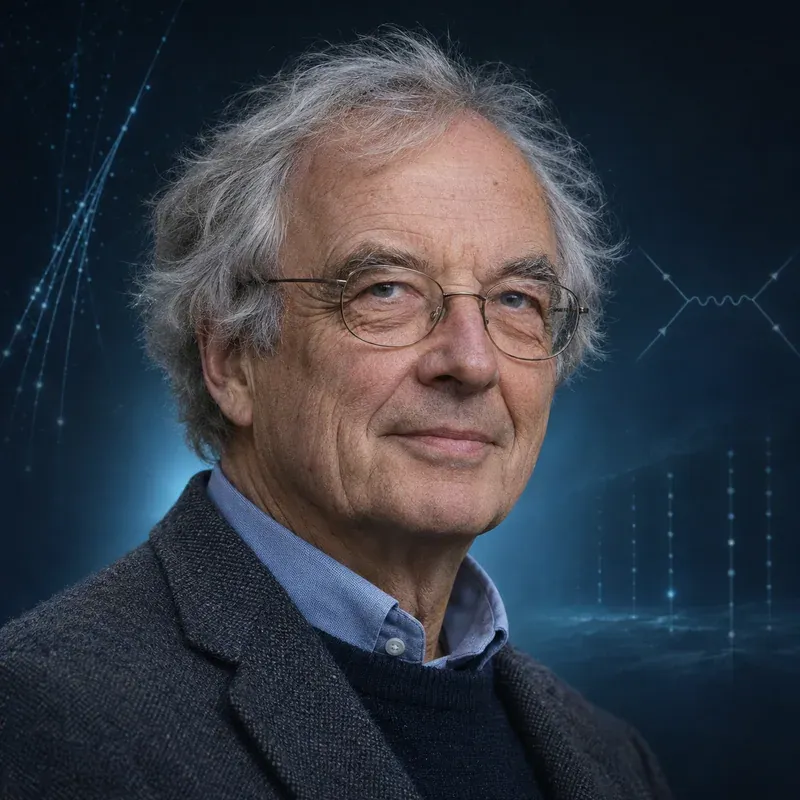
 Illustration
Christian Spiering
Spiering moved into astroparticle physics in 1988 and worked on the underwater neutrino telescope in Lake Baikal before leading DESY's neutrino astrophysics group in AMANDA and IceCube. He was AMANDA's European spokesperson (1997-2005) and IceCube spokesperson (2005-2007), and chaired the Global Neutrino Network linking IceCube, ANTARES, KM3NeT and Baikal-GVD.
- Born
- 1948
- Nationality
- German
- Field
- Astroparticle physics / neutrino astronomy
- Institutions
- DESY Zeuthen, Humboldt University of Berlin, JINR Dubna / IHEP Protvino
Early career
Christian Spiering, born in 1948, studied physics at the Humboldt University of Berlin, where he also obtained his doctorate. He began as an accelerator particle physicist and spent about four and a half years at the Soviet research centres in Dubna and Protvino, where East German groups took part in experiments at the large proton accelerators. He later worked at the institute for high-energy physics in Zeuthen near Berlin, which became part of DESY after German reunification.
Path to neutrino physics
In 1988 Spiering moved from accelerator physics to astroparticle physics, and the Zeuthen group joined the Soviet project to build a neutrino telescope in Lake Baikal. The project, led on the Russian side by Grigory Domogatsky, followed the idea of Moisey Markov to use a large, clear natural body of water as the target and the Cherenkov light of muons as the signal. Baikal had a practical advantage over ocean sites: in late winter the lake freezes over with a thick sheet of ice that serves as a stable platform for deploying and repairing strings of light sensors. In 1993–94 the first small configuration recorded the first neutrino candidates detected under water, and the NT-200 array was completed in 1998.
Key contributions
From the mid-1990s DESY Zeuthen also joined the AMANDA experiment at the South Pole. Spiering was AMANDA's European spokesperson from 1997 to 2005 and led DESY's neutrino astrophysics group, making it one of the main European partners in the polar programme. When AMANDA was absorbed into IceCube, he served as IceCube spokesperson from 2005 to 2007, the period when construction of the cubic-kilometre detector began under principal investigator Francis Halzen. The spokesperson represents a collaboration scientifically and coordinates its internal organisation, so this role placed him at the centre of IceCube's early science planning.
Spiering was also an advocate of cooperation between the different neutrino telescopes. Instruments in water and ice see different parts of the sky with different strengths: a telescope in the northern hemisphere, such as ANTARES, KM3NeT or Baikal-GVD, looks through the Earth at the southern sky including the centre of the Milky Way, while IceCube sees the northern sky best. From 2014 to 2017 he chaired the Global Neutrino Network, which links these projects, coordinates joint analyses and alerts and helps share technology.
Historian of neutrino astronomy
Spiering is widely known for his careful historical reviews of the field. His article 'Towards high-energy neutrino astronomy. A historical review' (European Physical Journal H, 2012) traces the subject from Markov's proposal in 1960 through the DUMAND pioneers, the Baikal and AMANDA projects and the early years of IceCube. The review draws on original documents and on his personal involvement, and it is one of the standard references for the history of neutrino telescopes. He has continued to write and lecture on the history of astrophysical neutrinos since his retirement from DESY in 2013.
Legacy
Spiering's career illustrates how neutrino astronomy grew from a few small, isolated groups into a coordinated global effort. He helped bring an East German and later a reunified German laboratory into two of the founding experiments of the field and contributed both to their science management and to the record of how they came about.
Known for
- Baikal neutrino telescope
- IceCube spokesperson (2005-2007)
- Chair of the Global Neutrino Network (2014-2017)
- Historian of neutrino astronomy
- DESY Zeuthen participation in Baikal (from 1988)
- European spokesperson of AMANDA 1997–2005
Chronology
- 1988Moves to astroparticle physics
- 1988Zeuthen group joins Baikal
- 1997AMANDA European spokesperson (to 2005)
- 2005IceCube spokesperson (to 2007)
- 2013Retires from DESY
- 2014Chair of the Global Neutrino Network
Original papers
- C. Spiering, Towards high-energy neutrino astronomy. A historical review, Eur. Phys. J. H 37, 515 (2012)arXiv:1207.4952
Experiments
- Baikal NT200
- AMANDA
- IceCube Neutrino Observatory
- Global Neutrino Network
- Baikal NT-200
Connected people
Frequently asked questions
What was Christian Spiering's role in IceCube?
He led DESY's group in AMANDA and IceCube, was AMANDA's European spokesperson from 1997 to 2005 and served as spokesperson of the IceCube Collaboration from 2005 to 2007.
What is the Global Neutrino Network?
A framework that connects the large neutrino telescopes – IceCube, ANTARES, KM3NeT and Baikal-GVD – for joint analyses, coordinated alerts and technical exchange. Spiering chaired it from 2014 to 2017.
On the timeline
- 1993First underwater neutrino telescope in Lake Baikal
- 1994AMANDA deploys detectors in the South Pole ice
- 2005IceCube deploys its first string
- 2010IceCube is completed at the South Pole
Mentioned in 11 pages
Lessons 1
Milestones 4
Terms 1
Last updated: · Editorial standard
Cite this page
Text
Neutrino Atlas (2026). “Christian Spiering”. Retrieved 22 November 2026, from https://neutrino-atlas.com/people/christian-spiering/BibTeX
@misc{neutrinoatlas2026peoplechristianspiering,
  title        = {Christian Spiering},
  author       = {{Neutrino Atlas}},
  year         = {2026},
  url          = {https://neutrino-atlas.com/people/christian-spiering/},
  note         = {Accessed 2026-11-22},
  language     = {english}
}