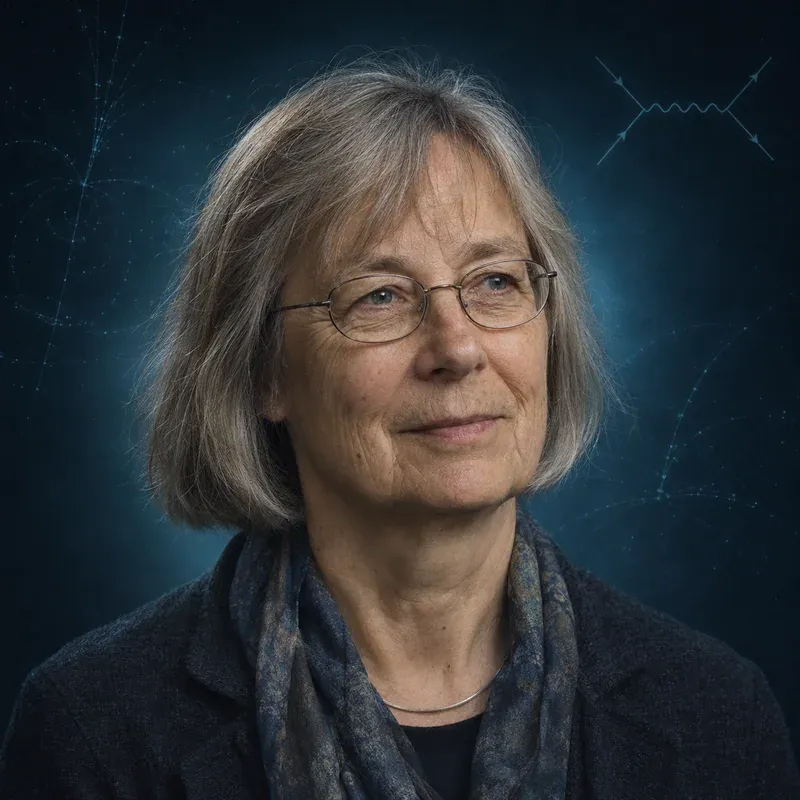
 Illustration
Olga Botner
Botner moved from accelerator physics at CERN to neutrino astronomy when her Uppsala group joined the AMANDA telescope at the South Pole in 1998, and the group then became part of IceCube. She was elected IceCube spokesperson in May 2013, a few months before the collaboration published evidence for high-energy neutrinos of astrophysical origin, and led it until May 2017. During her term IceCube confirmed the flux with upgoing muon neutrinos, recorded a track depositing about 2.6 PeV, published sterile-neutrino and oscillation results and built a real-time alert system for multimessenger follow-up.
- Nationality
- Swedish
- Field
- Experimental particle and astroparticle physics
- Institutions
- University of Copenhagen (PhD 1985), CERN, Uppsala University, IceCube Collaboration
From accelerators to the South Pole
Olga Botner took her candidate degree at the University of Copenhagen in 1978 and her PhD there in 1985. Her early research was at CERN: she worked on the Axial Field Spectrometer at the Intersecting Storage Rings and on identifying charm quarks with a ring-imaging Cherenkov counter in the UA2 experiment. The second project gave her hands-on experience with the physics of Cherenkov light, the same signal on which large neutrino telescopes are built. She later became professor of experimental particle physics at Uppsala University.
In 1998 Botner's Uppsala group joined AMANDA, the first neutrino telescope built in the deep Antarctic ice. AMANDA showed that strings of light sensors frozen into the ice could reconstruct muon tracks, and its groups formed the core of the larger IceCube collaboration led by Francis Halzen. Within IceCube she chaired the publications and speakers committees for several years and sat on the institutional board.
Spokesperson during the discovery years
The collaboration elected Botner spokesperson in May 2013, succeeding Greg Sullivan, and she was re-elected for a second term in 2015. Her first months in office coincided with the publication in Science of 28 high-energy events that could not be explained by atmospheric neutrinos alone, the first evidence for a flux of astrophysical neutrinos. That analysis used starting events whose interaction vertex lay inside the detector, which suppresses the atmospheric background through a self-veto.
Looking back in 2017, Botner named two outcomes of her term as especially important. One was the confirmation of the astrophysical flux with an independent sample of upgoing muon neutrinos, which crossed the Earth before reaching the detector. The other was the most energetic neutrino event recorded until then, a muon track that deposited about 2.6 PeV in IceCube. The collaboration also published a search for sterile neutrinos, increasingly precise atmospheric oscillation parameters from the dense DeepCore infill, and built a real-time trigger and alert system that sends candidate events to telescopes within minutes. That system later enabled the 2017 coincidence of a neutrino with the flaring blazar TXS 0506+056, a landmark of multimessenger astronomy. In May 2017 she handed the role to Darren Grant of the University of Alberta.
Other roles
Botner was elected a member of the Royal Swedish Academy of Sciences in 2001 and served on the Nobel Committee for Physics from 2010 to 2019. In 2017 Uppsala University awarded her the Rudbeck Medal.
Known for
- IceCube spokesperson (2013–2017)
- Leadership of the Uppsala AMANDA and IceCube group
- Collaboration leadership during the discovery of the astrophysical neutrino flux
- Member of the Nobel Committee for Physics (2010–2019)
- Earlier work on ring-imaging Cherenkov detection at CERN
Chronology
- 1985PhD, University of Copenhagen
- 1998Uppsala group joins AMANDA at the South Pole
- 2001Elected to the Royal Swedish Academy of Sciences
- 2010Joins the Nobel Committee for Physics (to 2019)
- 2013Elected IceCube spokesperson
- 2017Hands the spokesperson role to Darren Grant; Rudbeck Medal
Original papers
- IceCube Collaboration (M. G. Aartsen et al.), Evidence for high-energy extraterrestrial neutrinos at the IceCube detector, Science 342, 1242856 (2013)DOI 10.1126/science.1242856
- IceCube Collaboration (M. G. Aartsen et al.), Observation of high-energy astrophysical neutrinos in three years of IceCube data, Phys. Rev. Lett. 113, 101101 (2014)DOI 10.1103/PhysRevLett.113.101101
Experiments
Connected people
Frequently asked questions
What was Olga Botner's role in IceCube?
She led the Uppsala group in AMANDA and IceCube and was the collaboration's spokesperson from May 2013 to May 2017, the period in which the astrophysical neutrino flux was first reported and then confirmed.
What did IceCube find while she was spokesperson?
Evidence for high-energy astrophysical neutrinos (2013), its confirmation with upgoing muon neutrinos, a muon track depositing about 2.6 PeV, sterile-neutrino and oscillation results, and a real-time alert system for follow-up observations.
Did she sit on the Nobel Committee?
Yes. She was a member of the Nobel Committee for Physics from 2010 to 2019.
Last updated: · Editorial standard
Cite this page
Text
Neutrino Atlas (2026). “Olga Botner”. Retrieved 22 November 2026, from https://neutrino-atlas.com/people/olga-botner/BibTeX
@misc{neutrinoatlas2026peopleolgabotner,
  title        = {Olga Botner},
  author       = {{Neutrino Atlas}},
  year         = {2026},
  url          = {https://neutrino-atlas.com/people/olga-botner/},
  note         = {Accessed 2026-11-22},
  language     = {english}
}