2005Experiment
IceCube deploys its first string
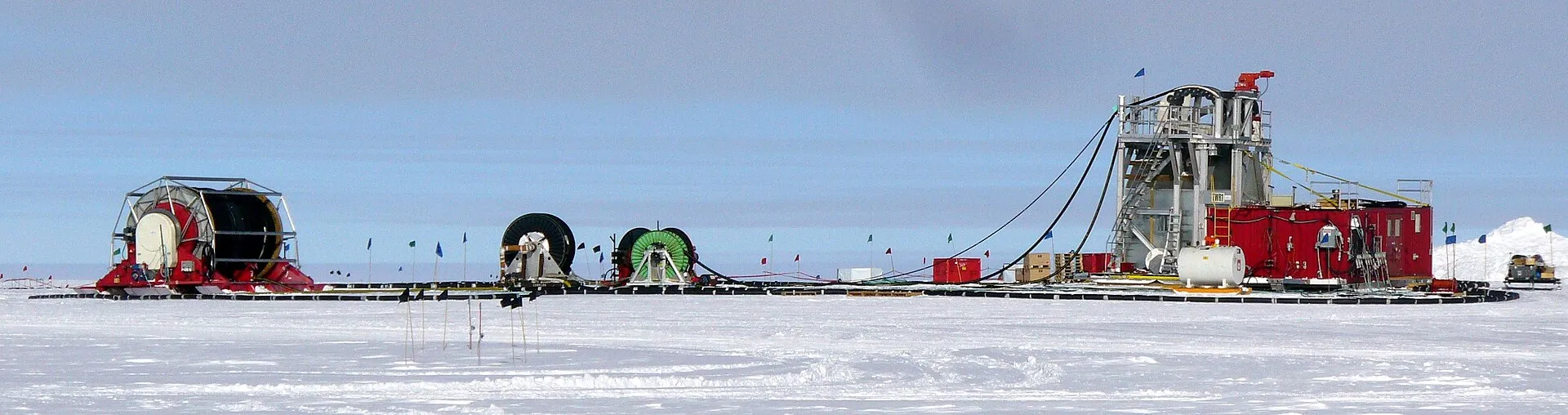
In January 2005 the first of IceCube's strings was lowered into a hole melted with hot water at the South Pole, carrying 60 digital optical modules at depths between 1,450 and 2,450 m. The project, led by Francis Halzen at the University of Wisconsin–Madison, aimed at a cubic kilometre of instrumented ice. Strings were added each austral summer until completion in December 2010.
- Date
- 2005
- Kind of event
- Experiment
- People involved
- Francis Halzen, Christian Spiering, Thomas K. Gaisser
- Experiments
- IceCube Neutrino Observatory
The situation before
Since the early 1990s the AMANDA detector had shown that the deep Antarctic ice under the South Pole station is clear enough to serve as a neutrino telescope. AMANDA saw thousands of atmospheric neutrinos but no cosmic sources. Estimates of the expected fluxes from active galaxies and gamma-ray bursts suggested that a detector of about one cubic kilometre was needed, some thirty times larger. Francis Halzen of the University of Wisconsin–Madison, with Christian Spiering at DESY Zeuthen and many others, proposed IceCube on that scale. The US National Science Foundation funded construction, with contributions from Germany, Sweden, Belgium and other countries.
What happened
Construction could only proceed during the short austral summer, roughly November to February, when aircraft can reach the Pole. In the 2004–2005 season the team commissioned a new Enhanced Hot Water Drill, which melts a hole about 60 cm wide and 2,500 m deep with a jet of hot water in around two days. In January 2005 the first string was lowered into such a hole before it refroze.
- Each string carried 60 digital optical modules, spaced 17 m apart between 1,450 and 2,450 m depth.
- Unlike AMANDA's analogue modules, each IceCube module digitised its photomultiplier signal inside the glass sphere and sent the data to the surface.
- The first season also installed tanks of the IceTop surface array for cosmic-ray air showers.
The first string worked from the start. Its modules recorded muons from cosmic-ray showers, and an early performance paper showed that the timing and noise rates met the design goals. That mattered: once frozen in, a module can never be retrieved, so the design had to be right before mass deployment.
What followed
With the drill proven, the pace increased each season: eight strings in 2005–2006, thirteen in 2006–2007, and 18 to 20 per season in the three seasons after that. Data taking ran in parallel with construction, so partial configurations named IC22, IC40 and IC59 produced physics results while the array grew. Thomas Gaisser, a leading figure in the IceTop air-shower programme, and many other groups built the analyses for these stages.
The last of 86 strings went in on 18 December 2010, completing the observatory. In 2013 IceCube reported the first high-energy astrophysical neutrinos, and in 2017–2018 it linked neutrinos to the blazar TXS 0506+056.
Frequently asked questions
When did IceCube construction begin?
The first string was deployed at the South Pole in January 2005, after the hot-water drill was commissioned in the 2004–2005 austral summer.
How are IceCube's sensors installed?
A hot-water drill melts a hole about 2.5 km deep; a cable with 60 optical modules is lowered into it, and the water refreezes around them within days.
Original papers
- ProposalJ. Ahrens et al. (IceCube), Sensitivity of the IceCube detector to astrophysical sources of high energy muon neutrinos, Astropart. Phys. 20, 507 (2004)arXiv:astro-ph/0305196
- First resultA. Achterberg et al. (IceCube), First year performance of the IceCube neutrino telescope, Astropart. Phys. 26, 155 (2006)arXiv:astro-ph/0604450
Concepts
Last updated: · Editorial standard
Cite this page
Text
Neutrino Atlas (2026). “2005: IceCube deploys its first string”. Retrieved 22 November 2026, from https://neutrino-atlas.com/timeline/2005-icecube-construction-begins/BibTeX
@misc{neutrinoatlas2026cecubeconstructionbegins,
  title        = {2005: IceCube deploys its first string},
  author       = {{Neutrino Atlas}},
  year         = {2026},
  url          = {https://neutrino-atlas.com/timeline/2005-icecube-construction-begins/},
  note         = {Accessed 2026-11-22},
  language     = {english}
}