2005Discovery
KamLAND detects geoneutrinos
In Nature on 28 July 2005, KamLAND reported the first experimental evidence for antineutrinos from uranium and thorium decays inside the Earth, after subtracting reactor antineutrinos. The number of events was consistent with Earth models, though with large uncertainty. Later analyses estimated the radiogenic heat from uranium and thorium at about 20 terawatts, roughly half of Earth's total heat flow. The detection opened neutrino geophysics.
- Date
- 28 July 2005
- Kind of event
- Discovery
- People involved
- Kunio Inoue, Atsuto Suzuki
- Experiments
- KamLAND
Background
The Earth loses heat into space at about 46 terawatts. Part of it is primordial, left over from the planet's formation, and part is radiogenic, produced by the decay of uranium, thorium and potassium in rocks. How the two compare is one of the basic open numbers of geophysics, because it controls mantle convection and plate tectonics. Rock samples reveal the composition of the crust, but almost nothing from the deep mantle is accessible. In the 1960s George Marx and Gernot Eder had noted that the decay chains emit electron antineutrinos, which leave the Earth unhindered. Measuring these geoneutrinos would weigh the planet's radioactive content directly, but the flux is tiny and no detector had seen it.
What happened
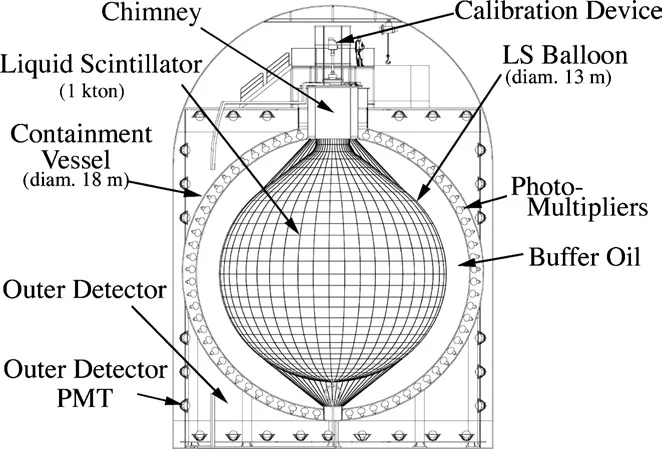
KamLAND was built to study reactor antineutrinos, but its 1,000 tonnes of scintillator could also record antineutrinos from uranium-238 and thorium-232 above the 1.8 MeV threshold of inverse beta decay. In the energy window from 1.7 to 3.4 MeV the collaboration, with Kunio Inoue leading the analysis and Atsuto Suzuki as head of the experiment, analysed 749 days of data taken between March 2002 and October 2004.
- 152 candidate events were found in the window.
- Backgrounds were estimated at about 127 events: mostly reactor antineutrinos, plus neutrons from the (α,n) reaction on carbon-13, with alphas from polonium-210 in the scintillator.
- The fit gave 25 (+19 −18) geoneutrino events, against about 19 expected from a reference Earth model.
- The data set an upper limit of 60 TW on radiogenic heat from uranium and thorium at 99 percent confidence.
The result was published in Nature on 28 July 2005 under the title „Experimental investigation of geologically produced antineutrinos with KamLAND“. The statistical significance was modest and the uncertainty large. But the energy spectrum showed the expected shape, and the measured rate was consistent with geochemical models of the Earth.
Reaction
Geophysicists greeted the paper as the start of a new tool. For the first time a number about the planet's interior had come from particle physics rather than from seismology or rock chemistry. The main criticisms were technical and acknowledged by the authors: Japan's dense reactor network produced most of the background, and the (α,n) background was not yet well measured. KamLAND later purified its scintillator to reduce the polonium contamination, and the shutdown of Japanese reactors after the March 2011 Fukushima accident lowered the reactor background sharply.
Consequences
- In 2010 Borexino at Gran Sasso, with far fewer nearby reactors, confirmed geoneutrinos at 4.2σ.
- In 2011 KamLAND estimated the radiogenic heat from uranium and thorium at about 20 TW, roughly half of the Earth's total heat flow, implying that primordial heat is still important.
- Combined KamLAND and Borexino results began to test models of radiogenic heat in the mantle; new detectors such as SNO+ and JUNO will add sites on different crust types.
The 2005 detection is regarded as the birth of neutrino geophysics, an observational field that did not exist before.
Frequently asked questions
When were geoneutrinos first detected?
KamLAND reported the first experimental evidence for geoneutrinos in Nature on 28 July 2005, using data from 2002 to 2004.
What can geoneutrinos tell us?
Their rate measures how much uranium and thorium the Earth contains, and therefore how much of the planet's internal heat comes from radioactivity rather than from its formation.
How many geoneutrinos did KamLAND see?
About 25 events, with an uncertainty of nearly 20 events, among 152 candidates in the relevant energy window.
Original papers
- DiscoveryT. Araki et al. (KamLAND), Experimental investigation of geologically produced antineutrinos with KamLAND, Nature 436, 499 (2005)DOI 10.1038/nature03980
Concepts
Mentioned in 4 pages
Last updated: · Editorial standard
Cite this page
Text
Neutrino Atlas (2026). “2005: KamLAND detects geoneutrinos”. Retrieved 22 November 2026, from https://neutrino-atlas.com/timeline/2005-kamland-geoneutrinos/BibTeX
@misc{neutrinoatlas2026e2005kamlandgeoneutrinos,
  title        = {2005: KamLAND detects geoneutrinos},
  author       = {{Neutrino Atlas}},
  year         = {2026},
  url          = {https://neutrino-atlas.com/timeline/2005-kamland-geoneutrinos/},
  note         = {Accessed 2026-11-22},
  language     = {english}
}