JUNO
A 20-kilotonne liquid scintillator detector in China designed to determine the neutrino mass ordering.
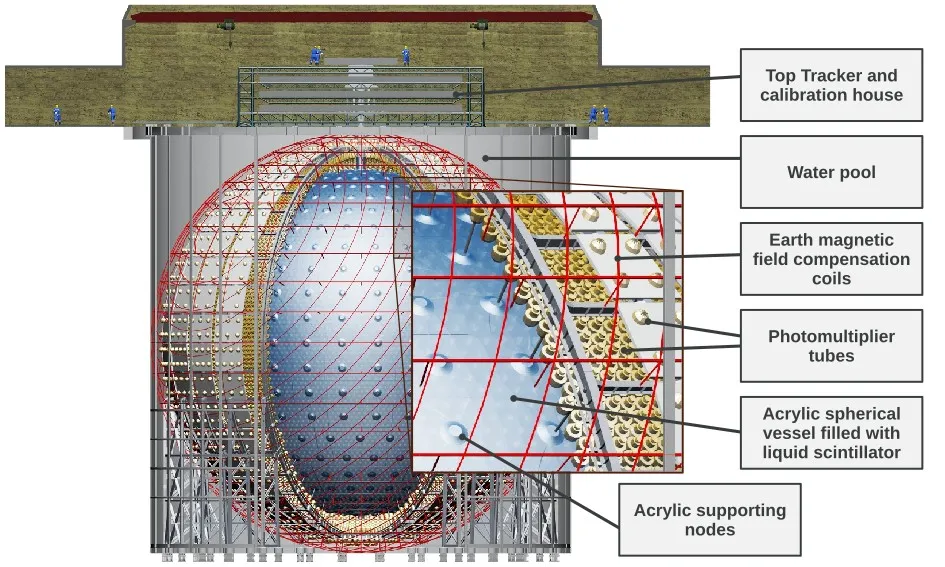
The Jiangmen Underground Neutrino Observatory sits about 52.5 km from the Yangjiang and Taishan reactor complexes. A 35.4 m acrylic sphere holds 20 kt of LAB scintillator, viewed by about 17,600 20-inch and 25,600 3-inch PMTs (about 78% coverage) for about 3% energy resolution. Physics data taking began on 26 August 2025. The first result (November 2025, 59 days) measured θ₁₂ and Δm²₂₁ 1.6 times more precisely than all previous experiments combined (Nature, June 2026).
Compare all experiments → · World map →
In plain words
Reactor antineutrinos travelling about 50 km oscillate in two ways at once: a slow, deep wave driven by the "solar" mass difference and, on top of it, fast small ripples driven by the "atmospheric" one. The exact spacing of those ripples depends on whether the third neutrino mass state is the heaviest or the lightest. JUNO is built to read that fine pattern, which demands an energy measurement sharper than any large scintillator detector before it.
How the detector works
The detector sits about 700 m underground near Kaiping in Guangdong, at a baseline of about 52.5 km from the Yangjiang and Taishan nuclear power plants. A 35.4 m acrylic sphere holds 20,000 tonnes of linear-alkylbenzene liquid scintillator. About 17,600 large 20-inch photomultipliers and 25,600 small 3-inch tubes watch it, covering about 78 percent of the surface (PMT coverage). The sphere sits in a 44 m deep water pool that shields against rock radioactivity and acts as a Cherenkov muon veto. The design goal is an energy resolution of about 3 percent at 1 MeV.
Key results
Detector installation ran from 2021 to December 2024, and physics data taking began on 26 August 2025. Only 59 days of data were enough for a first result in November 2025: sin²θ₁₂ = 0.3092 ± 0.0087 and Δm²₂₁ = (7.50 ± 0.12) × 10⁻⁵ eV², 1.6 times more precise than all earlier experiments combined. The value of Δm²₂₁ remains in mild tension, about 1.5σ, with the one inferred from solar neutrinos.
Why it matters for neutrino physics
JUNO is the only experiment that tests the mass ordering through vacuum oscillations of reactor antineutrinos, largely independent of the matter effects used by accelerator and atmospheric experiments. Comparing the two approaches is a strong consistency test. The collaboration expects about six to seven years of data for a determination at roughly 3σ, and sub-percent precision on θ₁₂, Δm²₂₁ and Δm²₃₁. The same detector records geoneutrinos, solar ⁸B neutrinos, and would see thousands of events from a galactic supernova.
Collaboration
JUNO was proposed in 2008 and approved in 2013 under the leadership of Wang Yifang, with Cao Jun among its initiators. The collaboration has more than 700 scientists from 74 institutions in 17 countries and regions. A small satellite detector, JUNO-TAO, measures the unoscillated reactor spectrum.
Frequently asked questions
When will JUNO determine the mass ordering?
The collaboration projects a roughly 3σ result after about six to seven years of running, earlier in combination with accelerator and atmospheric data.
Why is JUNO 52.5 km from the reactors?
At that distance the slow oscillation driven by Δm²₂₁ is near its first maximum, where the fast ripples that reveal the mass ordering are most visible.
Original papers
- ProposalF. An et al. (JUNO Collaboration), Neutrino physics with JUNO, J. Phys. G 43, 030401 (2016)DOI 10.1088/0954-3899/43/3/030401
- First resultJUNO Collaboration, First measurement of reactor neutrino oscillations at JUNO, Nature (2026)DOI 10.1038/s41586-026-10538-zarXiv:2511.14593
Go deeper
- JUNO-TAOA small, high-resolution satellite detector about 44 m from a Taishan reactor core that measures the reference reactor spectrum.
Related terms
People
Latest research on this topic
- Reactor Antineutrino Detection with JUNO-TAO: Commissioning Performance and First ResultsJUNO Collaboration · 16 October 2026
- Novel dependence between neutrino mass splittings strongly supported by initial JUNO resultsAlikhanov, I. · 5 October 2026
- Measurement of Neutrino Oscillation Parameters at JUNO and Indication of the Neutrino Mass OrderingJUNO Collaboration · 29 September 2026
- Constraining ultralight vector bosons via solar neutrino oscillations: The gauged <math display="inline"><msub><mi>L</mi><mi>μ</mi></msub><mo>-</mo><msub><mi>L</mi><mi>τ</mi></msub></math> model and prospects for JUNO and XLZDLopes, Ilídio · 27 September 2026
- Alumina filtration plant for optical purification of the JUNO liquid scintillatorLing, Xin, Sun, Lijun, Zhu, Zhihang et al. · 10 September 2026
- Quantifying Information Hierarchy for Neutrino Oscillation Parameters at JUNOShu, Yu-han, Chundawat, Neetu Raj Singh, Delgadillo, Luis A. et al. · 9 September 2026
On the timeline
- 2025JUNO begins data taking
- 2025JUNO's first results set precision records
- 2026JUNO sees a first hint of the mass ordering
Mentioned in 123 pages
Lessons 11
FAQ 9
Comparisons 5
Milestones 20
- 1956 · Cowan and Reines detect the neutrino
- 1966 · Antineutrinos from Earth's interior proposed
- 1978 · Wolfenstein: matter changes neutrino oscillations
- 1987 · Neutrinos from supernova SN 1987A
- 1995 · Nobel Prize for neutrino detection
- 2002 · KamLAND sees reactor antineutrinos disappear
- 2004 · KamLAND observes the oscillation spectrum
- 2005 · KamLAND detects geoneutrinos
12 more
- 2007 · Borexino measures beryllium-7 solar neutrinos in real time
- 2010 · Borexino confirms geoneutrinos
- 2012 · Daya Bay discovers a non-zero θ₁₃
- 2012 · RENO confirms θ₁₃
- 2015 · Breakthrough Prize honours five oscillation experiments
- 2020 · Borexino detects neutrinos from the CNO cycle
- 2020 · Gadolinium is added to Super-Kamiokande
- 2024 · KamLAND-Zen's complete data set tightens the Majorana bound
- 2025 · JUNO begins data taking
- 2025 · JUNO's first results set precision records
- 2025 · NOvA and T2K publish a joint analysis
- 2026 · JUNO sees a first hint of the mass ordering
People 13
Terms 65
57 more
- Coincidence / Delayed-signal technique
- Core-collapse supernova mechanism
- Cosmological neutrino mass bounds
- Cowan–Reines Neutrino Experiment
- Cross section
- Dark rate
- Day-night asymmetry measurement
- Daya Bay
- Diffuse supernova neutrino background
- Energy resolution
- Energy scale & nonlinearity
- Experiments & detectors
- Flavour symmetries
- Geoneutrinos
- Inverse beta decay
- Inverse beta decay (IBD)
- Inverted ordering
- JUNO-TAO
- KamLAND
- L/E
- L/E (baseline over energy)
- Liquid scintillator detector
- LVD (Large Volume Detector)
- Mass eigenstates
- Mass-ordering sensitivity
- Mixing angle θ12
- Neutrino mass ordering
- Neutrino oscillation physics
- Nuclear reactors as neutrino sources
- Open questions in oscillations
- Oscillation length
- Oscillation observables
- Oscillation parameter degeneracies
- Photocathode coverage
- Photodetection
- Photomultiplier tube (PMT)
- PMNS unitarity tests
- Pre-supernova neutrinos
- Proton decay
- Quantum efficiency
- Reactor antineutrinos
- Reactor neutrino experiments
- Scintillation
- Sensitivity
- Shielding
- Silicon photomultiplier (SiPM)
- SNEWS (SuperNova Early Warning System)
- Solar mass splitting Δm²21
- Solar metallicity problem
- Solar neutrino experiments
- STEREO
- Supernova neutrino signal phases
- Supernova neutrinos
- Systematic uncertainty
- Terrestrial neutrino unit (TNU)
- Trigger & data acquisition
- Wavelength shifter
Last updated: · Editorial standard
Cite this page
Text
Neutrino Atlas (2026). “JUNO”. Retrieved 22 November 2026, from https://neutrino-atlas.com/terms/juno/BibTeX
@misc{neutrinoatlas2026termsjuno,
  title        = {JUNO},
  author       = {{Neutrino Atlas}},
  year         = {2026},
  url          = {https://neutrino-atlas.com/terms/juno/},
  note         = {Accessed 2026-11-22},
  language     = {english}
}