2020Discovery
Borexino detects neutrinos from the CNO cycle
Borexino announced in June 2020, and published in Nature in November, the first detection of neutrinos from the carbon-nitrogen-oxygen fusion cycle, at about 5σ. The CNO cycle produces only about 1 percent of the Sun's energy but dominates in heavier stars. The measurement, which required exceptional thermal stabilisation of the detector to control backgrounds, completed Borexino's spectroscopy of solar fusion and bears on the solar metallicity problem.
- Date
- 2020
- Kind of event
- Discovery
- People involved
- Gianpaolo Bellini, Frank Paul Calaprice
- Experiments
- Borexino, Laboratori Nazionali del Gran Sasso (LNGS)
Background
In 1938 and 1939 Hans Bethe and Carl Friedrich von Weizsäcker independently described two ways in which stars fuse hydrogen into helium: the proton-proton chain and the carbon-nitrogen-oxygen, or CNO cycle, in which carbon, nitrogen and oxygen nuclei act as catalysts. In the Sun the CNO cycle contributes only about 1 percent of the energy, but in stars more than about 1.3 times as massive it dominates. Its neutrinos, from the beta decays of nitrogen-13, oxygen-15 and fluorine-17, had never been seen. Their flux also depends directly on the abundance of heavy elements in the solar core, which is at the centre of the solar metallicity problem.
What happened
Borexino at LNGS had already measured all main neutrino components of the pp chain. CNO neutrinos were harder. Their recoil spectrum, up to about 1.5 MeV, overlaps almost completely with that of bismuth-210, a radioactive contaminant on the inner vessel and in the scintillator. The bismuth rate could only be determined through its daughter, polonium-210, which emits easily identified alpha particles, but only if polonium from the vessel walls did not drift into the central volume.
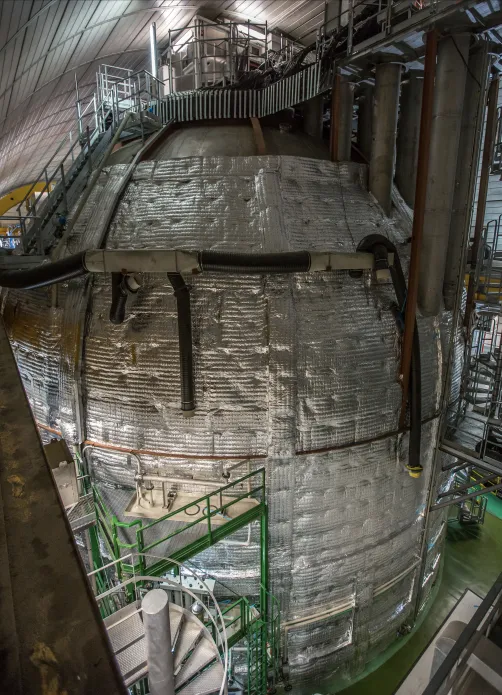
Tiny temperature differences drove slow convection currents that carried polonium inward. Between 2014 and 2016 the collaboration therefore wrapped the detector in thermal insulation and installed an active temperature control system. With the scintillator stabilised, a quiet region with low polonium content formed in the centre, allowing the bismuth-210 rate to be fixed. With Gianpaolo Bellini and Frank Calaprice among the long-time leaders of the effort, the collaboration analysed data from July 2016 to February 2020.
The fit found a CNO neutrino interaction rate of 7.2 (+3.0/−1.7) counts per day per 100 tonnes. The hypothesis of no CNO signal was rejected at 5.0σ. The corresponding flux at Earth was
The result was first presented at the online Neutrino 2020 conference in June 2020 and published in Nature in November 2020.
Reaction
The detection was described as the first direct experimental confirmation of the CNO cycle, more than 80 years after it was proposed. It completed the experimental picture of how the Sun produces energy. It also showed that a liquid-scintillator detector could be stabilised well enough to control backgrounds at a level once thought out of reach.
Why it matters
The CNO flux measures the carbon and nitrogen content of the solar core. Solar models based on older, higher abundances agree with helioseismology, while those based on newer spectroscopic analyses do not. The 2020 result was compatible with both but slightly favoured higher metallicity. Borexino stopped taking data in October 2021, and an analysis of its complete data set in 2022 raised the significance of the CNO signal and strengthened that mild preference. Future large detectors such as JUNO, SNO+ and proposed liquid-scintillator or water-based projects aim at a precise CNO measurement that could settle the metallicity question.
Frequently asked questions
What is the CNO cycle?
A fusion process in which carbon, nitrogen and oxygen nuclei catalyse the conversion of hydrogen into helium. It provides about 1 percent of the Sun's energy but dominates in heavier stars.
When were CNO neutrinos first detected?
Borexino announced the detection in June 2020 and published it in Nature in November 2020, at a significance of 5.0σ.
Why did Borexino need thermal stabilisation?
Convection currents carried polonium-210 into the centre of the detector and prevented a measurement of the bismuth-210 background. Insulating and temperature-controlling the detector stopped this mixing.
Original papers
- DiscoveryM. Agostini et al. (Borexino Collaboration), Experimental evidence of neutrinos produced in the CNO fusion cycle in the Sun, Nature 587, 577 (2020)DOI 10.1038/s41586-020-2934-0
Concepts
Mentioned in 3 pages
Last updated: · Editorial standard
Cite this page
Text
Neutrino Atlas (2026). “2020: Borexino detects neutrinos from the CNO cycle”. Retrieved 22 November 2026, from https://neutrino-atlas.com/timeline/2020-borexino-cno/BibTeX
@misc{neutrinoatlas2026timeline2020borexinocno,
  title        = {2020: Borexino detects neutrinos from the CNO cycle},
  author       = {{Neutrino Atlas}},
  year         = {2026},
  url          = {https://neutrino-atlas.com/timeline/2020-borexino-cno/},
  note         = {Accessed 2026-11-22},
  language     = {english}
}