2017Discovery
COHERENT observes coherent neutrino-nucleus scattering
The COHERENT collaboration reported in Science on 3 August 2017 the first observation of coherent elastic neutrino-nucleus scattering, predicted by Daniel Freedman in 1974. A 14.6 kg cesium-iodide crystal at the Spallation Neutron Source at Oak Ridge detected tiny nuclear recoils from neutrinos produced by stopped pions, at 6.7σ. Because the cross-section is so large, the detector weighed only a few kilograms. CEvNS opened a new way to test the Standard Model and to build compact neutrino detectors.
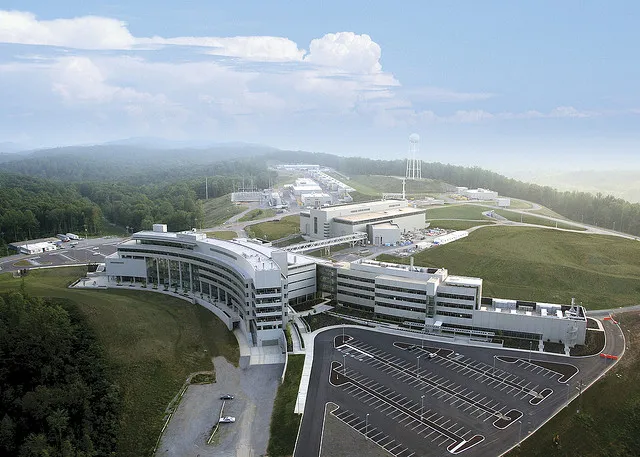
- Date
- 3 August 2017
- Kind of event
- Discovery
- People involved
- Juan I. Collar, Kate Scholberg, Daniel Z. Freedman
- Experiments
- COHERENT, Spallation Neutron Source (SNS)
Background
Soon after the discovery of the weak neutral current in 1973, Daniel Freedman pointed out in 1974 that a low-energy neutrino should be able to scatter off an entire nucleus at once. Because the neutrino interacts coherently with all neutrons, the cross-section grows roughly with the square of the neutron number and becomes far larger than for any other neutrino process at these energies. The catch is the signal: the nucleus recoils with only a few kiloelectronvolts. Freedman himself called the proposal possibly "an act of hubris" because of the experimental difficulties. For more than four decades coherent elastic neutrino-nucleus scattering, CEvNS, remained unobserved.
What happened
The COHERENT collaboration, with Kate Scholberg of Duke University as spokesperson, chose the Spallation Neutron Source at Oak Ridge National Laboratory as its neutrino source. There a pulsed 1 GeV proton beam strikes a mercury target 60 times per second. The pions produced come to rest and decay, emitting a prompt burst of muon neutrinos followed within microseconds by electron neutrinos and muon antineutrinos, all with energies of a few tens of MeV (decay at rest). The short pulses allow most backgrounds to be measured between beam spills.
The first detector was a 14.6 kg crystal of sodium-doped caesium iodide, prepared by Juan Collar's group at the University of Chicago. Caesium and iodine are both heavy nuclei with similar masses, so their recoils are similar and the coherent enhancement is large. The crystal sat in a basement corridor about 19.3 m from the target, later known as Neutrino Alley, inside layers of lead, polyethylene and water shielding.
In about 300 live days of beam operation between 2015 and 2016, the detector recorded 134 ± 22 CEvNS events, compared with a Standard Model expectation of 173 ± 48. The absence of a signal was rejected at 6.7σ, and the timing and energy of the events matched the expected neutrino pattern. The paper "Observation of coherent elastic neutrino-nucleus scattering" was published online in Science on 3 August 2017.
Reaction
The detection was widely reported, often under the headline that a neutrino detector had been shrunk from thousands of tonnes to the size of a fire extinguisher. Physicists emphasised that the measured rate agreed with the Standard Model within its uncertainties, and that this agreement already constrained non-standard interactions of neutrinos with quarks. The result also confirmed the dominant role of the nuclear recoil process that dark-matter experiments must account for as a background.
Why it matters
CEvNS opened a new, cleanly calculable channel for testing the electroweak theory at low momentum transfer, for measuring the neutron distribution in nuclei and for searching for new physics. COHERENT followed with a detection on argon in 2020 and further measurements with other target nuclei. Reactor experiments such as CONUS pursued the process at lower energies, and in 2024 the xenon dark-matter detectors XENONnT and PandaX-4T reported first signs of CEvNS from solar boron-8 neutrinos, the start of the neutrino fog. The large cross-section makes compact detectors possible, for example for reactor monitoring. CEvNS is also part of the physical context discussed for neutrinovoltaics, which considers the momentum that neutrinos transfer to matter.
Frequently asked questions
When was coherent elastic neutrino-nucleus scattering discovered?
COHERENT reported its observation in Science on 3 August 2017, 43 years after Daniel Freedman predicted it in 1974.
Why was the detector so small?
The coherent cross-section is much larger than for other neutrino processes at the same energy, so a 14.6 kg crystal was enough to record over a hundred events.
Why was it so hard to detect?
The recoiling nucleus receives only a few keV of energy. Detecting such tiny signals with low background took decades of detector development.
Original papers
- DiscoveryD. Akimov et al. (COHERENT Collaboration), Observation of coherent elastic neutrino-nucleus scattering, Science 357, 1123 (2017)DOI 10.1126/science.aao0990
- TheoryD. Z. Freedman, Coherent effects of a weak neutral current, Phys. Rev. D 9, 1389 (1974)DOI 10.1103/PhysRevD.9.1389
Concepts
Mentioned in 2 pages
Last updated: · Editorial standard
Cite this page
Text
Neutrino Atlas (2026). “2017: COHERENT observes coherent neutrino-nucleus scattering”. Retrieved 22 November 2026, from https://neutrino-atlas.com/timeline/2017-coherent-cevns/BibTeX
@misc{neutrinoatlas2026imeline2017coherentcevns,
  title        = {2017: COHERENT observes coherent neutrino-nucleus scattering},
  author       = {{Neutrino Atlas}},
  year         = {2026},
  url          = {https://neutrino-atlas.com/timeline/2017-coherent-cevns/},
  note         = {Accessed 2026-11-22},
  language     = {english}
}