2016Experiment
KamLAND-Zen pushes 0νββ limits beyond 10²⁶ years
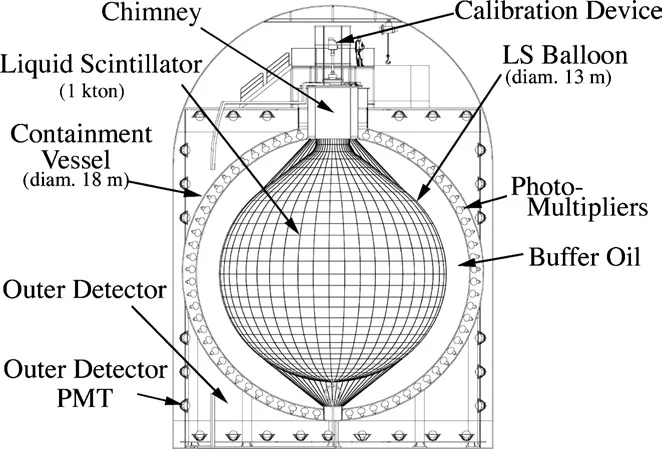
KamLAND-Zen, a balloon of xenon-loaded liquid scintillator suspended inside KamLAND, reported a lower limit of 1.07 × 10²⁶ years on the neutrinoless double beta decay half-life of xenon-136. It was the first limit beyond 10²⁶ years and constrained the effective Majorana mass to below roughly 61–165 meV, depending on nuclear models. It began to probe the region favoured by the inverted mass ordering.
- Date
- 2016
- Kind of event
- Experiment
- People involved
- Kunio Inoue
- Experiments
- KamLAND-Zen
Background
A detection of neutrinoless double beta decay would prove that neutrinos are Majorana particles. The decay rate depends on the effective Majorana mass mββ. If the mass ordering is inverted, mββ must lie roughly between 15 and 50 meV, so reaching that band became the benchmark for the field. Around 2013 the best limits, from germanium (GERDA) and xenon-136 (EXO-200 and KamLAND-Zen), were a few times 10²⁵ years.
What happened
KamLAND-Zen re-used the existing 1,000-tonne KamLAND detector in the Kamioka mine. In 2011 a transparent nylon balloon about 3 m in diameter was installed at its centre and filled with liquid scintillator containing dissolved xenon enriched to about 91 percent in xenon-136. The collaboration was led by Kunio Inoue of Tohoku University. The first phase revealed an unexpected background: silver-110m, a radioactive isotope apparently carried by fallout from the Fukushima reactor accident of March 2011, which had contaminated the balloon material during construction. Its gamma rays fell close to the decay energy of 2.46 MeV.
The team removed the xenon, purified the scintillator by distillation and restarted in December 2013 with about 383 kg of enriched xenon. Data from this second phase up to October 2015, combined with the first phase, gave a half-life limit published in Physical Review Letters in August 2016:
It was the first limit on this decay beyond 10²⁶ years for any isotope. Depending on the nuclear matrix element used, it corresponds to mββ < 61–165 meV.
Reaction and consequences
The result showed that a large liquid-scintillator detector with a dissolved isotope could compete with dedicated low-background experiments, and that the scale could be increased simply by adding more xenon. With the most favourable matrix elements, the limit came close to the upper edge of the inverted-ordering band. For KamLAND-Zen 800 the collaboration built a new, cleaner balloon and loaded about 745 kg of enriched xenon from 2019. Its 2023 result raised the limit to 2.3 × 10²⁶ years and mββ < 36–156 meV, entering the inverted-ordering region. Germanium experiments followed with GERDA's final limit of 1.8 × 10²⁶ years in 2020, and LEGEND and nEXO aim at 10²⁸ years.
Frequently asked questions
What did KamLAND-Zen report in 2016?
A lower limit of 1.07 × 10²⁶ years on the neutrinoless double beta decay half-life of xenon-136, the first limit beyond 10²⁶ years.
What is the Fukushima connection?
The first phase was limited by silver-110m on the balloon, apparently from the 2011 Fukushima fallout. The scintillator had to be purified before the second phase.
Has KamLAND-Zen improved since?
Yes. KamLAND-Zen 800, with about 745 kg of xenon, reported a limit of 2.3 × 10²⁶ years in 2023.
Original papers
- MeasurementA. Gando et al. (KamLAND-Zen Collaboration), Search for Majorana Neutrinos Near the Inverted Mass Hierarchy Region with KamLAND-Zen, Phys. Rev. Lett. 117, 082503 (2016)DOI 10.1103/PhysRevLett.117.082503arXiv:1605.02889
Concepts
Mentioned in 1 page
Lessons 1
Last updated: · Editorial standard
Cite this page
Text
Neutrino Atlas (2026). “2016: KamLAND-Zen pushes 0νββ limits beyond 10²⁶ years”. Retrieved 22 November 2026, from https://neutrino-atlas.com/timeline/2016-kamland-zen-limit/BibTeX
@misc{neutrinoatlas2026eline2016kamlandzenlimit,
  title        = {2016: KamLAND-Zen pushes 0νββ limits beyond 10²⁶ years},
  author       = {{Neutrino Atlas}},
  year         = {2026},
  url          = {https://neutrino-atlas.com/timeline/2016-kamland-zen-limit/},
  note         = {Accessed 2026-11-22},
  language     = {english}
}