2015Award
Nobel Prize for neutrino oscillations
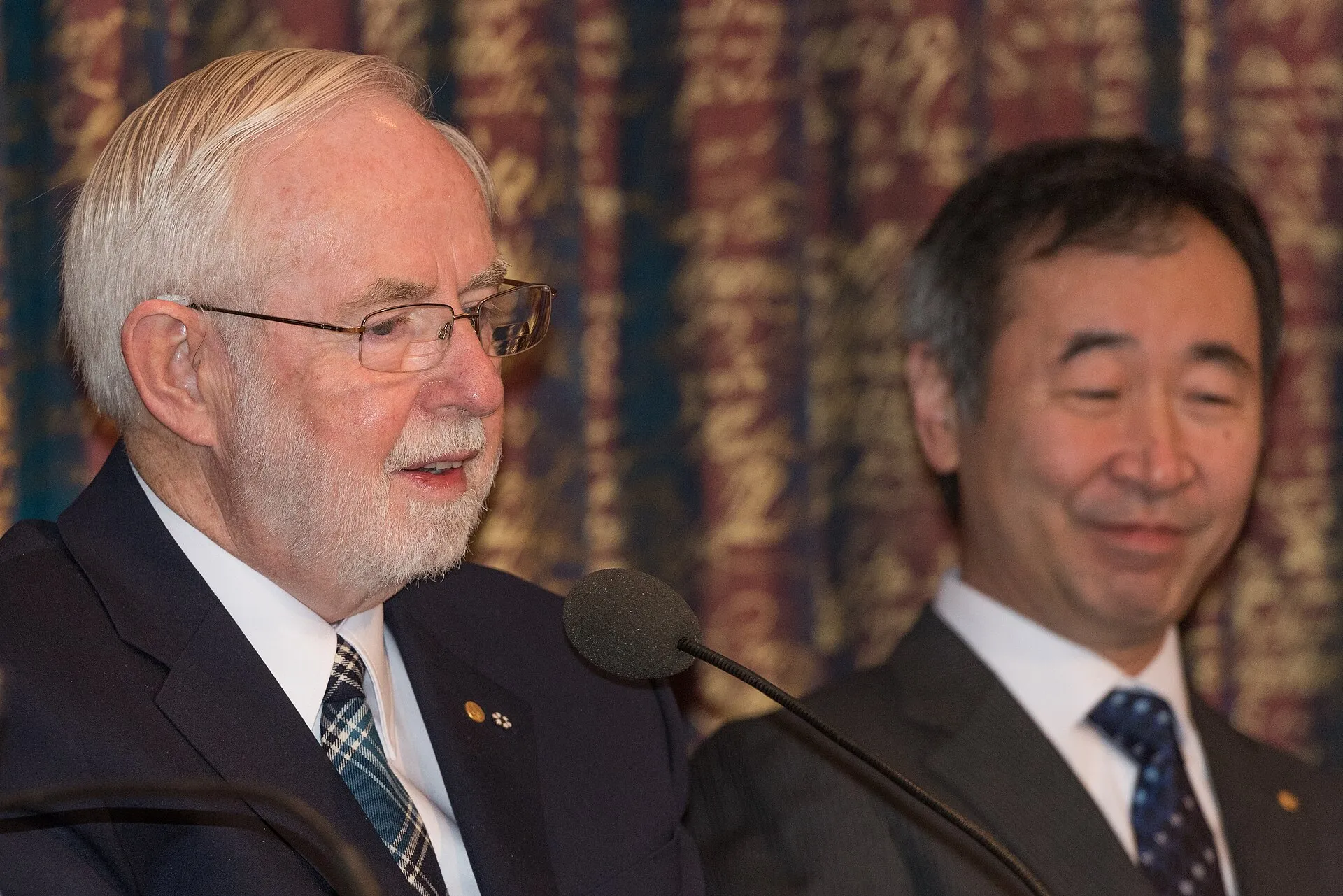
Takaaki Kajita and Arthur B. McDonald received the 2015 Nobel Prize in Physics 'for the discovery of neutrino oscillations, which shows that neutrinos have mass'. Kajita was honoured for Super-Kamiokande's 1998 atmospheric result, McDonald for SNO's 2001–2002 solar measurements. The prize recognised that the Standard Model must be extended to accommodate neutrino mass.
- Date
- 6 October 2015
- Kind of event
- Award
- People involved
- Takaaki Kajita, Arthur B. McDonald
- Experiments
- Super-Kamiokande, SNO (Sudbury Neutrino Observatory)
Background
For most of the twentieth century neutrinos were assumed to be massless, and the Standard Model was built that way. Two long-standing puzzles pointed in another direction. Since the late 1960s Raymond Davis Jr. had found only about a third of the solar neutrinos that John Bahcall's model predicted, the solar neutrino problem. In the 1980s Kamiokande and IMB found fewer atmospheric muon neutrinos than expected. Bruno Pontecorvo and others had suggested that neutrinos could change flavour if they had mass, but the evidence remained ambiguous until two experiments settled it.
What was recognised
On 6 October 2015 the Royal Swedish Academy of Sciences announced that the Nobel Prize in Physics would go jointly to Takaaki Kajita of the University of Tokyo and Arthur B. McDonald of Queen's University in Kingston, Canada, "for the discovery of neutrino oscillations, which shows that neutrinos have mass". The prize amount of 8 million Swedish kronor was shared equally.
- Kajita was honoured for the atmospheric neutrino result of Super-Kamiokande, presented at the Neutrino '98 conference in Takayama in June 1998. Muon neutrinos arriving from below, after crossing the Earth, were clearly fewer than those arriving from above. This zenith-angle dependence was the signature of oscillation into another flavour.
- McDonald was honoured for the results of the Sudbury Neutrino Observatory, which used 1,000 tonnes of heavy water. In 2001 SNO compared its electron-neutrino rate with Super-Kamiokande's data, and in 2002 it measured the neutral-current rate, which counts all flavours equally. The total flux matched the solar model; about two thirds of the electron neutrinos from the Sun had changed flavour on the way.
Both experiments were large collaborations, and both laureates stressed that the prize honoured their colleagues. Super-Kamiokande had been led at the time of the 1998 discovery by Yoji Totsuka, who died in 2008, and the detector traced back to Masatoshi Koshiba's Kamiokande. SNO went back to a 1984 proposal by Herbert Chen, who died in 1987; George Ewan was among its founding leaders. The prizes were presented in Stockholm on 10 December 2015.
Reaction
The award was widely expected; neutrino oscillations had already been recognised by many other prizes. It was the fourth Nobel Prize in Physics for neutrino research, after the prizes to Leon Lederman, Melvin Schwartz and Jack Steinberger in 1988, to Frederick Reines in 1995 and to Davis and Koshiba in 2002. A month later the 2016 Breakthrough Prize in Fundamental Physics honoured the oscillation collaborations themselves, including Super-Kamiokande and SNO.
Why it matters
The Nobel citation spelled out the deeper meaning: oscillations require neutrino mass, and the Standard Model in its original form has no place for it. The prize thus marked an established piece of physics beyond the Standard Model. It also pointed to the open questions that followed directly from the discovery: the absolute mass scale probed by KATRIN, the mass ordering, leptonic CP violation, and whether neutrinos are Majorana particles.
Frequently asked questions
Who won the 2015 Nobel Prize in Physics?
Takaaki Kajita and Arthur B. McDonald, jointly, for the discovery of neutrino oscillations, which shows that neutrinos have mass. The prize was announced on 6 October 2015.
Which experiments were behind the prize?
Kajita's work was with Super-Kamiokande on atmospheric neutrinos (1998); McDonald led SNO, which showed in 2001 and 2002 that solar neutrinos change flavour.
Why was the discovery so important?
It proved that neutrinos have mass, which the original Standard Model does not allow. It was the first firm laboratory evidence for physics beyond the Standard Model.
Original papers
- DiscoveryY. Fukuda et al. (Super-Kamiokande Collaboration), Evidence for Oscillation of Atmospheric Neutrinos, Phys. Rev. Lett. 81, 1562 (1998)DOI 10.1103/PhysRevLett.81.1562
- DiscoveryQ. R. Ahmad et al. (SNO Collaboration), Direct Evidence for Neutrino Flavor Transformation from Neutral-Current Interactions in the Sudbury Neutrino Observatory, Phys. Rev. Lett. 89, 011301 (2002)DOI 10.1103/PhysRevLett.89.011301
Concepts
Mentioned in 2 pages
Last updated: · Editorial standard
Cite this page
Text
Neutrino Atlas (2026). “2015: Nobel Prize for neutrino oscillations”. Retrieved 22 November 2026, from https://neutrino-atlas.com/timeline/2015-nobel-kajita-mcdonald/BibTeX
@misc{neutrinoatlas2026e2015nobelkajitamcdonald,
  title        = {2015: Nobel Prize for neutrino oscillations},
  author       = {{Neutrino Atlas}},
  year         = {2026},
  url          = {https://neutrino-atlas.com/timeline/2015-nobel-kajita-mcdonald/},
  note         = {Accessed 2026-11-22},
  language     = {english}
}