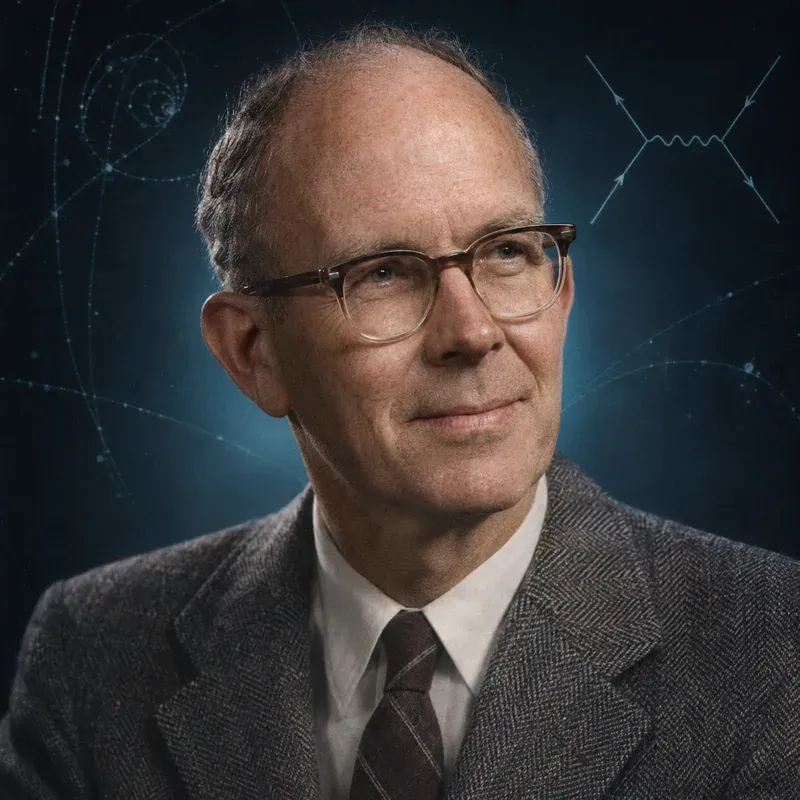
 Illustration
Raymond Davis Jr.
Implementing Pontecorvo's chlorine-argon method, Davis exposed chlorine detectors at the Brookhaven reactor (1954) and the Savannah River reactor (published 1955-56). He found no excess Ar-37, showing that reactor antineutrinos do not induce the reaction Cl-37 -> Ar-37 that neutrinos would - the first experimental evidence that neutrino and antineutrino are distinct, supporting lepton-number conservation. This work led to his Homestake solar-neutrino experiment of the 1960s, which first detected solar neutrinos and revealed the solar neutrino deficit.
- Born
- 14 October 1914
Washington, D.C., USA - Died
- 31 May 2006
Blue Point, New York, USA - Nationality
- American
- Field
- radiochemistry, experimental neutrino physics
- Nobel Prize
- Physics 2002 (shared with Masatoshi Koshiba; other half to Riccardo Giacconi) – for pioneering contributions to astrophysics, in particular for the detection of cosmic neutrinos
- Institutions
- Monsanto Mound Laboratory, Brookhaven National Laboratory, University of Pennsylvania
Early life and education
Raymond Davis Jr. was born in Washington, D.C., in 1914. He studied chemistry at the University of Maryland, graduating in 1938, and received a PhD in physical chemistry from Yale University in 1942. After military service during the Second World War he worked briefly at Dow Chemical and from 1945 at the Monsanto Chemical Company's Mound Laboratory in Ohio. In 1948 he joined the chemistry department of the newly founded Brookhaven National Laboratory on Long Island, where he was asked to choose his own research topic.
Path to neutrino physics
Davis chose the neutrino, a particle that had been predicted by Wolfgang Pauli but not yet observed. He took up a method suggested by Bruno Pontecorvo in 1946: a neutrino striking a chlorine-37 nucleus can turn it into radioactive argon-37 and an electron. Because argon is a noble gas, a few atoms of it can be flushed out of a large volume of liquid and counted by their decay. This radiochemical technique, the chlorine–argon method, suited a chemist perfectly: it needed no particle tracks, only patient chemistry and very sensitive counters.
His first tests used reactors, at Brookhaven in 1954 and then at the Savannah River Plant. He found no excess argon, which mattered more than it might seem. A reactor emits antineutrinos, and the chlorine reaction can only be triggered by neutrinos. The null result was early evidence that the antineutrino is distinct from the neutrino in the way it interacts, consistent with conservation of lepton number. In the same years Frederick Reines and Clyde Cowan detected reactor antineutrinos with a different reaction, inverse beta decay.
Key contributions
Davis then turned to the Sun. Nuclear fusion in the solar core produces vast numbers of electron neutrinos, and theory predicted that a small fraction of them, mostly the high-energy boron-8 neutrinos, could be captured on chlorine. Calculations by John Bahcall based on the standard solar model showed that a detector of several hundred tonnes might see roughly one capture per day. To shield it from cosmic rays, Davis placed it 1,478 metres underground in the Homestake gold mine in Lead, South Dakota.
The Homestake experiment, built in the mid-1960s, consisted of a tank holding about 380 cubic metres (roughly 100,000 gallons) of perchloroethylene, a dry-cleaning fluid rich in chlorine. Every few weeks helium was bubbled through the tank to collect the handful of argon-37 atoms produced, which were then counted in small proportional counters. Davis, Don Harmer and Kenneth Hoffman published the first result in 1968. Solar neutrinos had been detected, but at only about a third of the predicted rate.
This discrepancy became the solar neutrino problem. For two decades many physicists suspected an error either in the extraction chemistry or in the solar model. Davis tested his efficiency repeatedly, including by introducing known numbers of argon atoms into the tank, and the deficit persisted. The experiment ran until 1994; the final analysis by Bruce Cleveland, Davis, Kenneth Lande and colleagues in 1998 gave a rate of about 2.56 SNU, well below the prediction.
Later experiments confirmed the deficit with other methods: Kamiokande and Super-Kamiokande in water, and SAGE and GALLEX with gallium. In 2001–2002 SNO showed that the total flux of solar neutrinos of all flavours agrees with the solar model, while only about a third arrive as electron neutrinos. The missing neutrinos had changed flavour on the way, through neutrino oscillation enhanced by the MSW effect in the Sun. Davis's number had been right.
Later work and legacy
Davis retired from Brookhaven in 1984 and became a research professor at the University of Pennsylvania, which had taken over operation of the Homestake detector. In 2002 he shared half of the Nobel Prize in Physics with Masatoshi Koshiba ‘for pioneering contributions to astrophysics, in particular for the detection of cosmic neutrinos’. At 88 he was then one of the oldest laureates. He also received the National Medal of Science, the Wolf Prize and the Comstock Prize. He died at his home in Blue Point, New York, in May 2006.
Davis's legacy is twofold. He founded experimental neutrino astronomy by showing that neutrinos from the Sun's core can be detected on Earth, and his persistent anomaly was one of the main threads that led to the discovery that neutrinos have mass. The Homestake mine later became the Sanford Underground Research Facility, which will host the far detector of DUNE.
Known for
- Reactor chlorine experiments showing antineutrino ≠ neutrino (1950s)
- Homestake chlorine solar neutrino experiment
- First detection of solar neutrinos
- Radiochemical neutrino detection
Chronology
- 1948Joins Brookhaven National Laboratory
- 1954Chlorine detector at Brookhaven reactor
- 1955Phys. Rev. paper on reactor antineutrino search
- 1956Savannah River chlorine null result
- 1968First Homestake solar neutrino result
- 1984Retires from Brookhaven
- 2002Nobel Prize in Physics
Original papers
- R. Davis Jr., Attempt to detect the antineutrinos from a nuclear reactor by the Cl37(ν̄,e−)A37 reaction, Phys. Rev. 97, 766 (1955)DOI 10.1103/PhysRev.97.766
- R. Davis Jr., D. S. Harmer, K. C. Hoffman, Search for Neutrinos from the Sun, Phys. Rev. Lett. 20, 1205 (1968)DOI 10.1103/PhysRevLett.20.1205
- B. T. Cleveland et al., Measurement of the Solar Electron Neutrino Flux with the Homestake Chlorine Detector, Astrophys. J. 496, 505 (1998)DOI 10.1086/305343
Experiments
- Brookhaven and Savannah River reactor chlorine experiments
- Homestake Chlorine Experiment
- Savannah River reactor chlorine test
Connected people
- Bruce T. Cleveland
- Bruno Pontecorvo
- Frederick Reines
- Kenneth Lande
- Luis W. Alvarez
- Masatoshi Koshiba
- Till A. Kirsten
- Lev Borisovich Okun
Frequently asked questions
What did Raymond Davis Jr. discover?
He made the first detection of neutrinos from the Sun with the Homestake chlorine detector and found that only about a third of the predicted number arrived, the origin of the solar neutrino problem.
Why did Davis use dry-cleaning fluid?
Perchloroethylene is rich in chlorine-37, which a neutrino can convert into argon-37. It is also cheap and safe to handle in large quantities, and argon atoms can be flushed out of it with helium.
Did Raymond Davis Jr. win a Nobel Prize?
Yes. He shared the 2002 Nobel Prize in Physics with Masatoshi Koshiba; the other half went to Riccardo Giacconi.
On the timeline
- 1946Pontecorvo proposes the chlorine-argon detector
- 1955Davis shows antineutrinos do not make argon
- 1964Bahcall and Davis propose a solar neutrino test
- 1968Homestake finds too few solar neutrinos
- 1998Homestake publishes its final solar result
- 2002Nobel Prize for neutrino astrophysics
Mentioned in 64 pages
Lessons 4
FAQ 4
Comparisons 1
Milestones 14
- 1937 · Majorana: a neutrino could be its own antiparticle
- 1939 · Stellar fusion predicts neutrinos from the Sun
- 1946 · Pontecorvo proposes the chlorine-argon detector
- 1955 · Davis shows antineutrinos do not make argon
- 1957 · Pontecorvo proposes neutrino oscillations
- 1964 · Bahcall and Davis propose a solar neutrino test
- 1968 · Homestake finds too few solar neutrinos
- 1969 · Oscillations proposed to explain the solar deficit
People 15
Terms 26
- Antineutrino
- Antiparticle
- Chlorine–Argon method
- Detection efficiency & acceptance
- Detection principles & detector technology
- Dirac vs Majorana nature
- Disappearance measurement
- Discovery of neutrino oscillations
18 more
- Homestake Chlorine Experiment
- Lepton number
- Mixing angle θ12
- Neutrino astronomy
- Neutrino capture on nuclei
- Neutrino in the Standard Model
- Neutrino oscillation physics
- Neutrino–antineutrino oscillation
- Radiochemical detectors
- Radiochemical signal (transmutation)
- Sanford Underground Research Facility (SURF)
- Solar neutrino experiments
- Solar neutrino problem
- Solar neutrino unit (SNU)
- Solar neutrinos
- Standard solar Model
- Underground depth & metres water equivalent
- Underground laboratories
Last updated: · Editorial standard
Cite this page
Text
Neutrino Atlas (2026). “Raymond Davis Jr.”. Retrieved 22 November 2026, from https://neutrino-atlas.com/people/raymond-davis-jr/BibTeX
@misc{neutrinoatlas2026peopleraymonddavisjr,
  title        = {Raymond Davis Jr.},
  author       = {{Neutrino Atlas}},
  year         = {2026},
  url          = {https://neutrino-atlas.com/people/raymond-davis-jr/},
  note         = {Accessed 2026-11-22},
  language     = {english}
}