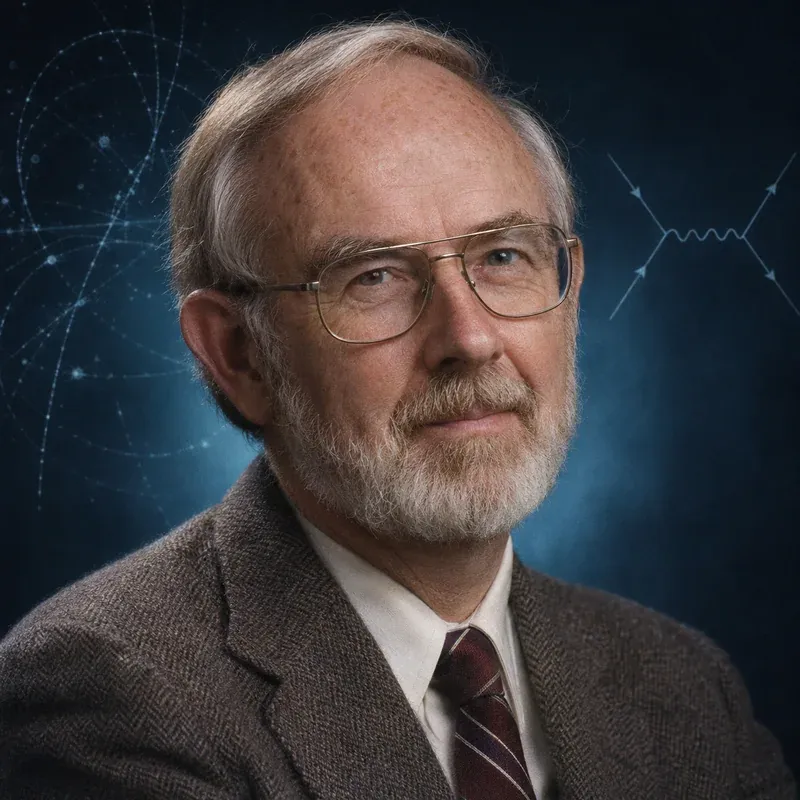
 Illustration
Arthur B. McDonald
McDonald was among the founders of the SNO collaboration in 1984 and led SNO from 1989. Using 1,000 tonnes of heavy water, SNO measured both the electron-neutrino flux (charged current) and the total flux of all active flavours (neutral current) from solar ⁸B neutrinos. The 2001-2002 results showed that electron neutrinos from the Sun change flavour on their way to Earth, which implies non-zero neutrino mass.
- Born
- 29 August 1943
Sydney, Nova Scotia, Canada - Nationality
- Canadian
- Field
- Experimental nuclear and particle astrophysics
- Nobel Prize
- Physics 2015 (shared with Takaaki Kajita) – for the discovery of neutrino oscillations, which shows that neutrinos have mass
- Institutions
- Chalk River Nuclear Laboratories, Princeton University, Queen's University
Early life and education
Arthur Bruce McDonald was born in 1943 in Sydney, Nova Scotia. He studied physics at Dalhousie University in Halifax, earning a BSc in 1964 and an MSc in 1965, and then went to the California Institute of Technology, where he received his PhD in 1969. His early research was in experimental nuclear physics.
Path to neutrino physics
From 1969 to 1982 McDonald was a research officer at the Chalk River Nuclear Laboratories in Ontario, one of Canada’s main centres of nuclear research. In 1982 he moved to Princeton University as professor of physics. During these years the solar neutrino problem was the most persistent puzzle in the field. Raymond Davis Jr.’s Homestake experiment had found only about a third of the electron neutrinos that John Bahcall’s standard solar model predicted. Either the model of the Sun was wrong, or something happened to the neutrinos on their way to Earth.
In 1984 Herbert Chen of the University of California, Irvine, pointed out that heavy water could settle the question. The deuteron, the nucleus of heavy hydrogen, can be broken up by neutrinos in two distinct ways: through a charged-current reaction that only electron neutrinos can cause, and through a neutral-current reaction to which all three flavours contribute equally. Canada had large stocks of heavy water for its CANDU reactors and a very deep mine near Sudbury. McDonald was among the founders of the collaboration that formed that year and in 1989 became its director, moving to Queen’s University in Kingston, Ontario.
Key contributions
The Sudbury Neutrino Observatory was built about two kilometres underground in the Creighton nickel mine. Its heart was 1,000 tonnes of heavy water, on loan from Atomic Energy of Canada Limited, held in a 12-metre acrylic sphere and surrounded by ultra-pure ordinary water and about 9,500 photomultipliers that recorded Cherenkov light. Building it required extraordinary cleanliness, since traces of natural radioactivity could mimic the neutron signal of the neutral-current reaction.
SNO began taking data in 1999. In 2001 it published its measurement of the charged-current rate from boron-8 solar neutrinos and compared it with the elastic-scattering rate measured by Super-Kamiokande, which is also sensitive, more weakly, to muon and tau neutrinos. The difference showed that some solar neutrinos arrive as other flavours. In 2002 SNO’s own neutral-current measurement made the case decisive: the total flux of all active flavours agreed with the solar model, while only about one third arrived as electron neutrinos. The Sun was producing the predicted neutrinos; they were changing flavour on the way. The interplay of the reaction channels is explained under CC/NC channels and the experiment’s three configurations under SNO phases.
Flavour change of this kind requires neutrinos to have mass and to mix, which is not part of the original Standard Model. Combined with reactor data from KamLAND, SNO’s results pinned down the large mixing angle θ₁₂ and showed that the MSW effect in the dense solar interior shapes the flavour content of high-energy solar neutrinos.
Later work
After SNO ended in 2006, its cavern became part of SNOLAB, a permanent underground laboratory. McDonald continued research there with SNO+, which refills the acrylic vessel with liquid scintillator to study low-energy solar neutrinos and to search for neutrinoless double beta decay, and with the dark-matter experiment DEAP-3600. He is also a member of the DarkSide-20k collaboration at Gran Sasso. He held the Gordon and Patricia Gray Chair in Particle Astrophysics at Queen’s from 2006 and became professor emeritus in 2013. In 2020 he led a Canadian team that developed a low-cost ventilator during the COVID-19 pandemic.
Recognition
McDonald shared the 2015 Nobel Prize in Physics with Takaaki Kajita for the discovery of neutrino oscillations, which shows that neutrinos have mass. In 2016 the SNO collaboration, with McDonald, was among the five teams that received the Breakthrough Prize in Fundamental Physics. His other honours include the Benjamin Franklin Medal (2007, with Yoji Totsuka), Fellowship of the Royal Society (2009) and appointment as Companion of the Order of Canada (2015). The Arthur B. McDonald Canadian Astroparticle Physics Research Institute bears his name.
Known for
- Director of the Sudbury Neutrino Observatory (SNO)
- Flavour-resolved measurement of solar neutrinos
- Resolution of the solar neutrino problem
- Nobel Prize in Physics 2015
Chronology
- 1984Co-founds SNO collaboration
- 1989Becomes leader/director of SNO
- 2001SNO charged-current result indicates flavour change of solar neutrinos
- 2002SNO neutral-current measurement confirms total solar flux
- 2015Nobel Prize in Physics
- 2016Breakthrough Prize in Fundamental Physics (with SNO team)
Original papers
- SNO Collaboration (Q. R. Ahmad et al.), Measurement of the rate of nu_e + d -> p + p + e- interactions produced by ⁸B solar neutrinos at the Sudbury Neutrino Observatory, Phys. Rev. Lett. 87, 071301 (2001)DOI 10.1103/PhysRevLett.87.071301
- SNO Collaboration (Q. R. Ahmad et al.), Direct evidence for neutrino flavor transformation from neutral-current interactions in the Sudbury Neutrino Observatory, Phys. Rev. Lett. 89, 011301 (2002)DOI 10.1103/PhysRevLett.89.011301
Experiments
- SNO (Sudbury Neutrino Observatory)
- DEAP-3600
Connected people
- George Ewan
- R. G. Hamish Robertson
- Herbert H. Chen
- Mark C. Chen
- Takaaki Kajita
- Frank Paul Calaprice
- Eugene W. Beier
Frequently asked questions
What did Arthur McDonald discover?
As director of the Sudbury Neutrino Observatory he led the experiment that showed that electron neutrinos from the Sun change into other flavours on their way to Earth, solving the solar neutrino problem.
Why did SNO use heavy water?
Deuterium nuclei react with neutrinos in two ways: one sensitive only to electron neutrinos and one sensitive to all flavours equally. Measuring both at once in the same detector showed directly how many neutrinos had changed flavour.
Who shared the 2015 Nobel Prize with McDonald?
Takaaki Kajita of Super-Kamiokande, who had found oscillations of atmospheric neutrinos.
On the timeline
- 1985Chen proposes a heavy-water solar detector
- 2001SNO shows solar neutrinos change flavour
- 2002SNO measures the total solar neutrino flux
- 2015Nobel Prize for neutrino oscillations
- 2015Breakthrough Prize honours five oscillation experiments
Mentioned in 37 pages
FAQ 5
Milestones 11
- 1957 · Pontecorvo proposes neutrino oscillations
- 1965 · First detection of atmospheric neutrinos
- 1985 · Chen proposes a heavy-water solar detector
- 1995 · Nobel Prize for neutrino detection
- 1998 · Super-Kamiokande discovers neutrino oscillation
- 2001 · SNO shows solar neutrinos change flavour
- 2002 · Nobel Prize for neutrino astrophysics
- 2002 · SNO measures the total solar neutrino flux
Last updated: · Editorial standard
Cite this page
Text
Neutrino Atlas (2026). “Arthur B. McDonald”. Retrieved 22 November 2026, from https://neutrino-atlas.com/people/arthur-b-mcdonald/BibTeX
@misc{neutrinoatlas2026peoplearthurbmcdonald,
  title        = {Arthur B. McDonald},
  author       = {{Neutrino Atlas}},
  year         = {2026},
  url          = {https://neutrino-atlas.com/people/arthur-b-mcdonald/},
  note         = {Accessed 2026-11-22},
  language     = {english}
}