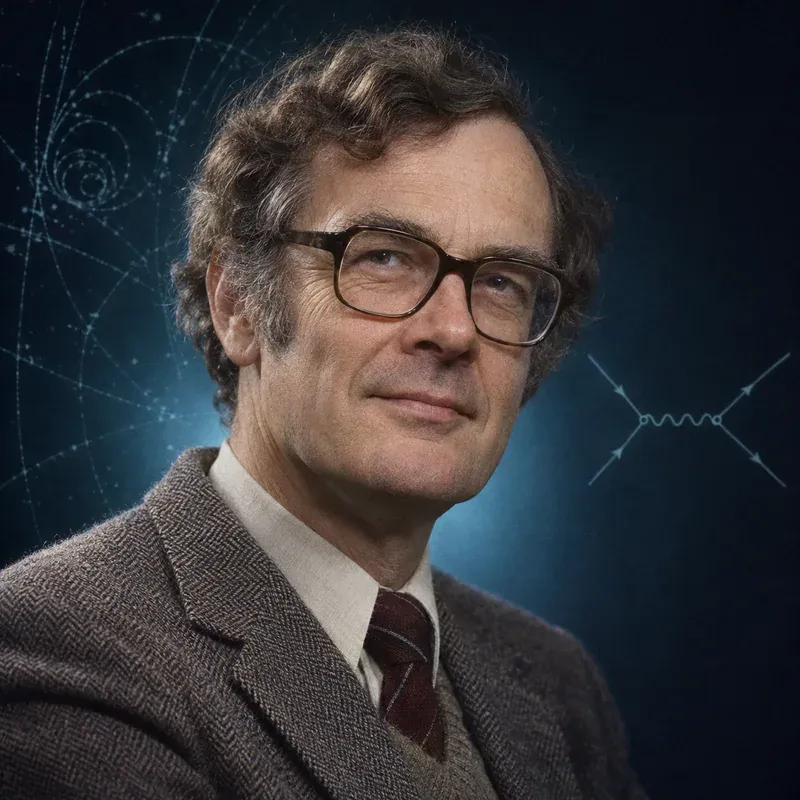
 Illustration
R. G. Hamish Robertson
Robertson used tritium beta decay to constrain the electron-neutrino mass and led the Los Alamos contribution to the Sudbury Neutrino Observatory, which confirmed neutrino flavour change. He later worked on the KATRIN tritium experiment and on Project 8, which aims to measure neutrino mass by cyclotron radiation emission spectroscopy.
- Born
- 3 October 1943
Ottawa, Canada - Nationality
- Canadian-American
- Field
- Experimental nuclear physics
- Institutions
- Michigan State University, Los Alamos National Laboratory, University of Washington
Education and early career
Robert Graham Hamish Robertson was born on 3 October 1943 in Ottawa, Canada, and went to school in Canada and England. He received a BA from the University of Oxford in 1965 and a PhD from McMaster University in 1971, with a dissertation on the properties of odd–odd cobalt nuclei. At Michigan State University, first as a postdoctoral fellow and then as a faculty member, he worked on nuclear astrophysics, including capture reactions of deuterium on helium-4 that helped settle the origin of lithium-6, and he identified the first isobaric quintet of states in nuclei.
Tritium and the neutrino mass
In 1981 Robertson moved to Los Alamos National Laboratory and turned to neutrino physics. At the time a group at ITEP in Moscow, led by Valentin Lyubimov, claimed to have measured a non-zero electron-antineutrino mass of several tens of eV from the beta decay of tritium. Such a mass would have had large consequences for cosmology. Because a neutrino mass changes the shape of the beta spectrum near its endpoint, the claim could be tested by measuring that shape very precisely.
The Los Alamos group built an experiment with a gaseous source of molecular tritium. A gas avoids the solid-state effects that complicate sources in which tritium is bound to a substrate, and the final states of the tritium molecule can be calculated reliably. In 1991 the group published an upper limit of 9.3 eV (95 per cent confidence level) on the effective electron-neutrino mass, excluding the Moscow claim. The result also showed that neutrinos were too light to close the universe gravitationally. Gaseous tritium sources became the design of choice, realised on a much larger scale in the windowless source of KATRIN.
Sudbury Neutrino Observatory
Robertson led the Los Alamos contribution to the Sudbury Neutrino Observatory, the 1,000-tonne heavy-water detector in Ontario led by Arthur B. McDonald. SNO could measure both the electron-neutrino flux, through charged-current reactions, and the total flux of all flavours, through the neutral-current break-up of deuterium. In 2001–2002 it showed that the total flux matched solar models while the electron-neutrino part was only about a third, direct evidence that solar neutrinos change flavour. He continued with SNO after moving to the University of Washington in Seattle in 1994, including a year as visiting scientist at the Sudbury site in 2003–2004.
KATRIN and Project 8
At the University of Washington, where he directed the Center for Experimental Nuclear Physics and Astrophysics and became Boeing Distinguished Professor in 2008, Robertson returned to direct mass measurements. He is a member of KATRIN in Karlsruhe, which uses a MAC-E filter spectrometer and in 2022 reported a limit below 0.8 eV. He also works on Project 8 with Joseph Formaggio and others, which measures the energy of individual beta electrons from the frequency of their cyclotron radiation. That technique could in principle reach below the sensitivity of KATRIN using atomic tritium. He became professor emeritus in 2017.
Recognition
Robertson received the Tom W. Bonner Prize in Nuclear Physics in 1997. He is a Fellow of the American Physical Society and the American Academy of Arts and Sciences and was elected to the US National Academy of Sciences in 2004.
Known for
- Tritium beta-decay neutrino-mass limits
- Leader of Los Alamos role in SNO
- KATRIN
- Project 8
Chronology
- 1981Moves to Los Alamos National Laboratory
- 1994Joins University of Washington
- 1997Tom W. Bonner Prize in Nuclear Physics
- 2004Elected to US National Academy of Sciences
Experiments
Connected people
Frequently asked questions
What is Hamish Robertson known for?
For tritium beta-decay measurements of the neutrino mass, including the 1991 Los Alamos limit of 9.3 eV, for leading the Los Alamos role in SNO, and for work on KATRIN and Project 8.
Why use a gaseous tritium source?
Gaseous molecular tritium avoids solid-state effects of bound sources, and the molecular final states can be calculated precisely. This reduces systematic uncertainties in the shape of the spectrum near the endpoint.
On the timeline
Mentioned in 7 pages
Last updated: · Editorial standard
Cite this page
Text
Neutrino Atlas (2026). “R. G. Hamish Robertson”. Retrieved 22 November 2026, from https://neutrino-atlas.com/people/hamish-robertson/BibTeX
@misc{neutrinoatlas2026peoplehamishrobertson,
  title        = {R. G. Hamish Robertson},
  author       = {{Neutrino Atlas}},
  year         = {2026},
  url          = {https://neutrino-atlas.com/people/hamish-robertson/},
  note         = {Accessed 2026-11-22},
  language     = {english}
}