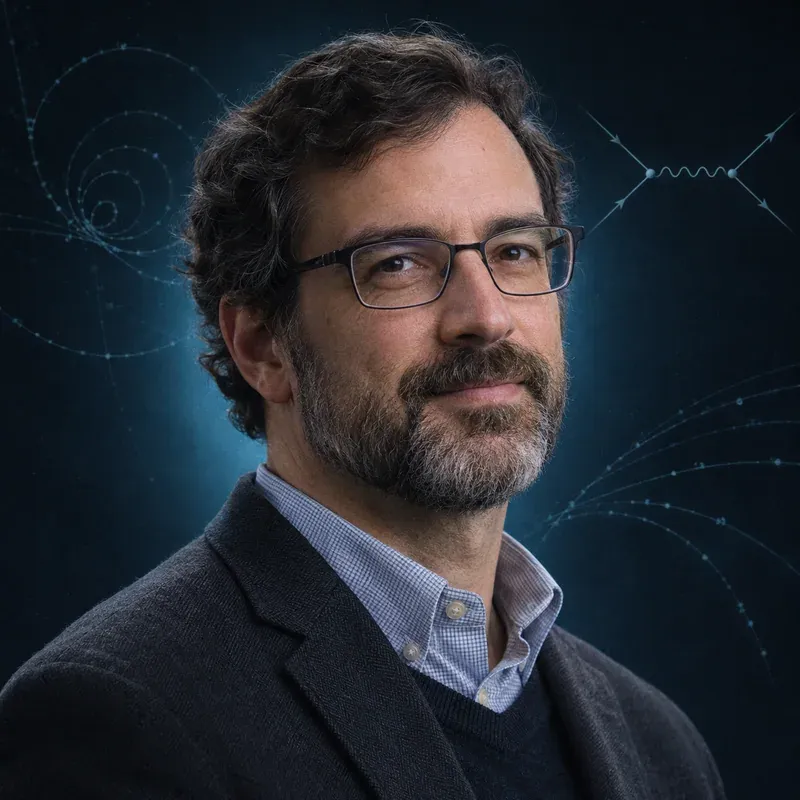
 Illustration
Joseph A. Formaggio
With Benjamin Monreal, Formaggio proposed in 2009 measuring the neutrino mass by detecting the cyclotron radiation of individual tritium beta-decay electrons (CRES), the principle of Project 8, which demonstrated single-electron CRES in 2015. Earlier he worked on SNO, which showed solar neutrino flavour change, and he is a member of KATRIN.
- Nationality
- American
- Field
- Experimental nuclear physics
- Institutions
- Yale University (BS 1996), Columbia University (PhD), University of Washington, MIT
Education and career
Joseph A. Formaggio is an American experimental nuclear physicist and professor of physics at MIT. He studied physics at Yale (BS 1996) and received his PhD from Columbia University. From 2001 he was a postdoc at the University of Washington, working on the Sudbury Neutrino Observatory, and in 2005 he joined the MIT faculty.
SNO
SNO measured solar neutrinos in 1000 tonnes of heavy water, counting electron neutrinos through the charged current and all flavours through the neutral current. Formaggio worked in Hamish Robertson's Seattle group, which built the detectors for SNO's third phase: an array of helium-3 proportional counters detected the neutrons from neutral-current breakups independently of the earlier methods (see SNO phases). Formaggio shared the 2016 Breakthrough Prize awarded to the collaboration.
A new way to weigh the neutrino
Formaggio's best-known idea concerns the absolute mass scale. The most direct method looks at the endpoint of the tritium beta spectrum: a non-zero neutrino mass slightly reduces the highest energy the electron can have. KATRIN, of which Formaggio is a member, does this with a huge MAC-E filter spectrometer and has set an upper limit of 0.45 eV.
In 2009 Benjamin Monreal and Formaggio proposed cyclotron radiation emission spectroscopy (CRES). An electron in a magnetic field circles at a frequency set by its energy and emits faint microwave radiation. Measuring that frequency very precisely gives the electron's energy without having to extract it from the source:
Because frequencies can be measured with very high precision, the method can in principle reach a sensitivity to mass differences far below what a spectrometer allows. Project 8, the collaboration built on this idea, detected single electrons via their cyclotron radiation for the first time in 2015, and in 2023 published its first neutrino mass limit from tritium with this technique.
Other work and recognition
His MIT group also works on the Ricochet experiment on coherent elastic neutrino–nucleus scattering at reactors and the CUPID double-beta-decay search. He was elected a Fellow of the American Physical Society in 2019 'for leadership in the pursuit of neutrino masses determination'.
Known for
- Co-proposer of cyclotron radiation emission spectroscopy (CRES, 2009) and Project 8
- KATRIN
- SNO (Breakthrough Prize 2016 with the collaboration)
Chronology
- 1996BS, Yale
- 2001Joins SNO as postdoc at University of Washington
- 2005Joins MIT
- 2009Monreal & Formaggio propose CRES
- 2015First single-electron CRES detection
- 2016Breakthrough Prize (SNO collaboration)
- 2019APS Fellow
Original papers
- B. Monreal and J. A. Formaggio, Relativistic cyclotron radiation detection of tritium decay electrons as a new technique for measuring the neutrino mass, Phys. Rev. D 80, 051301 (2009)DOI 10.1103/PhysRevD.80.051301
- Project 8 Collaboration (D. M. Asner et al.), Single-electron detection and spectroscopy via relativistic cyclotron radiation, Phys. Rev. Lett. 114, 162501 (2015)DOI 10.1103/PhysRevLett.114.162501
Experiments
Connected people
Frequently asked questions
What is CRES?
Cyclotron radiation emission spectroscopy: measuring the microwave frequency of an electron circling in a magnetic field to determine its energy, proposed by Monreal and Formaggio in 2009 for tritium neutrino-mass experiments.
How is Formaggio connected to SNO?
He worked on SNO as a postdoc at the University of Washington, in the group that built its helium-3 neutral-current detectors, and shared the collaboration's 2016 Breakthrough Prize.
On the timeline
- 2002SNO measures the total solar neutrino flux
- 2015Project 8 detects single electrons by their radiation
Mentioned in 7 pages
Last updated: · Editorial standard
Cite this page
Text
Neutrino Atlas (2026). “Joseph A. Formaggio”. Retrieved 22 November 2026, from https://neutrino-atlas.com/people/joseph-formaggio/BibTeX
@misc{neutrinoatlas2026peoplejosephformaggio,
  title        = {Joseph A. Formaggio},
  author       = {{Neutrino Atlas}},
  year         = {2026},
  url          = {https://neutrino-atlas.com/people/joseph-formaggio/},
  note         = {Accessed 2026-11-22},
  language     = {english}
}