CUPID
The planned upgrade of CUORE using scintillating Li₂¹⁰⁰MoO₄ bolometers with light readout for alpha rejection.
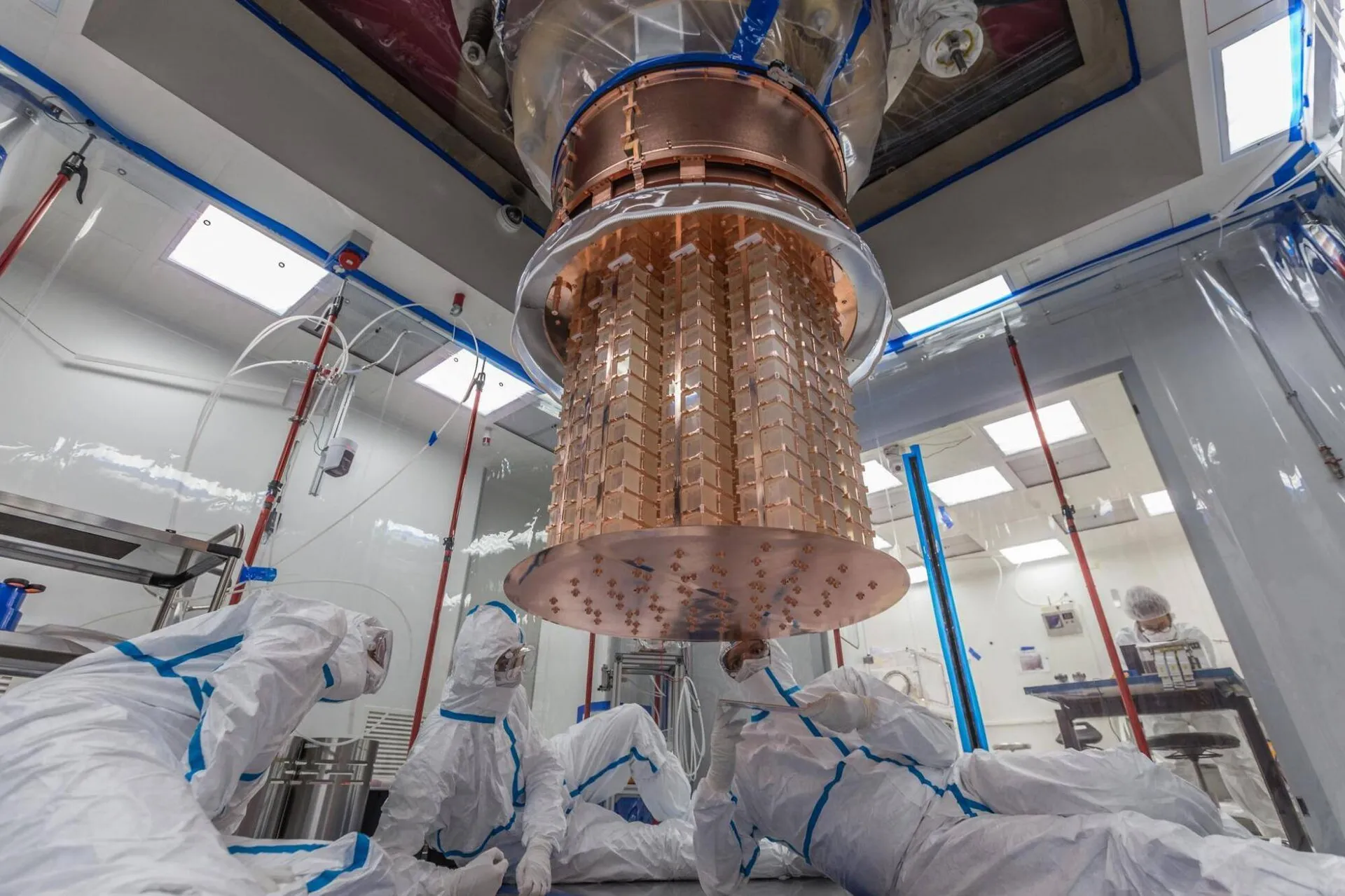
CUPID (CUORE Upgrade with Particle IDentification) will reuse the CUORE cryostat with about 1500 enriched ¹⁰⁰Mo crystals, aiming at a background roughly 100 times lower and a half-life sensitivity around 10²⁷ yr.
Compare all experiments → · World map →
In plain words
CUPID (CUORE Upgrade with Particle IDentification) adds a second sense to the CUORE technique. Its crystals still measure heat, but they also emit a faint flash of light when struck. Electrons and alpha particles of the same energy produce different amounts of light, so comparing light and heat reveals which particle caused an event. This removes the alpha background that limits CUORE.
In detail
Each CUPID module pairs a lithium molybdate (Li₂MoO₄) crystal, enriched in ¹⁰⁰Mo, with a thin germanium wafer operated as a light-detecting bolometer. Both are read out at about 10 mK. Molybdenum-100 was chosen for two reasons:
- Its decay energy, Qββ = 3034 keV, lies above the 2615 keV gamma line of ²⁰⁸Tl, the highest-energy common line from natural radioactivity, so gamma backgrounds are naturally low.
- Its two-neutrino half-life is comparatively short, which is a background concern, but a favourable phase space also raises the expected 0νββ rate for a given neutrino mass.
Because ¹⁰⁰Mo decays quickly in the two-neutrino mode, random pile-up of two 2νββ events within a few milliseconds can fake a signal. CUPID therefore needs fast light detectors, and the collaboration has developed techniques to resolve pulses separated by under a millisecond.
Demonstrators
- CUPID-0 at Gran Sasso used Zn⁸²Se scintillating bolometers and demonstrated alpha rejection at scale.
- CUPID-Mo at Modane operated 20 enriched Li₂MoO₄ crystals and showed full alpha rejection with excellent resolution and radiopurity, setting T½(¹⁰⁰Mo) > 1.8 × 10²⁴ years.
Status today
The baseline design foresees about 1,600 crystals containing roughly 240 kg of ¹⁰⁰Mo in the existing CUORE cryostat, with a background goal near 10⁻⁴ counts/(keV·kg·yr). Its half-life sensitivity of order 10²⁷ years would cover most of the inverted-ordering region. Construction is planned after CUORE completes data taking.
Frequently asked questions
What does 'particle identification' mean in CUPID?
For the same heat signal, an alpha particle produces much less scintillation light than an electron. Reading light and heat together lets CUPID reject alpha events, the main background of CUORE.
Why not simply keep using tellurium?
TeO₂ scintillates very weakly, which makes alpha rejection difficult, and the ¹³⁰Te decay energy sits below the ²⁰⁸Tl gamma line. Molybdenum-100 avoids both problems.
Original papers
- ProposalCUPID Interest Group, CUPID pre-CDR (2019)arXiv:1907.09376
- First resultO. Azzolini et al. (CUPID-0 Collaboration), First Result on the Neutrinoless Double-β Decay of ⁸²Se with CUPID-0, Phys. Rev. Lett. 120, 232502 (2018)DOI 10.1103/PhysRevLett.120.232502arXiv:1802.07791
- MeasurementC. Augier et al. (CUPID-Mo Collaboration), Final results on the 0νββ decay half-life limit of ¹⁰⁰Mo from the CUPID-Mo experiment, Eur. Phys. J. C 82, 1033 (2022)arXiv:2202.08716
Go deeper
- CUPID-MoDemonstrator at Modane that ran 20 Li₂¹⁰⁰MoO₄ scintillating bolometers in 2019–2020 and set T½(¹⁰⁰Mo, 0νββ) > 1.8 × 10²⁴ yr.
Related terms
People
Latest research on this topic
- Development of millikelvin scintillation photodetectors with CUPIDManenti, N., Alfonso, K., Angeloni, A. et al. · 11 November 2026
- Fabrication and Testing of NTL-Enhanced HPGe Light Detectors for CUPID - ExperimentDiPreta, Maximo, Singh, Vivek, Lisovenko, Marharyta et al. · September 2026
- Radioactive contamination in Li2MoO4 crystals for the CUPID experimentCUPID Collaboration · 15 July 2026
- Transmissibility-Based Transfer Path Analysis of a Cryostat Interface for the CUPID ExperimentD’Eramo, Serena, Brunetti, Jacopo, D’Addabbo, Antonio et al. · 13 July 2026
- Resolution Studies for Axion Searches with CUPID-0CUPID-0 Collaboration · 20 March 2026
- Methodology for sterile neutrino searches in CUPID-0CUPID-0 Collaboration · 20 March 2026
On the timeline
Mentioned in 21 pages
Milestones 3
Last updated: · Editorial standard
Cite this page
Text
Neutrino Atlas (2026). “CUPID”. Retrieved 22 November 2026, from https://neutrino-atlas.com/terms/cupid/BibTeX
@misc{neutrinoatlas2026termscupid,
  title        = {CUPID},
  author       = {{Neutrino Atlas}},
  year         = {2026},
  url          = {https://neutrino-atlas.com/terms/cupid/},
  note         = {Accessed 2026-11-22},
  language     = {english}
}