MAJORANA Demonstrator
A US-led ⁷⁶Ge experiment at SURF using ultra-pure electroformed copper cryostats.
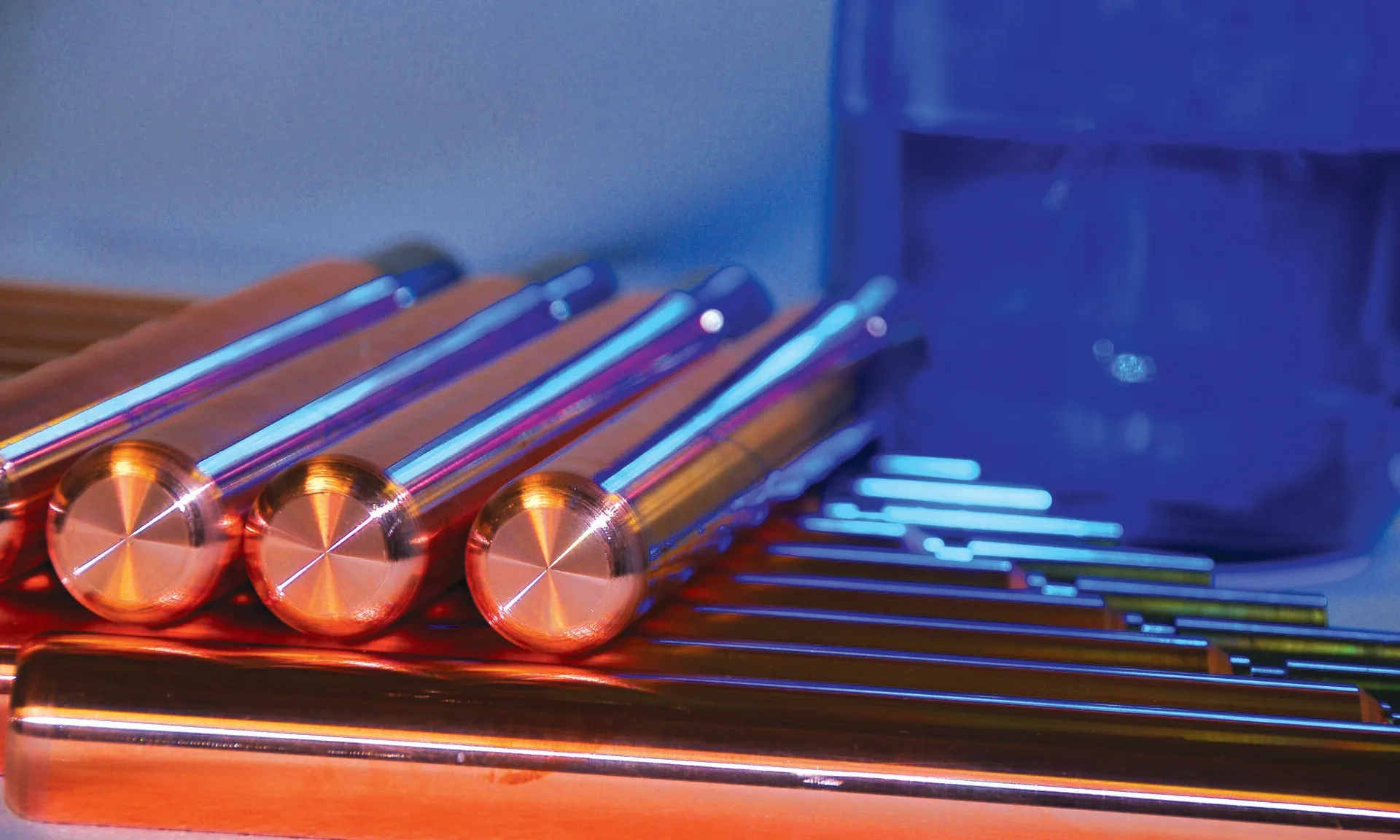
About 30 kg of enriched germanium in two compact cryostats made of underground-electroformed copper reached excellent energy resolution (about 2.5 keV FWHM at Qββ). Its final limit was T½ > 8.3 × 10²⁵ yr. It merged with GERDA to form LEGEND.
Compare all experiments → · World map →
In plain words
Every material near a 0νββ detector contains traces of uranium and thorium, whose decays can mimic the signal. The MAJORANA collaboration tackled this by making its own copper, atom by atom, deep underground, where cosmic rays cannot activate it. From that copper it built two compact vacuum cryostats holding enriched germanium crystals.
How the detector works
The Demonstrator was installed on the 4850-foot level of the Sanford Underground Research Facility in South Dakota. Copper was electroformed underground, grown slowly onto mandrels from a copper-sulfate bath, which leaves thorium and uranium behind in solution and avoids cosmogenic activation. The array held 44 kg of germanium, about 30 kg of it enriched to roughly 88% in ⁷⁶Ge, mostly in p-type point-contact (PPC) detectors. Their small readout contact gives a low electronic noise and a characteristic pulse shape, which helps to separate single-site ββ events from multi-site gamma backgrounds. A layered shield of copper, lead, a radon-purged enclosure, an active muon veto and polyethylene surrounded the cryostats.
Key results
- Energy resolution of about 2.5 keV FWHM at Qββ = 2039 keV, the best of any 0νββ experiment at the time.
- Final result (2023): T½(⁷⁶Ge) > 8.3 × 10²⁵ years at 90% CL from 64.5 kg·yr of exposure, corresponding to an effective Majorana mass below roughly 113–269 meV depending on the nuclear matrix element.
- The low threshold of the PPC detectors also allowed searches for dark matter candidates and other rare processes at keV energies.
Why it matters for neutrino physics
The Demonstrator was built less to win the race than to prove that a tonne-scale germanium experiment could reach the required radiopurity. Together with GERDA's liquid-argon concept it provided the blueprint for LEGEND, which combines underground-electroformed copper parts and point-contact detector technology with an instrumented argon bath. Several of its enriched detectors were moved to LEGEND-200 at Gran Sasso.
Frequently asked questions
Why is it called a 'Demonstrator'?
Its goal was to demonstrate that backgrounds and technology were good enough for a future tonne-scale experiment, not to be the final search itself.
Where was the MAJORANA Demonstrator located?
At the Sanford Underground Research Facility in Lead, South Dakota, about 1.5 km below the surface, in the former Homestake gold mine that also hosted Raymond Davis's solar neutrino experiment.
Original papers
- First resultC. E. Aalseth et al. (Majorana Collaboration), Search for Neutrinoless Double-β Decay in ⁷⁶Ge with the Majorana Demonstrator, Phys. Rev. Lett. 120, 132502 (2018)DOI 10.1103/PhysRevLett.120.132502arXiv:1710.11608
- Final resultI. J. Arnquist et al. (Majorana Collaboration), Final Result of the Majorana Demonstrator's Search for Neutrinoless Double-β Decay in ⁷⁶Ge, Phys. Rev. Lett. 130, 062501 (2023)DOI 10.1103/PhysRevLett.130.062501
Related terms
People
Mentioned in 18 pages
Lessons 1
Milestones 2
People 6
Last updated: · Editorial standard
Cite this page
Text
Neutrino Atlas (2026). “MAJORANA Demonstrator”. Retrieved 22 November 2026, from https://neutrino-atlas.com/terms/majorana-demonstrator/BibTeX
@misc{neutrinoatlas2026ermsmajoranademonstrator,
  title        = {MAJORANA Demonstrator},
  author       = {{Neutrino Atlas}},
  year         = {2026},
  url          = {https://neutrino-atlas.com/terms/majorana-demonstrator/},
  note         = {Accessed 2026-11-22},
  language     = {english}
}