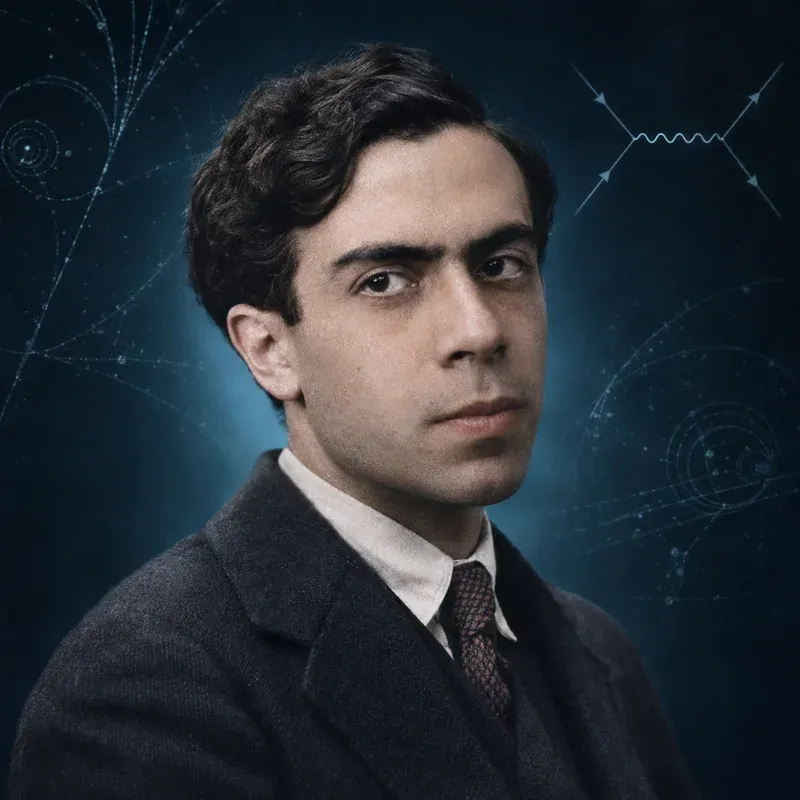
 Illustration
Ettore Majorana
In his last paper (1937) Majorana gave a symmetric theory of the electron and positron showing that a neutral spin-1/2 particle can be its own antiparticle, and that the conclusions of beta-decay theory remain valid with a single neutrino type. Whether neutrinos are Majorana or Dirac particles remains one of the central open questions of neutrino physics, tested today by searches for neutrinoless double-beta decay.
- Born
- 5 August 1906
Catania, Sicily, Italy - Disappeared
- 25 March 1938
- Nationality
- Italian
- Field
- theoretical physics
- Institutions
- Sapienza University of Rome (Fermi's group), University of Leipzig (with Heisenberg), University of Naples
Early life and education
Ettore Majorana was born in Catania, Sicily, on 5 August 1906, into a family of engineers, lawyers and politicians. He began studying engineering in Rome, but in 1928, persuaded by his fellow student Emilio Segrè, he moved to physics and joined the group of Enrico Fermi at the Institute of Physics on Via Panisperna. He graduated in 1929 with a thesis on the quantum theory of radioactive nuclei. Colleagues remembered his speed at calculation and his habit of solving problems that the group had struggled with, then not publishing the results.
Path to neutrino physics
Majorana published only nine papers. In 1932 he wrote a relativistic wave equation for particles of arbitrary spin, a result that later work rediscovered independently. In 1933, after the discovery of the neutron, he proposed a theory of nuclear forces in which protons and neutrons exchange their positions but not their spins; these 'Majorana exchange forces' explained why the helium-4 nucleus is so tightly bound. The same year he spent several months in Leipzig with Werner Heisenberg, who had developed a related model. After his return to Rome he withdrew from regular academic life for several years.
Key contributions
In 1937 he accepted a chair of theoretical physics at the University of Naples and published his last paper, 'Teoria simmetrica dell'elettrone e del positrone'. Dirac's theory of the electron contains negative-energy solutions that are interpreted as positrons, and it treats particle and antiparticle asymmetrically. Majorana showed that the equations can be rewritten so that particle and antiparticle appear symmetrically. For an electrically neutral particle this allows a further step: the field can be made real, so that the particle is identical to its own antiparticle. Such a particle, now called a Majorana fermion, has half as many independent states as a Dirac fermion.
Majorana suggested that this description could apply to the neutrino and noted that Fermi's theory of beta decay works equally well with it. The same year Giulio Racah proposed an experimental test, and in 1939 Wendell Furry pointed out that a Majorana neutrino allows double beta decay without the emission of neutrinos. That process violates lepton number by two units.
Disappearance
On 25 March 1938 Majorana took the night ferry from Naples to Palermo. He sent letters that suggested he intended to end his life, then a telegram and a further letter saying he had changed his mind. He was reported to have boarded a ferry back to Naples, and was never seen again. Many theories have been proposed, from suicide to a retreat into a monastery or emigration to South America. In 2015 the public prosecutor's office in Rome closed an inquiry with the conclusion that he had probably lived in Venezuela in the second half of the 1950s; the question remains debated, and no date of death is known.
Legacy
Whether neutrinos are Majorana or Dirac particles is still one of the central open questions of the field, discussed on the Dirac vs. Majorana page. The Standard Model does not decide it. If neutrinos are Majorana particles, their small masses fit naturally into seesaw models, two additional Majorana phases enter the PMNS matrix, and leptogenesis becomes a possible origin of the matter in the universe.
The most sensitive test is the search for neutrinoless double beta decay. Experiments such as GERDA, KamLAND-Zen, CUORE and LEGEND have pushed half-life limits beyond 10²⁶ years for some isotopes without seeing the decay. The rate would depend on the effective Majorana mass, a combination of the neutrino masses and mixing parameters. One of the US experiments in this programme was named the Majorana Demonstrator in his honour. Since the 2000s 'Majorana modes' have also become a topic in condensed-matter physics, where certain superconducting systems show quasiparticle states that are their own antiparticles.
Known for
- Majorana fermions / Majorana neutrino (1937)
- Theory of nuclear exchange forces (1933)
- Mysterious disappearance (1938)
Chronology
- 1929Graduates in physics in Rome
- 1933Nuclear exchange-force theory
- 1937'Teoria simmetrica dell'elettrone e del positrone'
- 1938Disappears in March
Original papers
- E. Majorana, Teoria simmetrica dell'elettrone e del positrone, Nuovo Cimento 14, 171 (1937)DOI 10.1007/BF02961314
Experiments
- Neutrinoless double-beta decay searches
Connected people
Frequently asked questions
What is a Majorana neutrino?
A neutrino that is its own antiparticle. It is described by a single real field instead of separate particle and antiparticle fields. The idea comes from Majorana's 1937 paper; the details are on the Majorana neutrino page.
How can we find out whether neutrinos are Majorana particles?
The main method is to search for neutrinoless double beta decay, in which a nucleus emits two electrons and no neutrinos. Observing it would show that lepton number is violated and that neutrinos have a Majorana mass component.
What happened to Ettore Majorana?
He disappeared in March 1938 during or after a ferry journey between Palermo and Naples. His fate has never been established with certainty.
On the timeline
Mentioned in 15 pages
Lessons 1
Comparisons 1
Milestones 4
People 6
Terms 1
Last updated: · Editorial standard
Cite this page
Text
Neutrino Atlas (2026). “Ettore Majorana”. Retrieved 22 November 2026, from https://neutrino-atlas.com/people/ettore-majorana/BibTeX
@misc{neutrinoatlas2026peopleettoremajorana,
  title        = {Ettore Majorana},
  author       = {{Neutrino Atlas}},
  year         = {2026},
  url          = {https://neutrino-atlas.com/people/ettore-majorana/},
  note         = {Accessed 2026-11-22},
  language     = {english}
}