1955Experiment
Davis shows antineutrinos do not make argon
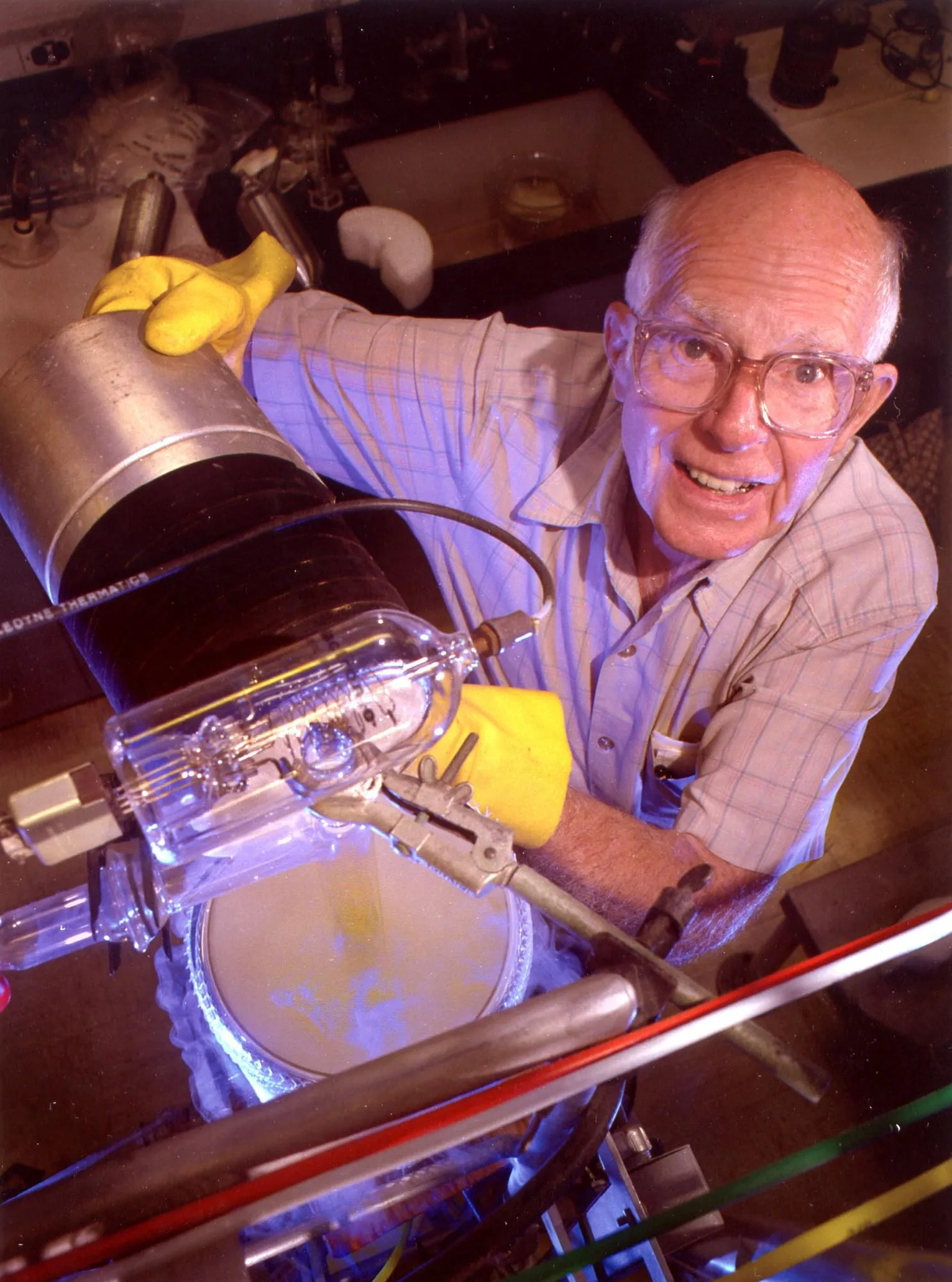
Raymond Davis placed chlorine-based detectors near reactors at Brookhaven and later Savannah River to look for argon-37 production by reactor antineutrinos. He found none, at a level well below what would be expected if neutrinos and antineutrinos were identical in this reaction. The null result supported the idea that neutrinos and antineutrinos are distinct, now described by lepton number conservation. It also established the radiochemical technique Davis later used at Homestake.
- Date
- 1955
- Kind of event
- Experiment
- People involved
- Raymond Davis Jr.
The situation before
Bruno Pontecorvo had proposed in 1946 that neutrinos could be detected through their capture on chlorine-37, which produces radioactive argon-37. Nuclear reactors were the strongest available sources. But reactors emit antineutrinos, from the beta decay of neutron-rich fission fragments, while the chlorine reaction is the inverse of electron capture and should be induced by neutrinos. Whether that difference mattered was an open question. If neutrino and antineutrino were the same particle, as Ettore Majorana's theory allowed, reactor antineutrinos should produce argon too.
What happened
Raymond Davis, a chemist at Brookhaven National Laboratory, set out to try. In 1954 he placed tanks of carbon tetrachloride, a cheap chlorine-rich cleaning fluid, next to the Brookhaven research reactor and shielded them. After exposure he flushed the liquid with helium to sweep out any argon atoms, collected them and counted their decays in a small proportional counter. He found no argon attributable to the reactor.
He published the null result as "Attempt to detect the antineutrinos from a nuclear reactor by the ³⁷Cl(ν̄, e⁻)³⁷Ar reaction" in the Physical Review in 1955. A larger set-up at the Savannah River reactor, where Clyde Cowan and Frederick Reines were working at the same time, pushed the limit on the cross-section for this reaction to below about 10⁻⁴⁵ cm², far below what identical particles would have given.
Reaction
The result was read as evidence that neutrinos and antineutrinos are distinct. It fitted a new conservation law: in 1953 Emil Konopinski and Hormoz Mahmoud had proposed assigning a lepton number of +1 to electrons and neutrinos and −1 to their antiparticles, which forbids an antineutrino from producing an electron. After the discovery of parity violation in 1957 it became clear that the interpretation is subtler: because the reactor antineutrinos have the wrong handedness, the reaction would be suppressed even if they were Majorana particles. The question of the neutrino's nature thus remained open.
A rumour in 1957 that Davis had seen a few events prompted Pontecorvo to consider neutrino-antineutrino transitions, the first idea of neutrino oscillations. The events did not survive further analysis.
Why it matters
The reactor runs established the chlorine-argon technique, its backgrounds and its sensitivity. Davis then turned to the Sun, whose fusion reactions emit neutrinos, not antineutrinos. That path led to the Homestake mine and the first measurement of solar neutrinos.
Frequently asked questions
What did Davis find at the reactor?
No argon-37 production. Reactor antineutrinos do not induce the capture reaction that neutrinos would.
Did this prove neutrinos are not Majorana particles?
No. After 1957 it was understood that the antineutrinos' handedness alone would suppress the reaction. Whether neutrinos are Majorana particles is still unknown.
Original papers
- MeasurementR. Davis, Attempt to Detect the Antineutrinos from a Nuclear Reactor by the Cl37(ν̄,e−)A37 Reaction, Phys. Rev. 97, 766 (1955)DOI 10.1103/PhysRev.97.766
Concepts
Last updated: · Editorial standard
Cite this page
Text
Neutrino Atlas (2026). “1955: Davis shows antineutrinos do not make argon”. Retrieved 22 November 2026, from https://neutrino-atlas.com/timeline/1955-davis-reactor-null/BibTeX
@misc{neutrinoatlas2026line1955davisreactornull,
  title        = {1955: Davis shows antineutrinos do not make argon},
  author       = {{Neutrino Atlas}},
  year         = {2026},
  url          = {https://neutrino-atlas.com/timeline/1955-davis-reactor-null/},
  note         = {Accessed 2026-11-22},
  language     = {english}
}