 Illustration
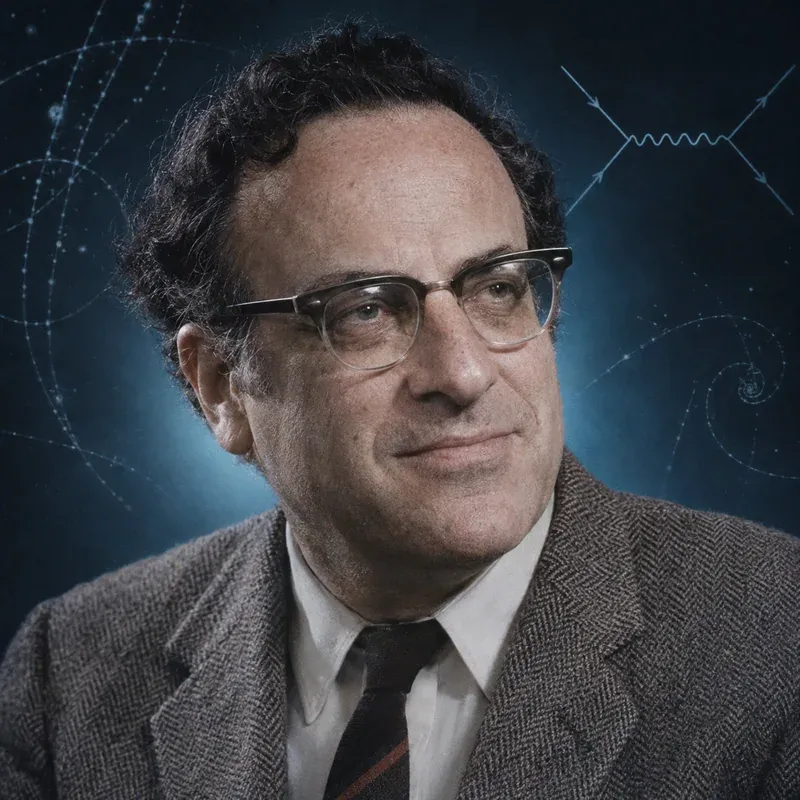
Frederick Reines
With Clyde Cowan, Reines devised and carried out the first detection of the free neutrino, using inverse beta decay of reactor electron antineutrinos on protons in a hydrogen-rich liquid scintillator, with a delayed-coincidence signature of positron annihilation followed by neutron capture on cadmium. A first attempt at the Hanford reactor in 1953 gave only a hint because of cosmic-ray background; the definitive experiment at the Savannah River reactor in 1955-56 succeeded, and on 14 June 1956 they telegraphed Pauli. He later pioneered atmospheric-neutrino detection deep underground and was a leader of the IMB detector that recorded neutrinos from SN1987A.
- Born
- 16 March 1918
Paterson, New Jersey, USA - Died
- 26 August 1998
Orange, California, USA - Nationality
- American
- Field
- experimental physics
- Nobel Prize
- Physics 1995 (shared with Martin L. Perl) – for the detection of the neutrino (joint motivation: for pioneering experimental contributions to lepton physics)
- Institutions
- Los Alamos Scientific Laboratory, Case Institute of Technology / Case Western Reserve University, University of California, Irvine
Early life and education
Frederick Reines was born in Paterson, New Jersey, in 1918, the youngest of four children of immigrants from Russia; his father ran a general store in Hillburn, New York. In his Nobel autobiography he recalls building crystal radios as a boy and being handed the key to the school laboratory by a high-school science teacher. His yearbook ambition was “to be a physicist extraordinaire.” He studied engineering at the Stevens Institute of Technology (BS 1939, MS in mathematical physics 1941) and completed a theoretical doctorate at New York University on the liquid-drop model of nuclear fission.
Los Alamos
Around 1944 Reines joined the Theoretical Division at Los Alamos, working under Richard Feynman, and later became a group leader. After the war he directed Operation Greenhouse, a series of nuclear tests at Eniwetok atoll, analysed results from tests at Eniwetok, Bikini and Nevada, and co-authored a study of blast waves with John von Neumann. This work gave him a detailed feel for intense sources of radiation, which is exactly what a neutrino experiment needs.
Key contributions
In 1951, together with Clyde Cowan, Reines set out to detect the free neutrino. After first considering a bomb test as the source, they settled on a fission reactor and on inverse beta decay, in which an antineutrino turns a proton into a neutron and a positron. The prompt positron flash and the later neutron capture form a delayed coincidence that background rarely imitates. The project, nicknamed Project Poltergeist, gave a first hint at Hanford in 1953 and a definitive signal at Savannah River in 1956. The details of the apparatus are described on the page of the Cowan–Reines experiment.
On 14 June 1956 the pair cabled Wolfgang Pauli: “We are happy to inform you that we have definitely detected neutrinos from fission fragments by observing inverse beta decay of protons.” Pauli’s reply, dated the following day, read: “Thanks for message. Everything comes to him who knows how to wait.” A quarter of a century after Pauli had postulated the particle, it was finally observed.
Later work
Reines moved in 1959 to the Case Institute of Technology in Cleveland as professor and head of physics. His group there studied reactor neutrinos, double beta decay and searches for nucleon decay. Its most important result came from a detector placed about three kilometres underground in the East Rand gold mine in South Africa: in 1965 it recorded the first atmospheric neutrinos, produced when cosmic rays strike the upper atmosphere. Almost simultaneously a group working at the Kolar Gold Fields in India reported similar events. Going deep underground to escape the cosmic-muon background became the standard strategy of neutrino physics.
In 1966 Reines became the founding dean of the School of Physical Sciences at the University of California, Irvine. He continued reactor experiments, including searches for neutrino oscillations and for a neutrino magnetic moment, and promoted the idea of a large deep-ocean detector that became the DUMAND project, a forerunner of today’s neutrino telescopes such as IceCube and KM3NeT.
His Irvine group was a founding member of the IMB collaboration, together with groups led by Lawrence Sulak, John Learned and others. IMB was a water Cherenkov detector in a salt mine near Cleveland, built to search for proton decay. On 23 February 1987 it recorded eight neutrino events from SN 1987A, at the same time as Kamiokande in Japan. The two collaborations shared the 1989 Bruno Rossi Prize for this first detection of neutrinos from a supernova.
Nobel Prize and legacy
In 1995 Reines received half of the Nobel Prize in Physics for the detection of the neutrino; the other half went to Martin Perl for the discovery of the tau lepton. Cowan, who had died in 1974, could not share it. Reines retired as professor emeritus in 1988 and died in Orange, California, in 1998. His career spans the whole arc of experimental neutrino physics: from the first reactor detection through atmospheric and supernova neutrinos to the vision of detectors the size of a lake or an ocean.
Known for
- First detection of the (anti)neutrino with Clyde Cowan (1956)
- Project Poltergeist
- First detection of atmospheric neutrinos (1965)
- IMB detector and SN1987A neutrinos
- DUMAND pioneer
Chronology
- 1951Decides with Cowan to attempt detecting the neutrino
- 1953Hanford reactor experiment ('Project Poltergeist') gives first hint
- 1956Savannah River detection; telegram to Pauli on 14 June; Science paper 20 July
- 1956Reactor neutrino detection with Cowan
- 1965First detection of atmospheric neutrinos (East Rand mine, South Africa)
- 1973Proposes deep-water detector (DUMAND idea) at ICRC
- 1987IMB detects neutrinos from supernova SN1987A
- 1995Nobel Prize in Physics
Original papers
- F. Reines, C.L. Cowan, Detection of the free neutrino, Phys. Rev. 92, 830 (1953)DOI 10.1103/PhysRev.92.830
- C.L. Cowan, F. Reines, F.B. Harrison, H.W. Kruse, A.D. McGuire, Detection of the free neutrino: a confirmation, Science 124, 103 (1956)DOI 10.1126/science.124.3212.103
- F. Reines, C.L. Cowan, The neutrino, Nature 178, 446 (1956)DOI 10.1038/178446a0
- F. Reines, C.L. Cowan, Neutrino physics, Physics Today 10 (8), 12 (1957)DOI 10.1063/1.3060455
- F. Reines et al., Evidence for High-Energy Cosmic-Ray Neutrino Interactions, Phys. Rev. Lett. 15, 429 (1965)DOI 10.1103/PhysRevLett.15.429
- R. M. Bionta et al. (IMB), Observation of a neutrino burst in coincidence with supernova 1987A in the Large Magellanic Cloud, Phys. Rev. Lett. 58, 1494 (1987)DOI 10.1103/PhysRevLett.58.1494
Experiments
- Cowan–Reines Neutrino Experiment
- Case–Witwatersrand–Irvine atmospheric neutrino experiment
- IMB (Irvine–Michigan–Brookhaven)
- Cowan–Reines experiment
- East Randdetector
- DUMAND
Connected people
- Clyde L. Cowan Jr.
- Henry W. Sobel
- John G. Learned
- Lawrence R. Sulak
- Michael K. Moe
- Raymond Davis Jr.
- Wolfgang Pauli
- Herbert H. Chen
- Arthur Roberts
- Kenneth Ingvard Greisen
- Martin Lewis Perl
Frequently asked questions
What did Frederick Reines discover?
With Clyde Cowan he made the first detection of the neutrino, in fact the electron antineutrino, at the Savannah River reactor in 1956. His groups later recorded the first atmospheric neutrinos (1965) and, as part of IMB, neutrinos from supernova SN 1987A.
Why did Reines win the Nobel Prize so late?
The detection was made in 1956, but the Nobel Prize came only in 1995, almost forty years later. Neutrino physics gained in prominence over the following decades, and the prize was eventually given to Reines together with Martin Perl for pioneering experimental work on leptons.
What was Project Poltergeist?
It was the nickname of the Los Alamos project in which Reines and Cowan tried to catch the elusive, ghost-like neutrino, first at Hanford in 1953 and then at Savannah River.
On the timeline
- 1953Project Poltergeist at the Hanford reactor
- 1956Cowan and Reines detect the neutrino
- 1965First detection of atmospheric neutrinos
- 1976DUMAND plans a deep-ocean neutrino telescope
- 1983Large water Cherenkov detectors begin operation
- 1995Nobel Prize for neutrino detection
Mentioned in 68 pages
Lessons 7
FAQ 4
Comparisons 2
Milestones 16
- 1930 · Pauli proposes a new neutral particle
- 1932 · Discovery of the neutron renames Pauli's particle
- 1934 · Bethe and Peierls estimate a tiny cross-section
- 1942 · First indirect evidence from nuclear recoil
- 1953 · Project Poltergeist at the Hanford reactor
- 1955 · Davis shows antineutrinos do not make argon
- 1956 · Cowan and Reines detect the neutrino
- 1960 · Proposals for accelerator neutrino beams
8 more
- 1965 · First detection of atmospheric neutrinos
- 1975 · Tau lepton discovery implies a third neutrino
- 1976 · DUMAND plans a deep-ocean neutrino telescope
- 1978 · Neutrinos proposed for reactor monitoring
- 1983 · Large water Cherenkov detectors begin operation
- 1995 · Nobel Prize for neutrino detection
- 2015 · Nobel Prize for neutrino oscillations
- 2026 · Nobel Prize for Francis Halzen and IceCube
People 17
Terms 22
- Antineutrino
- Atmospheric & Large water Cherenkov experiments
- Atmospheric neutrinos
- Case–Witwatersrand–Irvine (East Rand) experiment
- Coincidence / Delayed-signal technique
- Cowan–Reines Neutrino Experiment
- Cross sections
- Detection principles & detector technology
14 more
- DUMAND
- Electron neutrino
- ILL Grenoble reactor experiment
- IMB (Irvine–Michigan–Brookhaven)
- Inverse beta decay
- Kolar Gold Fields neutrino experiments
- Lepton
- Neutrino properties
- Neutrino-electron elastic scattering
- Nuclear reactors as neutrino sources
- Pauli's neutrino hypothesis
- Reactor antineutrinos
- Reactor neutrino experiments
- Underground laboratories
Last updated: · Editorial standard
Cite this page
Text
Neutrino Atlas (2026). “Frederick Reines”. Retrieved 22 November 2026, from https://neutrino-atlas.com/people/frederick-reines/BibTeX
@misc{neutrinoatlas2026peoplefrederickreines,
  title        = {Frederick Reines},
  author       = {{Neutrino Atlas}},
  year         = {2026},
  url          = {https://neutrino-atlas.com/people/frederick-reines/},
  note         = {Accessed 2026-11-22},
  language     = {english}
}