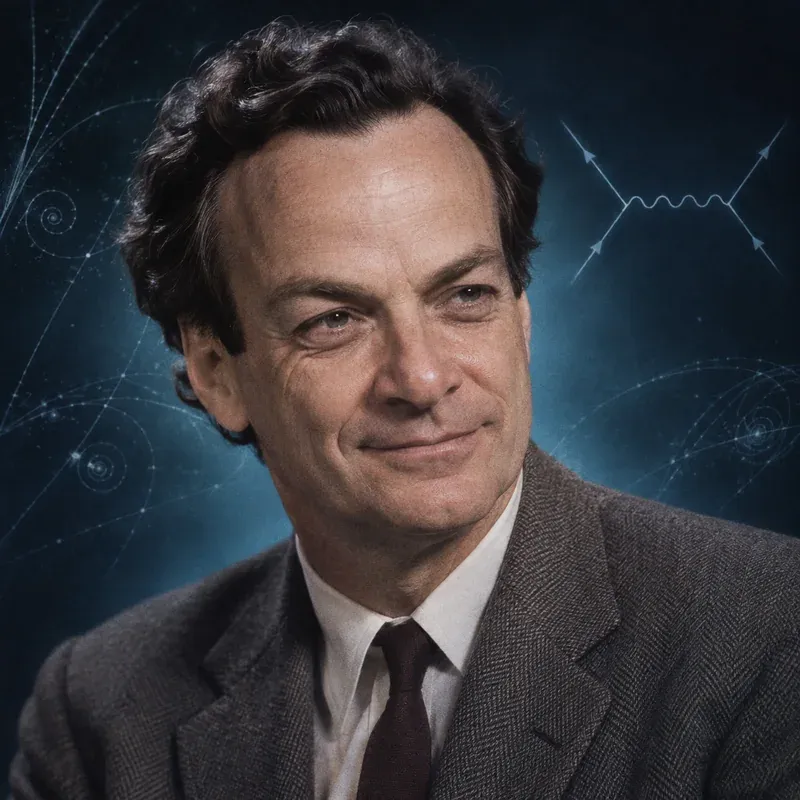
 Illustration
Richard P. Feynman
After informally presenting a preliminary version at the April 1957 Rochester conference, Feynman with Murray Gell-Mann published in January 1958 the 'Theory of the Fermi interaction', proposing a universal V-A current-current weak interaction in which only left-handed two-component fermion fields participate, and the conserved vector current (CVC) hypothesis. Together with the parallel work of Sudarshan and Marshak, this fixed the chiral structure of the weak interaction and the left-handedness of the neutrino, in contradiction with some contemporary data (e.g. He-6) that later proved wrong.
- Born
- 11 May 1918
New York City, USA - Died
- 15 February 1988
Los Angeles, California, USA - Nationality
- American
- Field
- theoretical physics
- Nobel Prize
- Physics 1965 (shared with S. Tomonaga and J. Schwinger) – for their fundamental work in quantum electrodynamics, with deep-ploughing consequences for the physics of elementary particles
- Institutions
- MIT, Princeton University, Los Alamos, Cornell University
Early life and education
Richard Phillips Feynman was born in New York City on 11 May 1918 and grew up in Far Rockaway, Queens. He studied at the Massachusetts Institute of Technology, graduating in 1939, and completed his PhD at Princeton in 1942 under John Archibald Wheeler. His thesis introduced the principle of least action into quantum mechanics, the seed of his later path-integral formulation. During the Second World War he worked at Los Alamos in the theoretical division led by Hans Bethe. After the war he joined Cornell University and in 1950 moved to the California Institute of Technology, where he stayed for the rest of his life.
Path to neutrino physics
Feynman's fame rests on quantum electrodynamics. In the late 1940s he developed a method for calculating how electrons and photons interact, with the diagrams that now bear his name as a bookkeeping device. Those diagrams became the common language of particle physics, including every calculation of neutrino scattering and decay.
In 1956 the experimental physicist Martin Block asked Feynman whether parity might be violated in weak decays, and Feynman raised the question at that year's Rochester conference. After parity violation was confirmed in early 1957, the form of the weak interaction was suddenly open again. Fermi's original coupling could take five different mathematical forms, and the experiments of the day pointed in contradictory directions.
Key contributions
In the summer of 1957 Feynman learned that E. C. G. Sudarshan and Robert Marshak favoured a vector-minus-axial-vector coupling. Feynman had been looking for a way to write the electron's Dirac equation in two-component form, and he saw that the same idea fixed the weak interaction: only the left-handed component of each particle takes part. Murray Gell-Mann, his colleague at Caltech, was working along similar lines, and the two wrote a joint paper, 'Theory of the Fermi interaction', which appeared in Physical Review on 1 January 1958.
The paper made three claims. First, the interaction has the universal V−A form for nuclear beta decay, muon decay and the decay of strange particles. Second, it is a product of two currents, so that the same coupling acts between any pair of lepton or quark currents; the Fermi constant measured in muon decay therefore also governs nuclear beta decay. Third, the vector part of the current is conserved, in the same way as the electric current, which explains why the vector coupling is not altered by the strong interaction inside the nucleon. This conserved vector current (CVC) hypothesis had been suggested earlier by Semyon Gershtein and Yakov Zeldovich; experiments at Columbia by Chien-Shiung Wu and colleagues later confirmed one of its predictions.
For neutrinos the theory had a clear consequence: they are produced only with left-handed chirality, so a massless neutrino is always left-handed and an antineutrino right-handed. This agreed with the helicity measurement of Maurice Goldhaber and collaborators in 1958. Several older experiments that disagreed, such as one on the decay of helium-6, were later found to be wrong.
Later work
Feynman shared the 1965 Nobel Prize in Physics with Julian Schwinger and Sin-Itiro Tomonaga for quantum electrodynamics. He also explained the superfluidity of liquid helium and in 1969 proposed the parton model, in which a fast proton behaves like a collection of point-like constituents. The parton picture became the basis for interpreting deep inelastic scattering, including the neutrino experiments at CERN and Fermilab that measured the quark content of nucleons. His introductory course at Caltech was published as The Feynman Lectures on Physics, and in 1986 he served on the presidential commission investigating the loss of the Space Shuttle Challenger. He died in Los Angeles on 15 February 1988.
Legacy
The current–current form of the weak interaction that Feynman and Gell-Mann wrote down is still the low-energy description used for neutrino processes. In the electroweak theory it arises from the exchange of a heavy W boson that couples only to left-handed particles, and it is the reason the right-handed neutrino does not interact through the ordinary weak force.
Known for
- V−A theory of the weak interaction (with Gell-Mann, 1958)
- Conserved vector current hypothesis
- Quantum electrodynamics and Feynman diagrams
Chronology
- 1957Preliminary V−A ideas at the Seventh Rochester Conference (April)
- 1958'Theory of the Fermi interaction' with Gell-Mann (Phys. Rev., 1 January)
- 1965Nobel Prize in Physics
Original papers
- R.P. Feynman, M. Gell-Mann, Theory of the Fermi interaction, Phys. Rev. 109, 193 (1958)DOI 10.1103/PhysRev.109.193
Connected people
Frequently asked questions
What did Feynman contribute to neutrino physics?
With Murray Gell-Mann he formulated the universal V−A theory of the weak interaction in 1957–58, which implies that neutrinos are left-handed, and the conserved vector current hypothesis.
Did Feynman receive a Nobel Prize for the weak interaction?
No. His 1965 Nobel Prize, shared with Schwinger and Tomonaga, was for quantum electrodynamics.
Was Feynman the first to propose V−A?
No. E. C. G. Sudarshan and Robert Marshak reached the same conclusion independently and presented it in September 1957, before the Feynman–Gell-Mann paper was published. Feynman later credited them.
On the timeline
Mentioned in 15 pages
Lessons 1
Milestones 3
People 8
Last updated: · Editorial standard
Cite this page
Text
Neutrino Atlas (2026). “Richard P. Feynman”. Retrieved 22 November 2026, from https://neutrino-atlas.com/people/richard-feynman/BibTeX
@misc{neutrinoatlas2026peoplerichardfeynman,
  title        = {Richard P. Feynman},
  author       = {{Neutrino Atlas}},
  year         = {2026},
  url          = {https://neutrino-atlas.com/people/richard-feynman/},
  note         = {Accessed 2026-11-22},
  language     = {english}
}