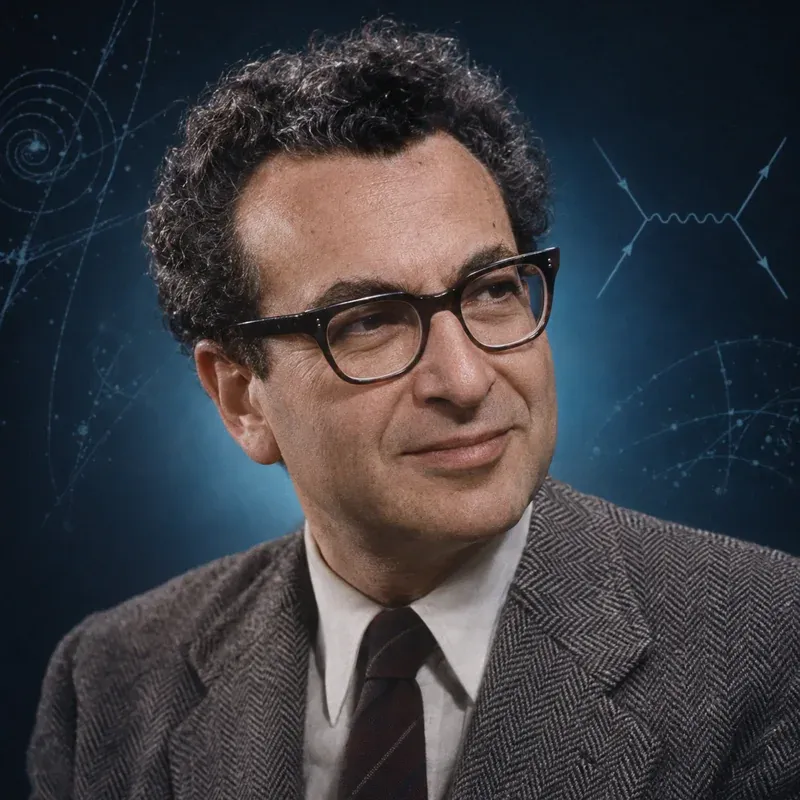
 Illustration
Murray Gell-Mann
With Richard Feynman, Gell-Mann formulated the universal V-A theory of the weak interaction (published January 1958), including the conserved vector current hypothesis later confirmed by C.S. Wu, which implied left-handed neutrinos and right-handed antineutrinos. Much later, with Ramond and Slansky (1979), he proposed the seesaw mechanism explaining why neutrino masses are so small.
- Born
- 15 September 1929
New York City, USA - Died
- 24 May 2019
Santa Fe, New Mexico, USA - Nationality
- American
- Field
- theoretical physics
- Nobel Prize
- Physics 1969 – for his contributions and discoveries concerning the classification of elementary particles and their interactions
- Institutions
- Institute for Advanced Study, University of Chicago, Caltech, Santa Fe Institute
Early life and education
Murray Gell-Mann was born in New York City on 15 September 1929, the son of immigrants from the Austro-Hungarian Empire. A precocious child with wide interests in languages, birds and history, he entered Yale University at fifteen and graduated in 1948. He received his PhD from the Massachusetts Institute of Technology in 1951 under Victor Weisskopf. After a year at the Institute for Advanced Study in Princeton he joined the University of Chicago, where Enrico Fermi's institute was a centre of particle physics, and in 1955 he moved to the California Institute of Technology, which remained his base for almost four decades.
Path to neutrino physics
Gell-Mann first made his name in 1953 by introducing strangeness, a quantum number that explained why certain newly discovered particles are produced easily in strong collisions but decay slowly through the weak interaction; Kazuhiko Nishijima found the same scheme independently. That work drew him into the problem of weak decays, which became acute in 1956–57 when parity violation was discovered and the mathematical form of the weak coupling had to be determined anew.
Key contributions
In 1957, at Caltech, Gell-Mann and Richard Feynman arrived at a universal V−A theory of the weak interaction, published as 'Theory of the Fermi interaction' in January 1958. E. C. G. Sudarshan and Robert Marshak had reached the same form independently. In the V−A theory only left-handed particles take part in weak processes, so neutrinos are left-handed and antineutrinos right-handed. The paper also proposed that the vector part of the weak current is conserved like the electric current. This conserved vector current hypothesis predicted a small 'weak magnetism' term in beta decay, which Chien-Shiung Wu and collaborators confirmed in 1963.
In 1960 Gell-Mann and Maurice Lévy noted that the strength of strangeness-changing decays could be understood if the weak current coupled to a rotated combination of particles. Nicola Cabibbo developed this idea in 1963 into the mixing angle that bears his name, the ancestor of quark mixing and, by analogy, of neutrino mixing in the PMNS matrix.
In 1961 Gell-Mann organised the known hadrons into patterns of the SU(3) symmetry he called the Eightfold Way, independently of Yuval Ne'eman, and in 1964 he proposed that hadrons are built from quarks, a model George Zweig developed at the same time. He received the 1969 Nobel Prize in Physics for his contributions to the classification of elementary particles and their interactions. In the early 1970s, with Harald Fritzsch and Heinrich Leutwyler, he formulated quantum chromodynamics.
The seesaw mechanism
In 1979, with Pierre Ramond and Richard Slansky, Gell-Mann wrote 'Complex spinors and unified theories', a contribution to a supergravity workshop. Studying grand unified theories such as SO(10), which contain a right-handed neutrino in each generation, they showed that a very large Majorana mass for the right-handed neutrino leaves the ordinary neutrino with a tiny mass, roughly the square of a typical charged-fermion mass divided by the heavy scale. This is the type-I seesaw mechanism, found in the same period by Peter Minkowski, Tsutomu Yanagida, Sheldon Glashow and by Rabindra Mohapatra and Goran Senjanović. The written version of the Gell-Mann–Ramond–Slansky paper was long hard to obtain and was posted on arXiv only in 2013.
Later work
In 1984 Gell-Mann co-founded the Santa Fe Institute, devoted to the study of complex systems, and he later wrote the book The Quark and the Jaguar (1994). He left Caltech in 1993 and spent his last years in Santa Fe, where he died on 24 May 2019.
Legacy
Gell-Mann's influence on neutrino physics appears at both ends of the story: the V−A structure that defines how neutrinos are produced and detected, and the seesaw idea that remains the most widely discussed explanation of why neutrino masses are so small. If the seesaw is correct, neutrinos are Majorana particles, a hypothesis tested by searches for neutrinoless double beta decay.
Known for
- V−A theory (with Feynman, 1958)
- Conserved vector current
- Strangeness, Eightfold Way and quarks
- Eightfold Way and quark model
- Seesaw mechanism with Ramond and Slansky (1979)
Chronology
- 1955Joins Caltech
- 1958'Theory of the Fermi interaction' with Feynman
- 1964Quark model
- 1969Nobel Prize in Physics
- 1979Seesaw mechanism (with Ramond and Slansky)
Original papers
- R.P. Feynman, M. Gell-Mann, Theory of the Fermi interaction, Phys. Rev. 109, 193 (1958)DOI 10.1103/PhysRev.109.193
- M. Gell-Mann, P. Ramond, R. Slansky, Complex spinors and unified theories, in Supergravity, North-Holland, p. 315 (1979)
Connected people
- Chien-Shiung Wu
- E. C. George Sudarshan
- Peter Minkowski
- Pierre Ramond
- Richard P. Feynman
- Richard C. Slansky
- Robert Marshak
- Tsutomu Yanagida
- Sheldon Lee Glashow
- Nicholas P. Samios
Frequently asked questions
Did Gell-Mann win the Nobel Prize for neutrino physics?
No. His 1969 Nobel Prize recognised his work on the classification of elementary particles and their interactions, including strangeness and the Eightfold Way.
What is the seesaw mechanism?
A model in which a very heavy right-handed neutrino makes the ordinary neutrinos very light: the heavier one partner, the lighter the other. See seesaw mechanism.
Who proposed the V−A theory?
Feynman and Gell-Mann, and independently Sudarshan and Marshak, in 1957. Both pairs concluded that only left-handed particles take part in the weak interaction.
On the timeline
Mentioned in 33 pages
Milestones 6
People 15
Last updated: · Editorial standard
Cite this page
Text
Neutrino Atlas (2026). “Murray Gell-Mann”. Retrieved 22 November 2026, from https://neutrino-atlas.com/people/murray-gell-mann/BibTeX
@misc{neutrinoatlas2026peoplemurraygellmann,
  title        = {Murray Gell-Mann},
  author       = {{Neutrino Atlas}},
  year         = {2026},
  url          = {https://neutrino-atlas.com/people/murray-gell-mann/},
  note         = {Accessed 2026-11-22},
  language     = {english}
}