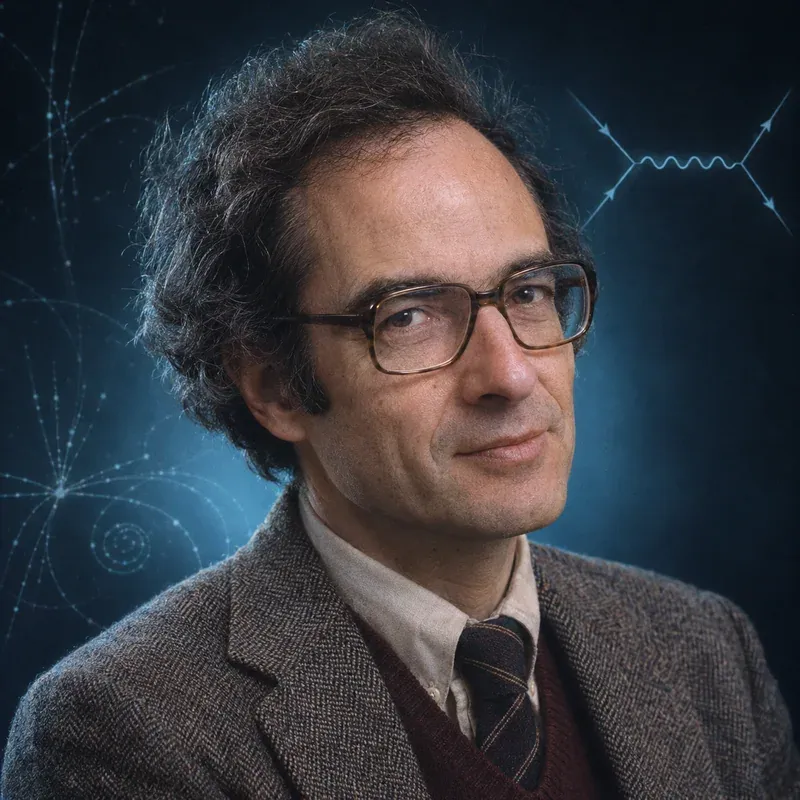
 Illustration
Pierre Ramond
In 1979, with Murray Gell-Mann and Richard Slansky, Ramond showed that in grand unified theories such as SO(10), large Majorana masses for right-handed neutrinos naturally give very small masses to the observed neutrinos, one of the founding seesaw papers.
- Born
- 31 January 1943
Neuilly-sur-Seine, France - Nationality
- French-born (US-based)
- Field
- Theoretical particle physics; string theory
- Institutions
- Fermilab (NAL), Yale University, Caltech, University of Florida
Early life and education
Pierre Ramond was born on 31 January 1943 in Neuilly-sur-Seine near Paris. He moved to the United States, where he received a bachelor's degree in electrical engineering from the Newark College of Engineering, now the New Jersey Institute of Technology, in 1965. He then switched to theoretical physics and obtained his PhD at Syracuse University in 1969 under A. P. Balachandran.
From 1969 to 1971 he was a postdoctoral fellow at the National Accelerator Laboratory, the future Fermilab, then taught at Yale University until 1976 and became a Millikan Senior Fellow at Caltech. In 1980 he joined the University of Florida, where he was named distinguished professor in 1999 and became distinguished professor emeritus on his retirement in 2023.
Fermionic strings
Ramond first became known for work far from neutrinos. At the start of the 1970s the dual resonance models that later became string theory described only bosons. In 1970–71 Ramond extended them to include fermions, introducing a structure that mixes bosonic and fermionic degrees of freedom on the two-dimensional world-sheet of the string. This was one of the first appearances of supersymmetry, and together with the work of André Neveu and John Schwarz it led to the superstring. Terms such as the Ramond sector, the Ramond–Ramond fields and the Kalb–Ramond field carry his name.
Key contributions to neutrino physics
In 1979 Ramond, Murray Gell-Mann and Richard Slansky, all then working on grand unified theories, presented a paper titled “Complex spinors and unified theories” at a supergravity workshop at Stony Brook; it appeared in the proceedings volume “Supergravity” and was placed on arXiv only in 2013. In the unification group SO(10), all fermions of one generation fit into a single 16-component spinor, and that spinor contains a right-handed neutrino in addition to the known particles. Nothing in the symmetry forbids this neutrino from having a large Majorana mass M, at a scale close to that of unification.
The authors showed that the light neutrino then acquires a mass of order m²/M, where m is a Dirac mass comparable to those of the charged fermions. A very heavy partner pushes the observed neutrino mass down, like the two ends of a seesaw. This type-I seesaw explains why neutrinos are so much lighter than the other fermions without tuning their couplings to tiny values. Similar conclusions were reached independently by Peter Minkowski in 1977, Tsutomu Yanagida in 1979, and Rabindra Mohapatra and Goran Senjanović in 1980.
The seesaw mechanism has become the most widely discussed explanation of neutrino mass. It predicts that neutrinos are Majorana particles, which is tested by searches for neutrinoless double beta decay, and its heavy neutrinos are the basis of leptogenesis, a leading explanation of the matter–antimatter asymmetry. Ramond also worked on the flavour structure of quark and lepton masses, the question of why the generations have such different masses and mixings.
Recognition
His honours include the Oskar Klein Medal (2004), the Lise Meitner Prize (2007), the Dannie Heineman Prize for Mathematical Physics (2015) and the Dirac Medal of the ICTP (2020), shared with André Neveu and Miguel Virasoro. He is a fellow of the American Physical Society and the American Academy of Arts and Sciences and wrote the textbook “Journeys Beyond the Standard Model”.
Known for
- Seesaw mechanism with Gell-Mann and Slansky (1979)
- Fermionic strings and 2D supersymmetry (1970)
- Ramond sector
Chronology
- 1970Fermionic string and 2D supersymmetry
- 1979Seesaw mechanism with Gell-Mann and Slansky
- 2015Dannie Heineman Prize for Mathematical Physics
- 2020ICTP Dirac Medal
Original papers
- M. Gell-Mann, P. Ramond, R. Slansky, Complex spinors and unified theories, in Supergravity, North-Holland, p. 315 (1979)
Connected people
Frequently asked questions
What did Pierre Ramond contribute to neutrino physics?
In 1979, with Gell-Mann and Slansky, he showed that in SO(10) grand unified theories a heavy right-handed neutrino naturally makes the observed neutrino very light. This is one of the founding papers of the seesaw mechanism.
Who invented the seesaw mechanism?
It was found independently by several authors between 1977 and 1980: Minkowski, Gell-Mann, Ramond and Slansky, Yanagida, and Mohapatra and Senjanović.
Is Ramond also known for string theory?
Yes. In 1970–71 he introduced fermions into dual models, an early form of supersymmetry that led to superstring theory.
On the timeline
Mentioned in 17 pages
Milestones 2
People 7
Last updated: · Editorial standard
Cite this page
Text
Neutrino Atlas (2026). “Pierre Ramond”. Retrieved 22 November 2026, from https://neutrino-atlas.com/people/pierre-ramond/BibTeX
@misc{neutrinoatlas2026peoplepierreramond,
  title        = {Pierre Ramond},
  author       = {{Neutrino Atlas}},
  year         = {2026},
  url          = {https://neutrino-atlas.com/people/pierre-ramond/},
  note         = {Accessed 2026-11-22},
  language     = {english}
}