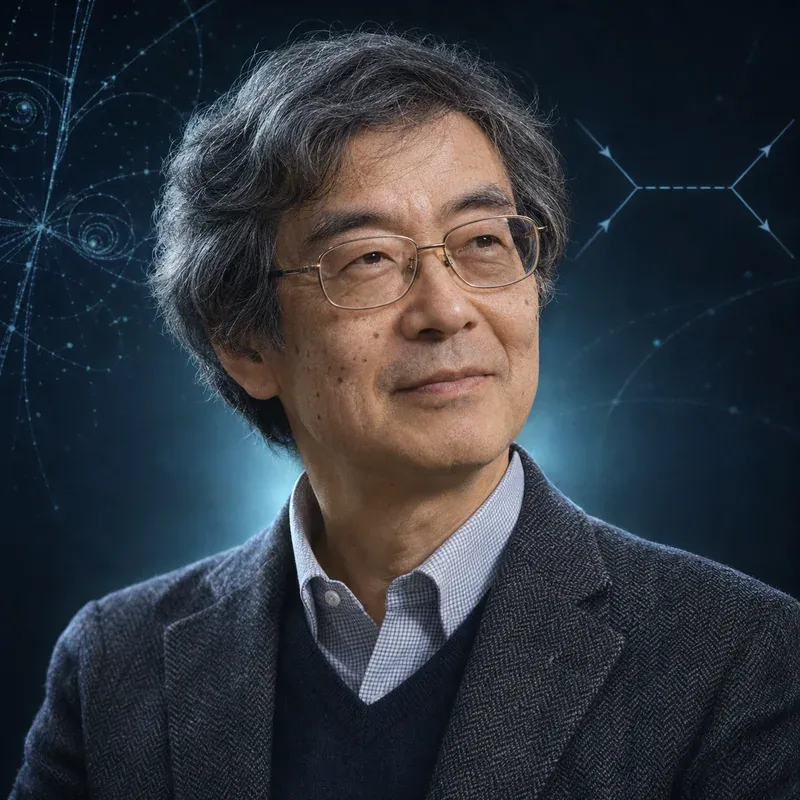
 Illustration
Tsutomu Yanagida
In 1979 Yanagida independently proposed the seesaw mechanism, in which heavy right-handed Majorana neutrinos make the observed neutrinos light, and he gave the mechanism its name in 1981. In 1986, with Masataka Fukugita, he proposed leptogenesis: CP-violating decays of heavy right-handed neutrinos create a lepton asymmetry that electroweak sphalerons convert into the baryon asymmetry of the universe.
- Nationality
- Japanese
- Field
- Theoretical particle physics; cosmology
- Institutions
- Hiroshima University (PhD 1977), University of Tokyo, Kavli IPMU, Shanghai Jiao Tong University (T. D. Lee Institute)
Education and career
Tsutomu Yanagida is a Japanese theoretical physicist working at the meeting point of particle physics and cosmology. He received his PhD from Hiroshima University in 1977. He later became a professor at the University of Tokyo and at the Kavli Institute for the Physics and Mathematics of the Universe (Kavli IPMU), and in 2019 he moved to Shanghai Jiao Tong University, where he works at the Tsung-Dao Lee Institute, named after Tsung-Dao Lee. His students include Junji Hisano, Takeo Moroi and Yasunori Nomura.
Key contributions: the seesaw mechanism
In the Standard Model neutrinos are massless. Oscillation data now show that they have masses, but these are at least a million times smaller than the electron mass. The Standard Model offers no reason for such a gap. In February 1979, at a workshop on unified theories and baryon number held at KEK in Tsukuba, Yanagida proposed an explanation in the context of a horizontal gauge symmetry: add a heavy right-handed neutrino for each generation. It can have a large Majorana mass of its own, because it carries no gauge charge in the Standard Model. Its mixing with the ordinary neutrino through a normal Dirac mass then produces one very heavy and one very light state.
With a Dirac mass near the electroweak scale and MR around 10¹⁴ to 10¹⁵ GeV, close to the scale of grand unification, the formula gives neutrino masses of a fraction of an electronvolt, in line with what oscillation experiments later measured. Peter Minkowski had made a related proposal in 1977, and in 1979–80 Murray Gell-Mann, Pierre Ramond and Richard Slansky, Sheldon Glashow, and Rabindra Mohapatra with Goran Senjanović arrived at the same idea independently. Yanagida coined the name ‘seesaw’ at a conference in Tokyo in 1981: as one mass goes up, the other goes down. The seesaw mechanism, in this form type I, remains the most widely studied explanation of small neutrino masses, and it predicts that neutrinos are Majorana particles, which neutrinoless double beta decay experiments are testing.
Leptogenesis
In 1986 Yanagida and Masataka Fukugita published ‘Baryogenesis without grand unification’. They pointed out that the heavy right-handed neutrinos of the seesaw would have been produced in the hot early universe and would then decay into leptons and Higgs particles. If these decays violate CP, slightly more leptons than antileptons are produced. Electroweak sphaleron processes, which Kuzmin, Rubakov and Mikhail Shaposhnikov had shown in 1985 to be fast at high temperature, convert part of this lepton excess into an excess of baryons. This mechanism, leptogenesis, links the matter–antimatter asymmetry of the universe to the origin of neutrino mass. It satisfies all three Sakharov conditions and gives a motivation for searching for leptonic CP violation in experiments such as DUNE and Hyper-Kamiokande, although the low-energy CP phase is not in general the same as the one that drives leptogenesis.
Other work
Yanagida has worked extensively on supersymmetry and its cosmology, including the role of the gravitino, on inflation and on the origin of the baryon asymmetry. In 1994, again with Fukugita, he argued that a non-zero cosmological constant would resolve the conflict between the age of the universe and the ages of the oldest stars, a few years before observations of distant supernovae revealed accelerated expansion.
Recognition
His awards include the Yukawa Memorial Prize (1989), the Nishina Memorial Prize (1992), a Humboldt Research Award (2003), the Yoji Totsuka Prize (2012, with Fukugita), named after Yoji Totsuka, a Helmholtz International Fellow Award (2014) and the Particle Physics Medal of the Physical Society of Japan (2020). He gave the Hertz Lecture at DESY in 2011.
Known for
- Seesaw mechanism (1979) and its name
- Leptogenesis with Fukugita (1986)
- Supersymmetry phenomenology
Chronology
- 1977PhD, Hiroshima University
- 1979Seesaw mechanism at the KEK workshop
- 1981Names the 'seesaw' mechanism
- 1986Leptogenesis with Fukugita
- 1989Yukawa Memorial Prize
- 1992Nishina Memorial Prize
- 2003Humboldt Research Award
- 2012Yoji Totsuka Memorial Prize (with Fukugita)
- 2019Moves to Shanghai Jiao Tong University
- 2020Particle Physics Medal, Physical Society of Japan
Original papers
- T. Yanagida, Horizontal gauge symmetry and masses of neutrinos, Proc. Workshop on Unified Theory and Baryon Number in the Universe, KEK, p. 95 (1979)
- T. Yanagida, Horizontal symmetry and masses of neutrinos, Prog. Theor. Phys. 64, 1103 (1980)DOI 10.1143/PTP.64.1103
- M. Fukugita, T. Yanagida, Baryogenesis without grand unification, Phys. Lett. B 174, 45 (1986)DOI 10.1016/0370-2693(86)91126-3
Connected people
- Masataka Fukugita
- Murray Gell-Mann
- Peter Minkowski
- Rabindra Nath Mohapatra
- Mikhail Shaposhnikov
- Hitoshi Murayama
Frequently asked questions
What is the seesaw mechanism?
A way to explain why neutrinos are so light: a very heavy right-handed neutrino mixes with the ordinary one, and the light mass is roughly the square of a normal Dirac mass divided by the heavy mass. See seesaw mechanism.
Who invented the seesaw mechanism?
Several physicists independently: Minkowski (1977), Yanagida (1979), Gell-Mann, Ramond and Slansky (1979), Glashow (1979) and Mohapatra and Senjanović (1980). Yanagida gave it its name in 1981.
What is leptogenesis?
The idea, proposed by Fukugita and Yanagida in 1986, that CP-violating decays of heavy right-handed neutrinos in the early universe created a lepton asymmetry, which sphalerons turned into today’s excess of matter. See leptogenesis.
On the timeline
Mentioned in 30 pages
Milestones 3
People 13
Last updated: · Editorial standard
Cite this page
Text
Neutrino Atlas (2026). “Tsutomu Yanagida”. Retrieved 22 November 2026, from https://neutrino-atlas.com/people/tsutomu-yanagida/BibTeX
@misc{neutrinoatlas2026peopletsutomuyanagida,
  title        = {Tsutomu Yanagida},
  author       = {{Neutrino Atlas}},
  year         = {2026},
  url          = {https://neutrino-atlas.com/people/tsutomu-yanagida/},
  note         = {Accessed 2026-11-22},
  language     = {english}
}