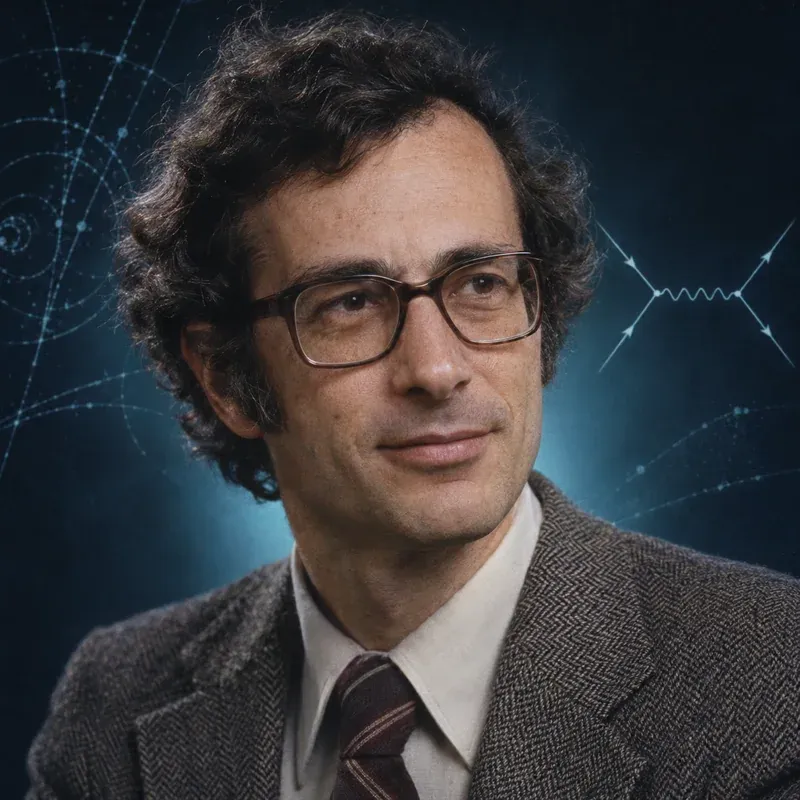
 Illustration
Richard C. Slansky
Slansky co-authored the 1979 Gell-Mann–Ramond–Slansky paper that placed the seesaw mechanism inside grand unified theories, explaining light neutrino masses through heavy right-handed Majorana neutrinos. His 1981 Physics Reports review of group theory became a standard tool for building GUT and neutrino-mass models.
- Born
- 3 April 1940
- Died
- 16 January 1998
- Nationality
- American
- Field
- Theoretical particle physics; grand unification
- Institutions
- Yale University, Los Alamos National Laboratory, Santa Fe Institute
Education and early career
Richard C. Slansky was born on 3 April 1940. He took his bachelor's degree at Harvard University and his PhD at the University of California, Berkeley. After postdoctoral work at Caltech he spent five years on the faculty of Yale University. In 1974 he joined the newly founded particle-theory group at Los Alamos National Laboratory, led by Peter Carruthers, and stayed there for the rest of his career.
Key contributions
Slansky's research centred on grand unified theories, in which the strong, weak and electromagnetic forces are pieces of one larger symmetry group. His most cited neutrino work is the contribution he wrote with Murray Gell-Mann and Pierre Ramond, 'Complex spinors and unified theories', presented at the Stony Brook supergravity workshop in 1979 and published in its proceedings. The paper surveyed routes to unification, from SU(5) and SO(10) up to E6 and beyond, and in passing proposed a natural reason why neutrinos are so light.
The argument runs as follows. In SO(10) every fermion family fits into a single 16-component representation, and that representation automatically contains a right-handed neutrino. Because this particle carries no charge under the Standard Model forces, nothing forbids it from having a large Majorana mass M, possibly close to the unification scale. Combined with an ordinary Dirac mass mD of the size of other fermion masses, the light neutrino ends up with a mass of order mD²/M. A heavy partner pushes the light state down, which is the seesaw mechanism. Similar ideas appeared independently from Peter Minkowski (1977), Tsutomu Yanagida (1979) and Rabindra Mohapatra with Goran Senjanović (1980). The Gell-Mann–Ramond–Slansky version was influential because it showed that unification itself supplies the needed ingredients. The proceedings were hard to find for decades; the text was placed on arXiv in 2013.
In 1981 Slansky published 'Group theory for unified model building' in Physics Reports. It collected the representations, branching rules and tensor products of the Lie groups used by model builders, with extensive tables. For a generation of theorists it was the reference to consult when placing quarks, leptons and Higgs fields into SU(5), SO(10) or E6, and it remains heavily cited by people building neutrino mass models.
Later work and legacy
At Los Alamos Slansky became head of the theory group in 1989. He also held an adjunct professorship at the University of California, Irvine, served as an editor of Physics Reports and was among the co-founders of the Santa Fe Institute in 1983. He was elected a Fellow of the American Physical Society in 1987 and of the American Association for the Advancement of Science. He published about 85 scientific papers. Slansky died of a brain aneurysm on 16 January 1998, aged 57. Today the type-1 seesaw is the standard benchmark for explaining small neutrino masses and underpins leptogenesis, the idea that the decays of heavy right-handed neutrinos produced the matter–antimatter asymmetry of the universe.
Known for
- Seesaw mechanism with Gell-Mann and Ramond (1979)
- 'Group theory for unified model building' (1981)
- Head of Los Alamos theory division
Chronology
- 1974Joins Los Alamos
- 1979Seesaw paper with Gell-Mann and Ramond
- 1981'Group theory for unified model building'
- 1989Head of Los Alamos theory group
Original papers
- M. Gell-Mann, P. Ramond, R. Slansky, Complex spinors and unified theories, in Supergravity, North-Holland, p. 315 (1979)
- R. Slansky, Group theory for unified model building, Phys. Rep. 79, 1 (1981)DOI 10.1016/0370-1573(81)90092-2
Connected people
Frequently asked questions
What did Richard Slansky contribute to neutrino physics?
With Gell-Mann and Ramond he showed in 1979 that SO(10) grand unification contains a heavy right-handed neutrino whose large Majorana mass makes the ordinary neutrinos light, the seesaw mechanism. His 1981 group-theory review became the standard toolkit for building such models.
Did Slansky invent the seesaw mechanism alone?
No. The seesaw idea was found independently by several groups between 1977 and 1980, including Minkowski, Yanagida, and Mohapatra with Senjanović. Slansky's contribution was the formulation together with Gell-Mann and Ramond inside unified theories.
Why is the 'Group theory for unified model building' review still cited?
It gathers in one place the representation tables and decomposition rules that model builders need when assigning particles to symmetry groups, so it remains a practical reference.
On the timeline
Mentioned in 15 pages
Milestones 2
Last updated: · Editorial standard
Cite this page
Text
Neutrino Atlas (2026). “Richard C. Slansky”. Retrieved 22 November 2026, from https://neutrino-atlas.com/people/richard-slansky/BibTeX
@misc{neutrinoatlas2026peoplerichardslansky,
  title        = {Richard C. Slansky},
  author       = {{Neutrino Atlas}},
  year         = {2026},
  url          = {https://neutrino-atlas.com/people/richard-slansky/},
  note         = {Accessed 2026-11-22},
  language     = {english}
}